By Aps Tree Removal · · Updated
Api Mariner, Qualified Arborist · 24 min read

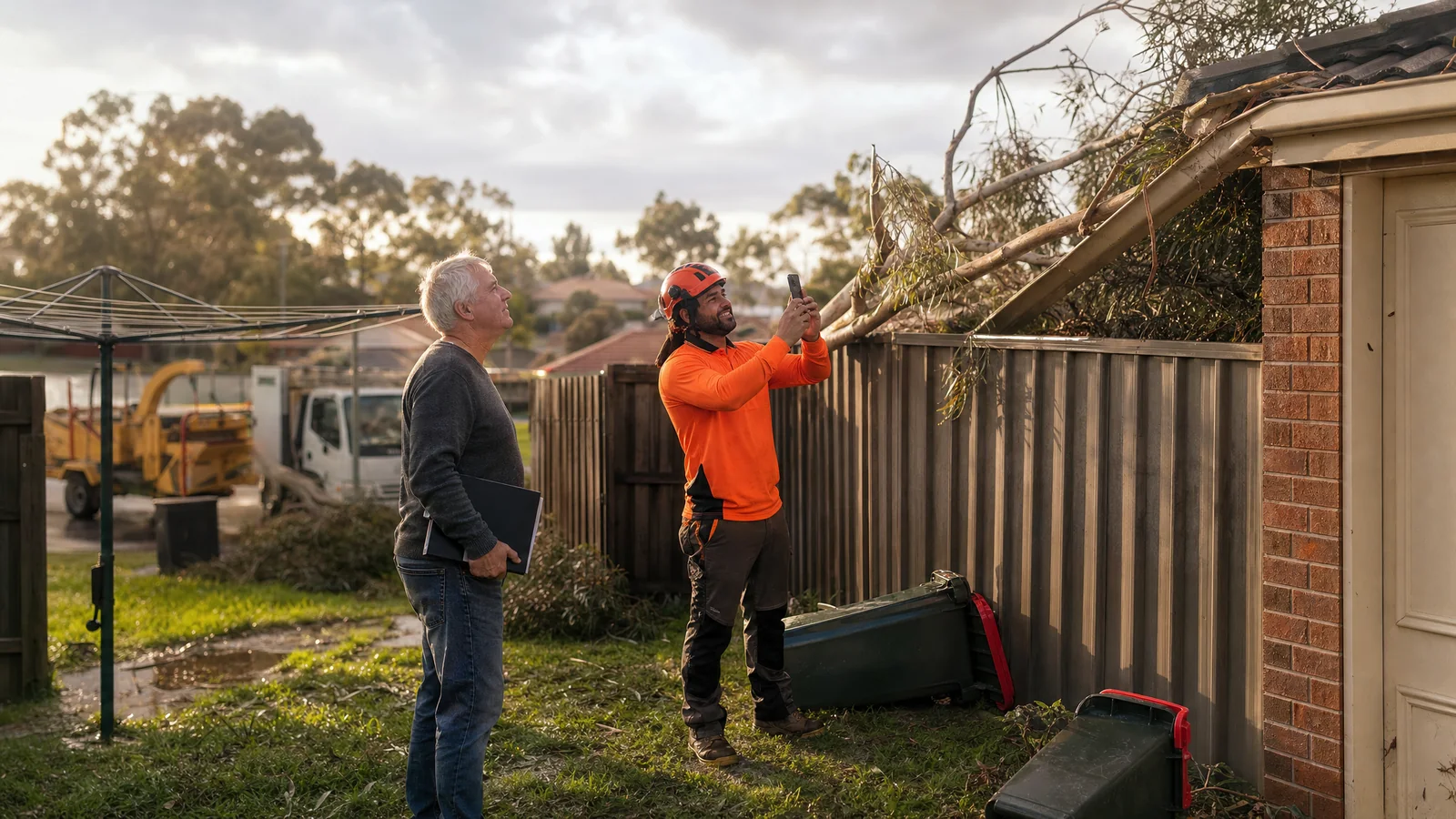
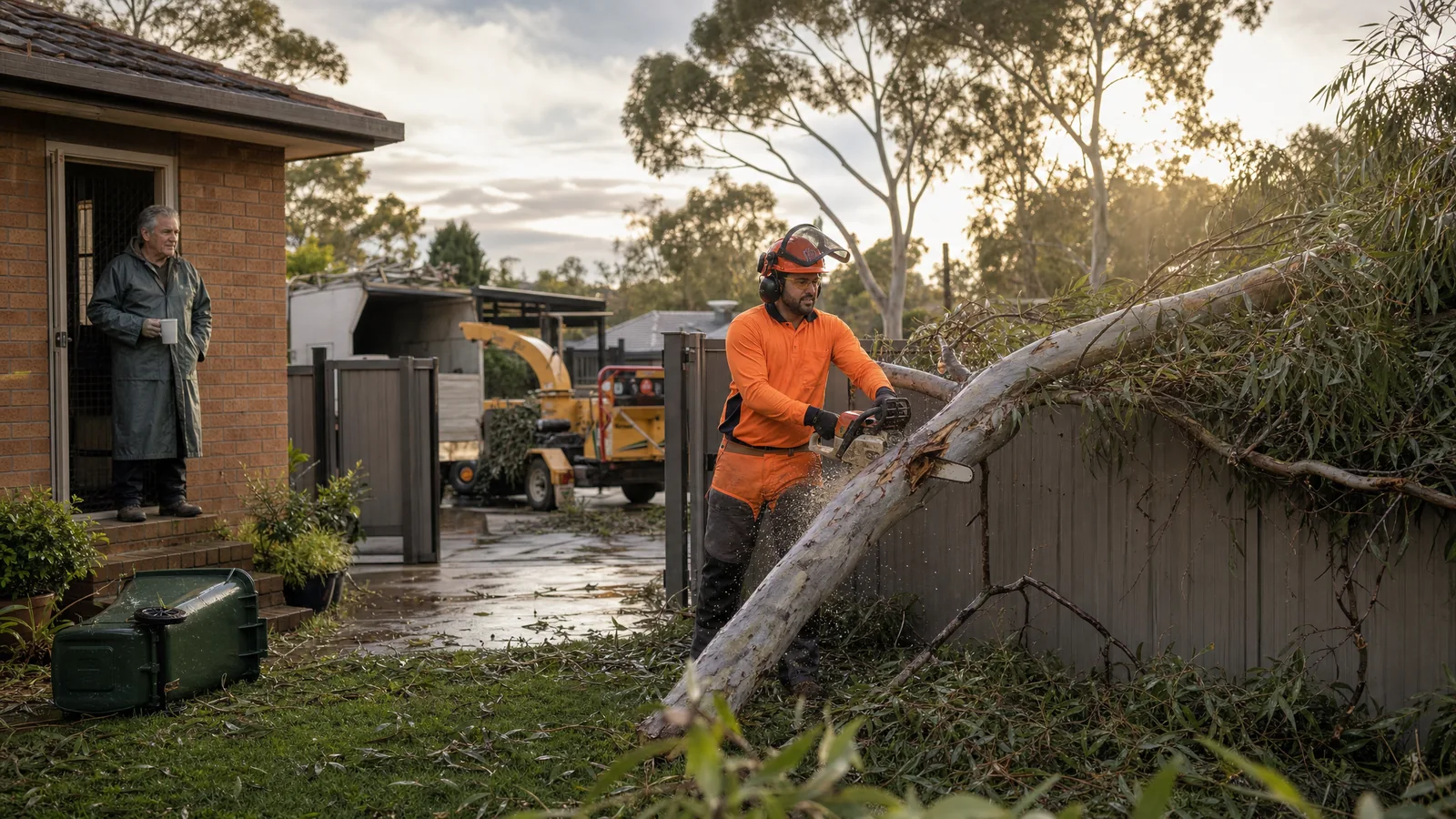
Every storm season the same call comes in, and it is never really about the tree. It is about the roof the tree is lying on, the Colorbond fence it flattened, the car parked under it, and one question: will tree removal insurance pay for this? The honest answer is that it depends on three things: what the tree hit, what your policy says, and the order you do things in over the next few hours. Get the order wrong, by having the tree cut up and carted off before the insurer has seen it, and a claim that should have been simple turns into an argument you are having with a photo of an empty lawn. This guide explains what most home policies cover when a tree comes down, what they usually do not, how to make the claim in the right order, why the arborist's insurance and your own policy are two different things, and what happens when the tree belongs to the neighbour.
Api Mariner is a qualified arborist who has cleared storm-fallen trees off roofs, fences and cars across Melbourne's west, the inner suburbs and Geelong for more than 16 years, and has dealt with the assessors, the neighbours and the paperwork that come with them. One thing needs saying plainly before anything else: this is general information about how home insurance usually works in Australia. It is not advice about your policy. The only document that decides your claim is your own product disclosure statement, and the only person who can confirm your cover is your insurer.
Tree removal insurance: what most home policies cover
Start with the good news. Moneysmart, ASIC's consumer money site, says most home insurance and contents insurance policies cover storms, and that storm cover includes damage caused by lightning, cyclones, strong winds, rainwater, hail and snow [1]. A gum that comes down in a wind event and lands on the house is, for most policies, a storm claim: the wind is the insured event, the tree is the thing it moved, and the roof is the insured property it damaged.
The words doing the work in that paragraph are most and usually. Moneysmart's own advice is that if you are not sure what cover you have, ask your insurer or read the policy's product disclosure statement, the PDS [1]. The PDS is where a policy says how it treats the tree itself, the debris, the fence and any cap on removal costs, and two policies from two insurers can read quite differently on all four. There is no separate tree removal insurance policy you can buy for a house; the cover, where it exists, lives inside the storm section of the home policy. Storm cover is close to universal; what a policy pays toward getting the tree off the house and out of the garden is not, and that is the gap most people fall into.
Storms are also where nearly all of these claims come from. VICSES responds to around 20,000 requests for assistance from storms in a typical year, roughly 80 per cent of everything it is called to, and it lists tree branches, cars parked under trees and falling overhanging limbs among the most common causes of the damage [2]. That is the backdrop every insurer is working against in a bad week. It is why the claims process has an order to it, and why the people who follow the order get paid faster.
Storm damage and tree claims in Victoria: the numbers behind the advice
What is usually covered, and what usually is not
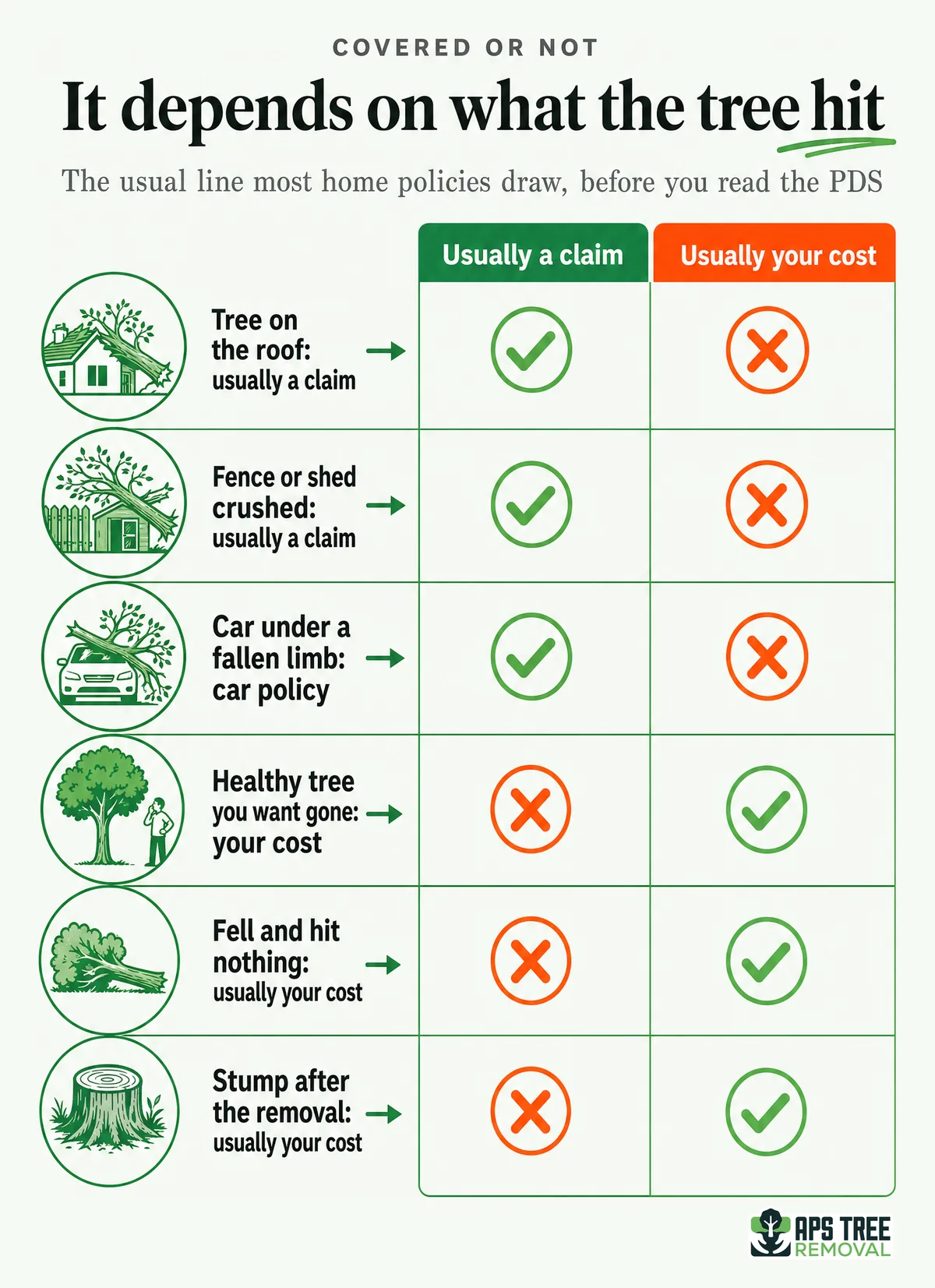
The simplest way to think about what your policy covers and what it does not is to ask what the tree hit. Home insurance is built around damage to the things it insures: the building, the fence, the shed, the contents. A tree is not one of those things. It is the cause of the damage, the same way hail or a lightning strike is, so the policy is interested in the tree only to the extent that it is sitting on something insured. That single idea explains almost every yes and no in the list below.
Tree removal insurance: the usual line between a claim and your own cost
Usually a claim
- A tree or limb that has fallen on the house, the garage or the roof in a storm
- A fence, pergola or shed crushed by a fallen tree
- A car damaged by a falling limb (usually through the car's comprehensive policy, not the home one)
- Cutting the tree off the damaged structure and removing the debris that is on it
- Emergency make-safe work the insurer has agreed to in writing
Usually your own cost
- A healthy tree you want removed because it is big, messy or blocking the light
- Preventive removal of a tree you are worried might fall one day
- A tree that fell across the lawn and hit nothing
- Grinding out the stump once the fallen tree is gone, under most policies
- Work you authorised before the insurer had agreed to it
The sore point in that list is the tree that hit nothing. It is the same wind, the same tree and the same clean-up bill, but because nothing insured was damaged there is often no claim to make, and the cost of cutting it up and carting it away sits with the homeowner. Some policies include a small allowance for removing a fallen tree that caused no damage and some do not; that is a PDS question, and it is worth knowing the answer before the storm rather than after.
| What happened | Who usually pays | The question to ask your insurer |
|---|---|---|
| A storm drops a gum on the roof | Home policy, as a storm event | Is removing the tree from the house included, and is there a limit on it? |
| A limb flattens the Colorbond fence | Home policy, if fences are covered | Are fences covered, and is there a separate limit for them? |
| The tree lands on the car in the driveway | The car's comprehensive policy | Is a storm claim treated differently from an at-fault one? |
| The tree falls across the lawn and hits nothing | The homeowner, in most cases | Is there any allowance for removing a fallen tree that caused no damage? |
| A healthy tree is leaning over the house | The homeowner | Nothing to ask: this is a planned removal, priced like any other job |
| The neighbour's tree comes through the fence | Your own home policy first, usually | Will you recover the cost from next door, and does it affect my excess? |
The healthy tree in the second-last row is the one people most want insurance to pay for and the one it never will. A tree you have decided to remove because it is too big for the block, dropping limbs, lifting the paving or simply in the way is a planned job, and it is priced the same way any removal is; if you want to know how tree removal is priced, the short version is that the tree is only half the job and what is around it is the other half. The one thing insurance does for that tree is give you a reason to deal with it before it becomes a claim.
Making a claim after a tree falls: the right order
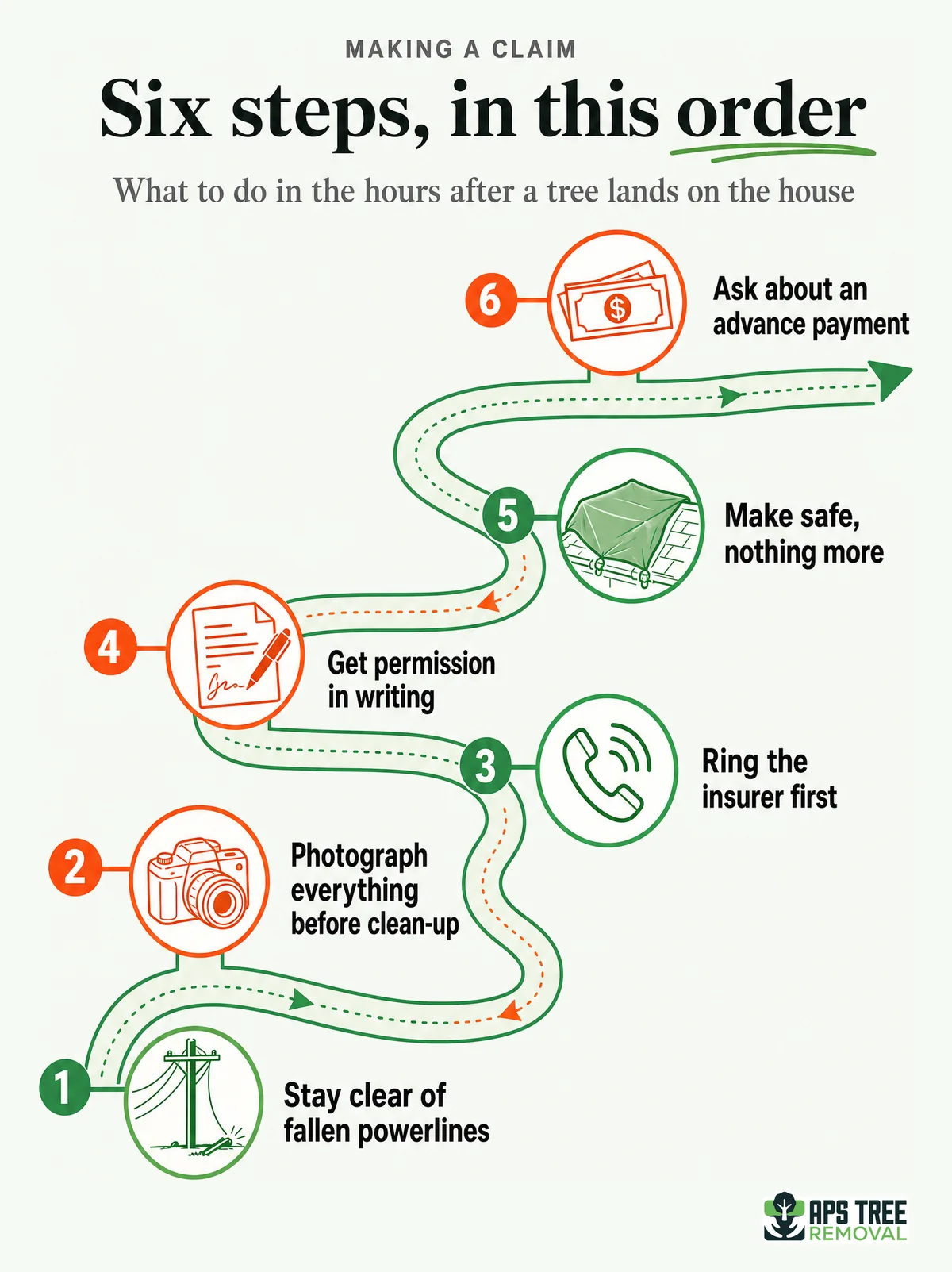
Making a claim after a tree falls is mostly a matter of sequence, and it is where tree removal insurance either does its job or does not. Every step below is something the Insurance Council of Australia, VICSES or Energy Safe Victoria tells homeowners to do after a storm. The only thing Api adds is the order, because the order is what people get wrong when a tree is on the roof and the rain has not stopped.
The claims order after a tree comes down
- 1Safety firstKeep everyone at least eight to ten metres from any fallen powerline and treat every line as live. Call 000 for anything life-threatening and 132 500 for VICSES storm help.
- 2Photograph everythingBefore a single branch is moved, take photos and video of the tree, the damage and the debris from several angles. The insurer needs to see what the storm did, not what the lawn looked like after the clean-up.
- 3Call the insurerLodge the claim as soon as you can and say straight away if the roof is damaged. You do not need the policy papers in your hand: your name, address and date of birth are enough for the insurer to find you.
- 4Get permission in writingAsk the insurer before you authorise any work, including emergency repairs, and ask for the go-ahead in writing. Work done without it may not be covered.
- 5Make safe, nothing moreTarp the roof, fence off the drop zone and have a hanging limb secured. Leave the full removal until the insurer has said yes or sent an assessor.
- 6Ask about an advanceIf the damage has left you in urgent financial need, ask the insurer to fast-track the claim. It can make an advance payment within five business days of you showing that need.
The safety step is not a formality. Energy Safe Victoria says to keep at least eight to ten metres from any fallen powerline, because you do not have to touch a line to receive a shock and even a broken line can still conduct [4]. VICSES says the same, adds that every fallen line should be assumed live, takes storm calls on 132 500, and sends anything life-threatening to 000 [2]. A tree that has brought a service line down with it is not a job for anyone until the line has been made dead, and a crew that starts cutting before that has been confirmed is not a crew you want on the property.
The photographs are the claim. The Insurance Council of Australia's advice after a severe storm is to document the damage with photos and videos before the clean-up starts, because that is what supports the claim, and to contact the insurer as soon as possible and let them know if the roof has been damaged [3]. The same advice settles the panic about paperwork: insurers keep electronic records, and your name, address and date of birth are all they need to find your policy [3]. VICSES says it in fewer words: call your insurance company to organise any insurance matters, and take photos of the damage [2].
The permission step is where most claims are won or lost. The Insurance Council's wording is exact: speak to your insurer before you attempt or authorise any building work, including emergency repairs, and ask for the insurer's permission in writing, because unauthorised work may not be covered by your policy [3]. Cutting a tree off a roof is work. Having it chipped and taken away is work. Doing either before the insurer has agreed can leave you paying for it, and it also destroys the evidence the assessor was coming to look at.
What to do in the first hour
Keep people and pets clear of the tree and any line it has brought down. Take more photos than you think you need, from the street, from the garden and from inside if the ceiling is wet. Ring the insurer, tell them a tree is on the house, and ask two questions: can I have a crew make it safe, and can I have that in writing. Then ring the arborist, and tell him what the insurer said.
If the damage has left you unable to live in the house or cover the immediate costs, say so. The Insurance Council notes that a policyholder in urgent financial need can ask the insurer to fast-track the claim and make an advance payment within five business days of showing that need [3]. Most people do not know to ask, and the insurer will not always offer.
Your arborist's insurance is not your insurance
Two different policies are involved in every insured tree job, and they do two different jobs. Your home policy pays for what the storm did to your property. The arborist's public liability policy pays for what the crew does while they are fixing it. If a limb is lowered badly and goes through the neighbour's carport, that is the arborist's insurer's problem, not your storm claim's, and if the arborist has no insurer, it may become yours.
Your policy pays for what the storm did. The arborist's policy pays for what the crew does. If the crew has none, the gap is yours.
Consumer Affairs Victoria puts it on its checklist for any home job: ask to see a certificate of currency for public liability insurance, which protects you or third parties against any damage the workers may cause [5]. The same checklist tells you to ask for the tradesperson's full name, a physical address rather than a post office box, and the registered business name [5]. Those three details are how you find them again if something goes wrong, and a crew that hesitates over any of them is telling you something.
The reason this matters more in tree work than in most trades is the danger of the work itself. WorkSafe Victoria reported a coroner's finding that 31 people died in Victoria from tree felling or related activity between January 2012 and September 2018, and that 13 of those deaths were at work [6]. Safe Work Australia's guide to tree work says plainly that tree trimming and removal should not be done from ladders, and that contact with any powerline, whether it carries 230 volts or 400,000, can kill without the line ever being touched [7]. A storm-damaged tree adds split timber, hung-up limbs and a roof that may not hold weight to all of that. It is the worst possible job to hand to someone without cover.
Arborists in Australia do not need a licence, which surprises most people. The hipages arborist guide says they should nonetheless carry public liability insurance and personal insurance, hold a Certificate II or III in Horticulture (Arboriculture), and belong to a recognised body such as Arboriculture Australia [8]. The Certificate III is the trade-level qualification, and it explicitly covers tree dismantling and removal as high-risk work, either at height or supporting someone who is [9]. Api holds his qualification, carries his insurance, and hands over the certificate of currency the moment anyone asks, because on an insured job the insurer often asks too.
What to ask any crew before they touch a storm-damaged tree
- A certificate of currency for public liability insurance, current and in the business name
- Whether the crew's own workers are covered if one of them is hurt on your property
- A qualification in arboriculture, Certificate II or III, for the person running the job
- The operator's full name, physical address and registered business name
- A written quote you can forward to the insurer, describing the tree, the method and the clean-up
- Whether that quote covers the stump, the chipping and the green waste, or only the tree
A tree on the roof and an insurer on the phone? Api photographs, quotes in writing and makes safe first, 7 days from 6am, so the claim goes through cleanly.
The neighbour's tree
A good share of storm calls involve a tree that was never yours: the neighbour's gum through your fence, or your pittosporum across their driveway. The insurance answer here is simpler than people expect and less satisfying. In most cases your own home policy is still the first call when a neighbour's tree damages your property in a storm, because the event is the storm, and the insurer decides afterwards whether there is anyone to recover the cost from. A healthy tree that a storm brought down is usually nobody's fault. A tree the owner had been told was dangerous and did nothing about is a different conversation, and one where a written record of what was said and when does a lot of the work.
What the council will not do is referee it. Brimbank's published position is a fair example: trees on private property are the owner's to look after, the council does not maintain them, and disputes about a neighbour's tree are treated as civil matters [10]. The state's answer to those civil matters is the Dispute Settlement Centre of Victoria, which names overhanging branches, dropped foliage and root damage as the classic tree disputes and offers free, voluntary and confidential mediation on 1300 372 888 so neighbours can sort it out without legal action [11]. Api's experience is that a phone call to that number resolves more fence disputes than any letter does.
Where the tree is still standing and merely overhanging, the practical fix is usually a prune rather than a removal, and it is one the two households can share the cost of. A tree that overhangs a fence can be cut back from your side without anyone setting foot on the neighbour's property, and both properties are left clean and undamaged when the work is done by a crew that has done it many times before.
Quick to respond with quote, able to get to the job promptly, site was left clean and undamaged with the tree over hanging a fence. Would highly recommend them.
The door-knocker after the storm
The morning after a big blow, utes appear in the street. Some are genuine crews clearing a backlog. Some are not, and the tell is the offer: a cheap price if you book today, and the line that they will bill your insurer directly so you do not have to worry about it.
Consumer Affairs Victoria's checklist is blunt on the first half: be wary of people who knock on your door or telephone unexpectedly offering cheap deals on jobs around your home [5]. The second half is worse than it sounds. Someone who offers to bill your insurer is asking you to authorise work the insurer has not approved, at a price you have not seen in writing, against a policy they have never read. The Insurance Council's advice is that work authorised without the insurer's permission may not be covered [3], which means the bill they promised to send to the insurer can come straight back to you, with the evidence of the damage already through the chipper.
Why the cheap storm quote costs more
A crew that arrives before you have spoken to the insurer is asking you to skip the two steps that protect you: the photos and the written permission. Consumer Affairs Victoria says a proper quote states whether it includes transport, materials and labour and how those are calculated, along with any call-out, weekend or public holiday rates [12]. A price shouted over the fence covers none of that, and a storm-damaged tree is the last job to have done without a method, a clean-up and an insurer written down.
A legitimate crew after a storm behaves differently. It asks whether you have rung the insurer. It makes safe first and leaves the rest until you have the go-ahead. It writes the quote so you can forward it, and it can produce its insurance without going back to the ute for it. The Consumer Affairs advice to get at least three quotes on the same detailed description, and to understand exactly what each one covers, applies in a storm as much as at any other time, even if the three quotes are a phone call each [5].
The tree you pay for yourself
Most of the trees Api removes were never a claim, and were never going to be. A healthy gum leaning over the house, a palm lifting the driveway, a tree growing hard against the wall: the homeowner pays for those, and the sensible ones pay before the storm rather than after. Preventive removal is not an insured event, because nothing insured has been damaged yet, and no policy pays you to stop a claim from happening. What a planned removal buys instead is a job done on a dry day, at a fixed written price, with the crew choosing where every limb lands rather than the wind choosing for them.
A planned removal also has one step a storm job does not: the council. Since 15 September 2025 every Victorian planning scheme has carried a canopy-tree clause, and a planning permit may be needed to remove, destroy or lop a canopy tree on a vacant residential lot or close to the street frontage or rear boundary of a lot with a house on it, with fast-tracked applications decided in about ten business days [13]. Consumer Affairs Victoria's checklist is clear that obtaining any permit is the homeowner's responsibility [5], which is why Api checks the council position on your title as part of quoting and tells you before the job is booked. Where a tree is being removed because it is genuinely dangerous, some councils ask for an arborist's or engineer's evidence of its condition before they grant the permit [14], and a written assessment from a qualified arborist is worth more to that application than a photo of a lean.
API came saw and removed a large tree growing up against the house. No damage to the house and all the stump removed. Prompt and efficient. Sorry it was too hot for coffee API. Thanks
The stump is the other place a claim and a planned job part ways. When an insurer pays to get a fallen tree off the house, the stump is often not part of what it pays for, and the industry's own pricing works the same way: stump removal is not usually included in the cost of tree removal, and getting both quoted together saves money because the arborist arrives with the gear for both [8]. There is a full guide to leaving a stump behind and why it costs more later; the short version is that a decaying stump is a magnet for ants, cockroaches and termites [15], and a gum stump resprouts. Api grinds stumps 300 to 400 mm below ground so the lawn goes straight back over the top, and it is cheaper on the same visit than as a second trip.
Lowering the odds of a claim at all
The cheapest tree claim is the one you never make, and most of the ways to avoid one are already in the storm advice. VICSES tells householders to trim back trees and branches away from the home and to park the car under cover or away from trees, and warns that heat, fire or a recent storm can leave a tree unstable and more likely to fall in the next one [2]. Energy Safe Victoria adds the powerline half: for a tree on your property you are responsible for keeping it clear of the service line that connects to your own house, and the clearing should happen before growth comes within one metre of that line in any direction [4]. Lines also sag in hot weather, so the gap you measured in winter is smaller in January than you think [16].
A year of keeping trees out of your insurance file
- Late winterWalk the block and look up. Dead limbs, split forks, a lean that was not there last year and any branch near the service line go on the list.
- SpringBook the pruning and any removal while calendars are quiet. Api checks the council position on your title so a permit does not hold the work up.
- Before summerClear the service line, move the trampoline and the outdoor furniture somewhere the wind cannot lift them, and look at what hangs over the car's parking spot.
- Storm seasonKeep the insurer's number and the policy number somewhere you can find them without the papers. Photograph the trees while they are standing so a before and after exists.
- After any big stormLook again. A tree that stood through one storm may have been loosened for the next, and a cracked limb is cheaper to take down on a dry day than off a roof.
The last item on that list is the insurance itself. Moneysmart's advice is to review your cover regularly so you are not underinsured [1], and the tree version of that is to read the storm section of the PDS once, on a quiet evening, and know whether fences, debris removal and a fallen tree that hit nothing are in or out before you need to know. If a tree on the block worries you now, the question is not whether insurance will pay for it later but who to call for tree removal this month, while it is still a planned job.
What Api does when insurance is involved
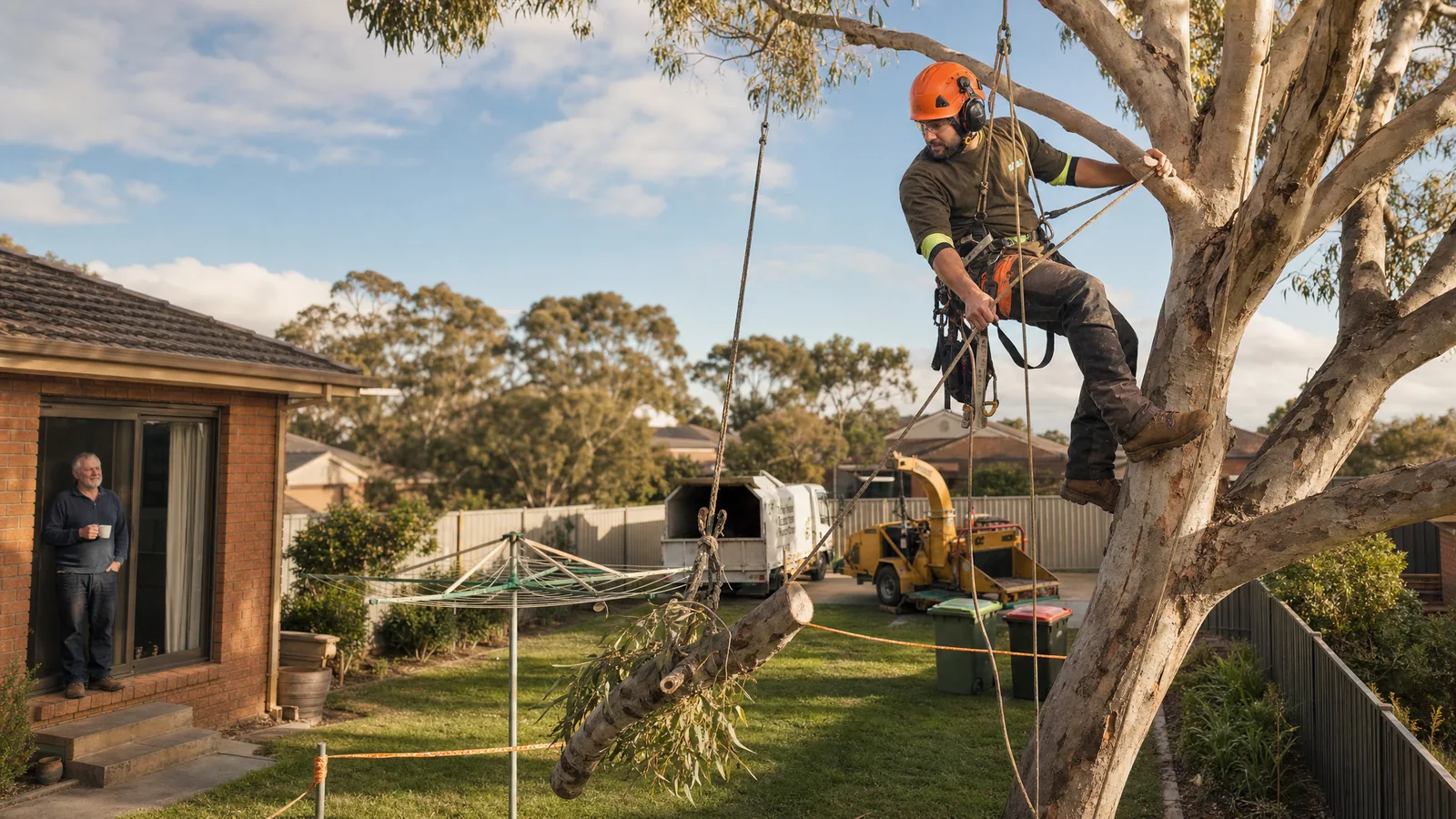
When a storm has put a tree on a house, our tree and palm removal service starts with the same order this guide does. Api asks whether you have spoken to the insurer. He photographs the tree and the damage himself, from the ground and from the roof, so there is a second set of pictures. He makes the site safe, which usually means securing or removing the limb that is doing the damage and tarping what it exposed, and he leaves the rest until you have the insurer's go-ahead. The quote is written, describes the tree, the method, the chipping and the clean-up, lists the stump separately, and is in a form you can forward to the assessor. The certificate of currency comes with it.
He also tells you straight when a job is not a claim. A tree that fell and hit nothing, a healthy tree you have decided to remove, or a stump left from a storm removal last year are jobs the homeowner pays for, and Api prices them the same way he prices everything: a free quote on site, a fixed written price before anything is cut, and the removal, the chipping, the clean-up and the green waste included unless the quote says otherwise. He takes calls 7 days a week from 6am and prioritises hazards, and the crew that quotes is the crew that turns up, fully insured.
None of this replaces a conversation with your insurer, and it is not meant to. Tree removal insurance, in the end, is storm cover with a tree in it: what your policy pays is set by the PDS you signed up to, and only your insurer can confirm it. What Api can do is make sure the tree comes off the house safely, the evidence survives, the paperwork is in the form the insurer wants, and nothing is done in the wrong order. That is how you get a fallen tree cleared without putting your claim at risk.
How you get a fallen tree cleared without putting your claim at risk
Getting a fallen tree cleared without putting your claim at risk does not have to be complicated. At Aps Tree Removal we look at the job with you, tell you what actually needs doing and what does not, and put a fixed price on it before anything is cut.
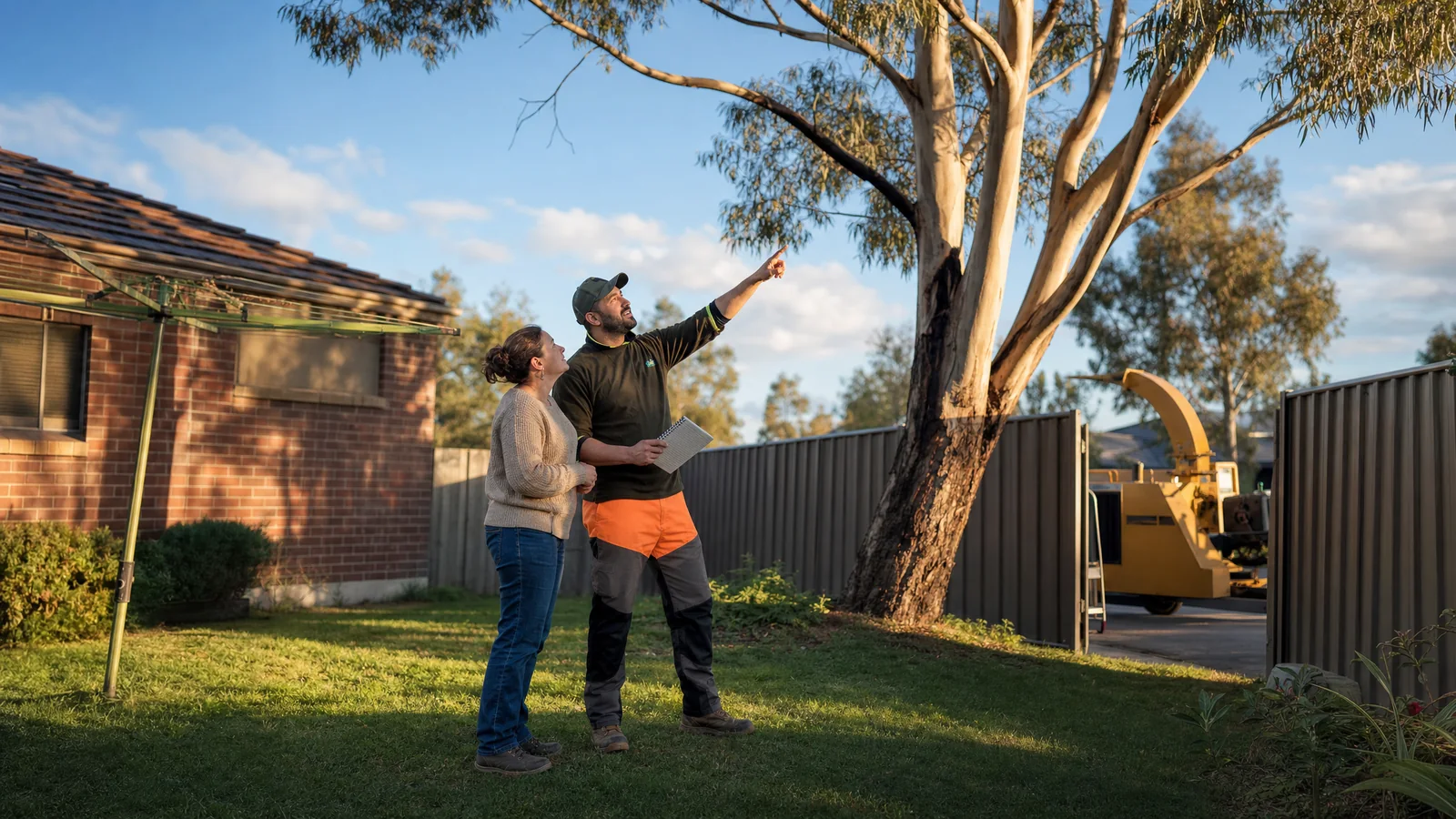
No pushy sales. Api comes out, walks the property with you, explains the options and what each one means for the result, the risk and the price. You decide at your own pace. People choose us because they understand the job before they book it, and the crew that quotes is the crew that turns up.
We will tell you if a council permit applies and what the process is, we will point out anything near powerlines or the neighbour's boundary that changes the method, and we will say plainly when a cheaper option is the better one. Every job is done by a qualified arborist, fully insured, and the site is left cleaner than we found it.
Get in touch today. Api quotes for free, 7 days, 6am to 5pm, across Melbourne's west, the inner city and Geelong.
How we work with you
We talk and answer your questions
Call 0422 856 090 or send the form. Api asks what is worrying you about the tree, hedge or stump, what access is like, and whether anything sits near powerlines or a fence line.
We look and give you a fixed price
Api visits, inspects the tree or hedge, checks the permit position for your council, and quotes in writing. The price covers the job, the clean-up and the green waste unless we say otherwise.
You decide what works best
Remove, reduce, prune or wait: we explain the difference and what each costs. No pressure, no expiring offers. The choice is yours.
We do the job and stay in touch
The crew arrives when we said, works to the plan, and leaves the site clean. If the tree throws a surprise on the day, we tell you before we change anything.
Frequently asked questions
Does home insurance cover tree removal?
Usually only when the tree has damaged something the policy insures, such as the roof, a fence, a shed or the contents, and most policies treat that as a storm claim. Removing a healthy tree you want gone, or a tree that fell and hit nothing, is generally not covered. Your PDS is the only document that answers it for your policy, so read the storm section or ask your insurer.
What is tree removal insurance, and can I buy it separately?
There is no separate tree removal insurance policy for a home. What people mean by it is the storm cover inside a home and contents policy, which pays for the damage a falling tree does to insured property and usually for getting the tree off that property. A tree that has not damaged anything is not part of that cover.
Can I have the tree removed before the insurer has seen it?
Make it safe, and stop there. The Insurance Council of Australia's advice is to speak to your insurer before you attempt or authorise any work, including emergency repairs, and to get permission in writing, because unauthorised work may not be covered. Photograph everything before a branch is moved, and leave the full removal until you have the go-ahead.
Who pays when the neighbour's tree falls on my fence?
In most cases your own home policy is the first call, because the insured event is the storm, and the insurer decides afterwards whether there is anyone to recover from. A healthy tree that a storm brought down is usually nobody's fault. If the tree was known to be dangerous, keep a written record, and the Dispute Settlement Centre of Victoria offers free mediation on 1300 372 888.
Does the insurer pay to grind the stump?
Often not. Insurers commonly pay to get the fallen tree off the damaged structure and to remove the debris on it, and the stump left in the lawn is treated as a separate job. Ask the question directly when you lodge the claim, and if the answer is no, have the stump quoted with the removal, because it is cheaper on the same visit.
Should I ask the arborist for proof of insurance on a storm job?
Yes, every time. Consumer Affairs Victoria's checklist says to ask for a certificate of currency for public liability insurance, which protects you and third parties against damage the workers may cause, along with the operator's full name, physical address and registered business name. Api hands his over on request, and insurers often ask for it too.
I cannot find my policy documents after the storm. Does that matter?
No. Insurers keep electronic records and need only your name, address and date of birth to find your policy and start the claim. Ring them first, then worry about the paperwork.
Is a tree I already knew was dangerous still covered if it falls?
That depends on the policy wording, and it is exactly the kind of question to put to the insurer rather than assume. Insurers look at whether the damage came from a sudden event and whether the tree had been left in a known unsafe condition. A written arborist's assessment and a booked removal date are worth having on file if a tree worries you, because they show you were dealing with it.
Sources
- Moneysmart (ASIC): Storm, flood and fire insurance (updated 18 August 2026)
- Victoria State Emergency Service (VICSES): Storms: plan and stay safe
- Insurance Council of Australia: What to do if your property has been impacted by severe storm
- Energy Safe Victoria: Trees and vegetation FAQ (reviewed 16 March 2026)
- Consumer Affairs Victoria: Home improvements costing $10,000 or less: checklist
- WorkSafe Victoria: Controlling the risks of working with trees (news, 28 January 2020)
- Safe Work Australia: Guide to managing the risks of tree work (March 2023)
- hipages: How much does an arborist cost? [2026] (updated 6 January 2026)
- training.gov.au (Australian Government): AHC30820 Certificate III in Arboriculture
- Brimbank City Council: Street and park trees / trees on private property
- Dispute Settlement Centre of Victoria: Neighbour disputes: trees
- Consumer Affairs Victoria: Giving quotes: tradespeople and small works (updated 8 July 2025)
- Planning Victoria (Department of Transport and Planning): Protecting and enhancing our tree canopy for a greener Victoria
- Moonee Valley City Council: Trees (private property tree permits)
- hipages: How much does stump grinding cost? [2026] (updated 6 January 2026)
- Energy Safe Victoria: No Go Zones: working around energy assets
Information about tree work, council permits and insurance changes often, and every property is different: figures here are general guidance and linked pages may change or become outdated. For a price on your own tree, hedge or stump, call Api on 0422 856 090 for a free quote.