By Aps Tree Removal · · Updated
Api Mariner, Qualified Arborist · 21 min read

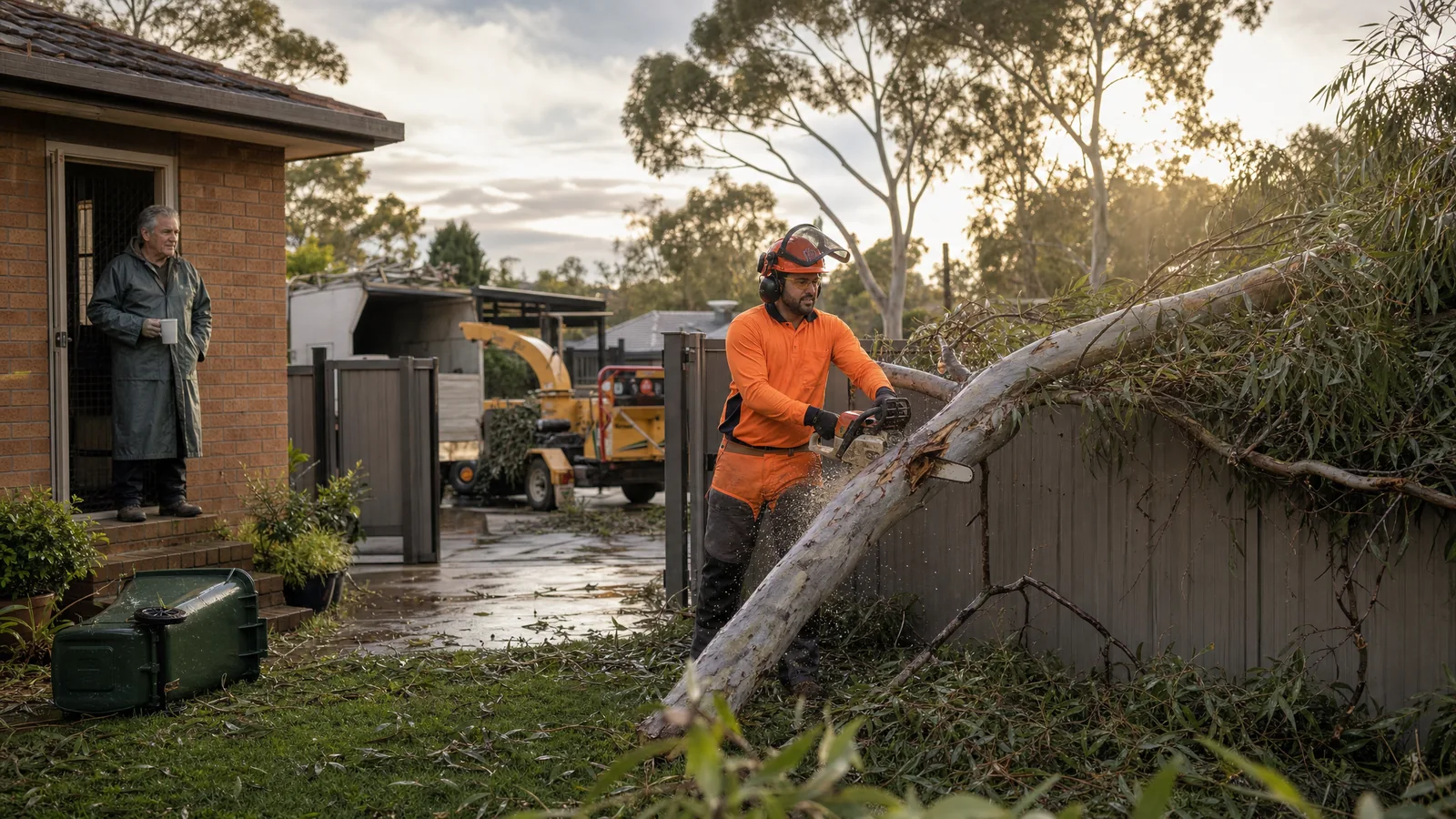
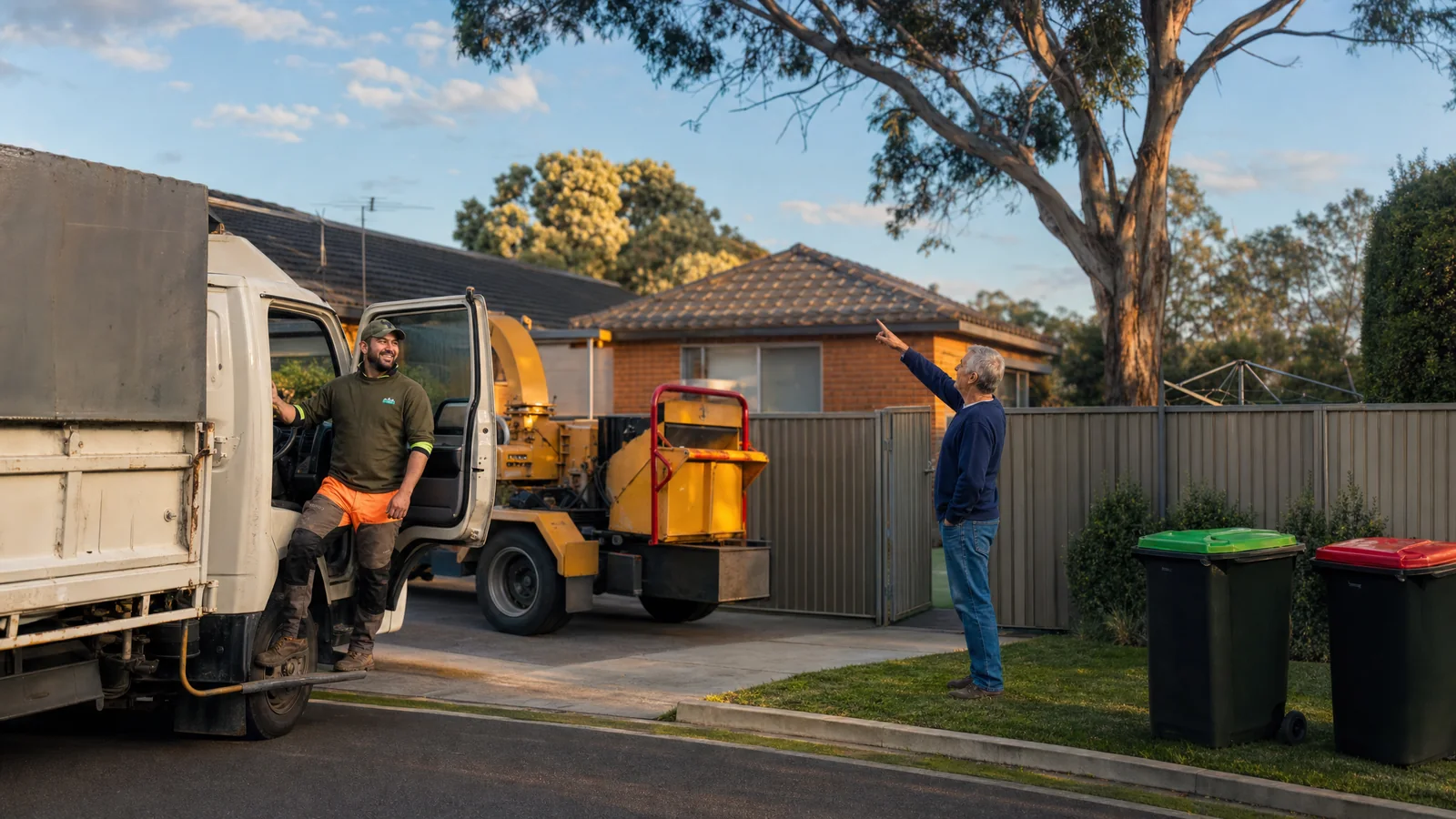
The call usually comes in the first hour after the wind drops. A limb is through the carport roof, a gum has gone over onto the fence, or a tree is leaning on the house and nobody knows whether it will hold. Api gets these calls every spring, and emergency tree removal in Melbourne is less about speed than people think and more about doing things in the right order: people away, powerlines respected, photos taken, the insurer told, and then the right crew with the right gear. This guide sets out the steps to take after a tree falls, who does what between VICSES and an arborist, how an urgent make-safe runs on the day, and what a storm-damaged tree changes about the way it comes down.
Api Mariner is a qualified arborist with more than 16 years on the tools across Melbourne's west, the inner suburbs and Geelong. He takes calls 7 days from 6am and puts hazards first, and what follows is the advice he gives on the phone, written down so you have it before the next storm rather than in the middle of one.
When a tree comes down in a storm: the first ten minutes
Storms are the Victoria State Emergency Service's main work. VICSES responds to around 20,000 requests for assistance from storms every year, roughly 80 per cent of everything it is called to [1]. Much of that damage comes from branches, trampolines and outdoor furniture turned into projectiles, from cars parked under trees, and from overhanging limbs coming down [1]. A tree on the fence in Werribee is one request in a queue of thousands on a bad night, which is why the first ten minutes belong to you and not to anyone you can phone.
Storms in Victoria, by the numbers
Nothing about a fallen tree gets worse in the next quarter of an hour, but a person walking under a hanging limb or towards a downed line can be hurt in a second. The order matters more than the speed.
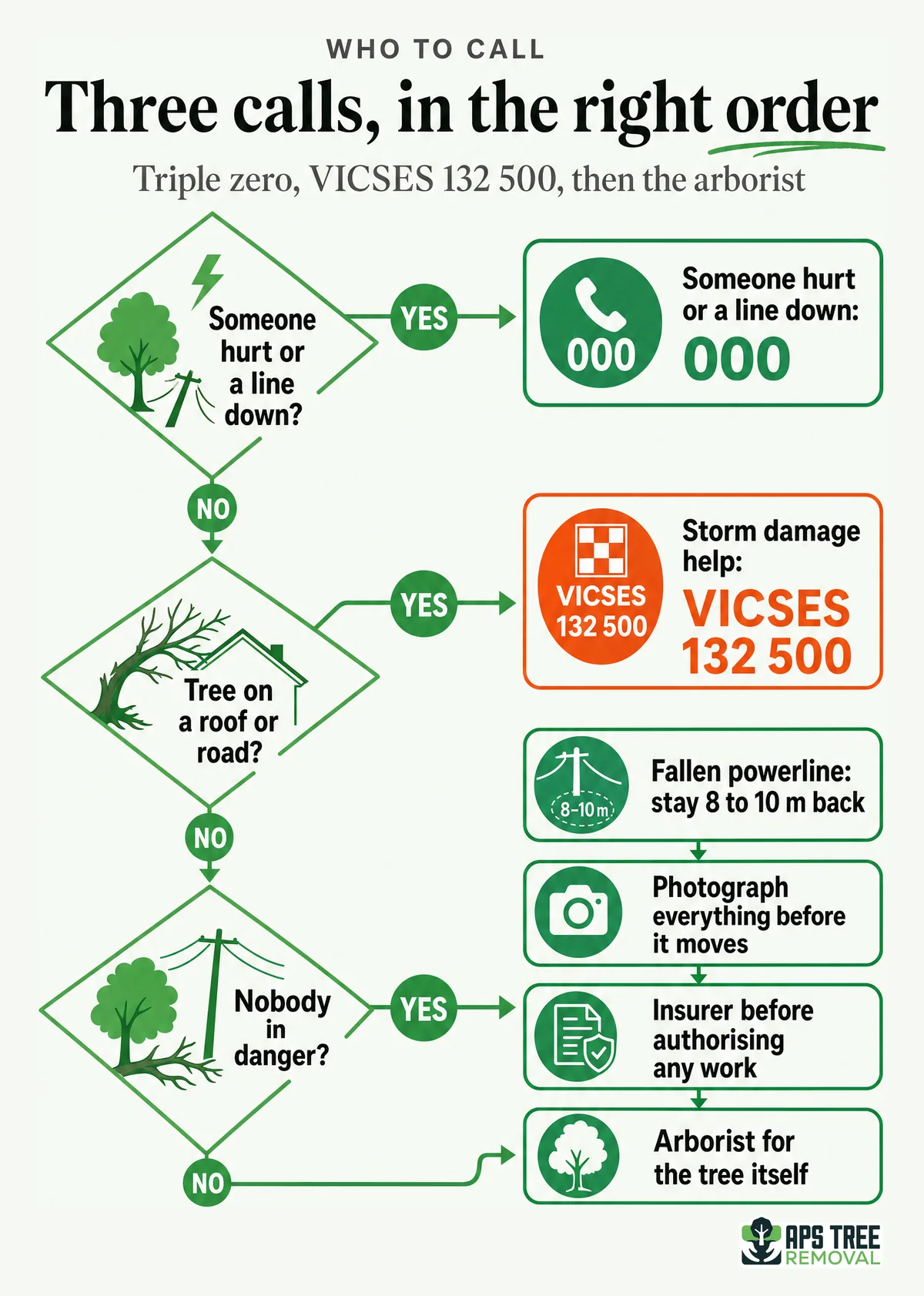
The steps to take after a tree falls
- 1People firstGet everyone, pets included, away from the tree and out from under anything it is resting on.
- 2Look for linesIf a powerline is down or the tree is touching one, keep everyone at least 8 to 10 metres away and treat it as live. Call 000 if anyone is hurt.
- 3Call VICSES on 132 500For storm damage that threatens people or property. For anything life-threatening, triple zero.
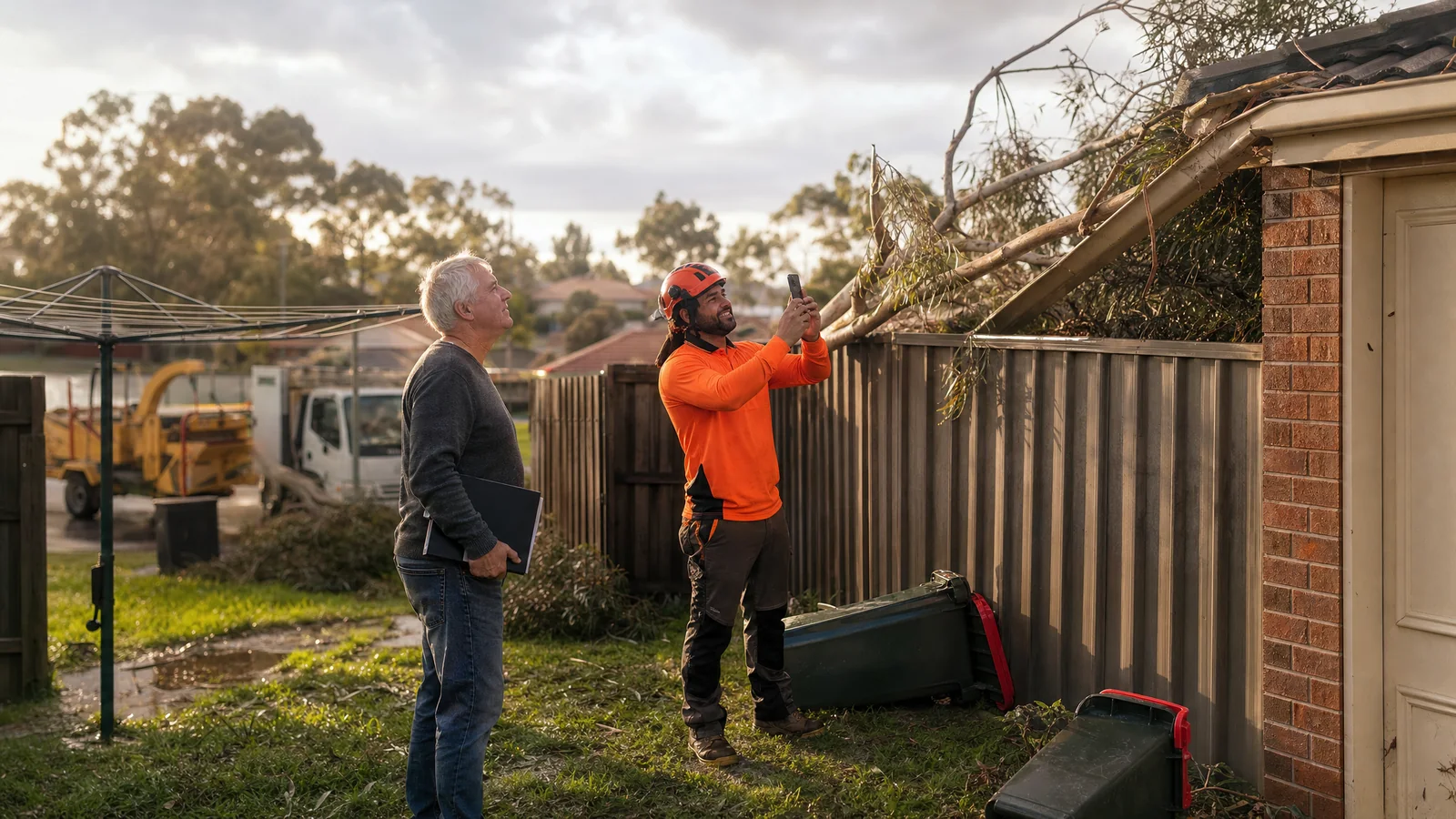
- 4Photograph everythingBefore a single branch is moved, photograph the tree, what it landed on and the damage around it.
- 5Ring the insurerTell them what has happened and get permission in writing before authorising any work beyond a make-safe.
- 6Then call the arboristWith the immediate danger handled, Api's crew takes over: assessing the tree, making it safe and taking it away.
Who does what: VICSES, triple zero and the arborist
People ring Api asking whether they should have called the SES instead, and the honest answer is that the two do different jobs. VICSES is the storm emergency service: its number for storm assistance is 132 500, and for a life-threatening emergency the call is triple zero [1]. VICSES crews deal with the immediate threat to people and property. They do not take the tree away, grind the stump or put the backyard back together, and after a major storm they are working through thousands of jobs by risk.
An arborist does the rest, and on private property with nobody in danger the arborist is usually the whole of the emergency tree removal call. If you have never had to hire one, the guide to finding tree removal near you covers what to look for, and the short version on a storm day is insured, qualified, and able to tell you the method before they start.
| What has happened | Who to call | What they do |
|---|---|---|
| Someone is hurt, or a powerline is down or arcing | Triple zero (000) | Emergency response; keep everyone 8 to 10 metres from any line [2] |
| A tree is on the roof, across the road or trapping a car | VICSES on 132 500 [1] | Makes the immediate danger safe; does not remove the tree |
| A tree is down on your property and nobody is in danger | Your insurer, then Api on 0422 856 090 | Insurer approves the work; Api assesses, makes safe, removes and clears |
| A tree is touching the powerlines outside your boundary | The electricity distribution business for your area [2] | Only authorised powerline contractors prune near lines [3] |
Powerlines: the 8 to 10 metre rule
Nothing on this list matters more. Energy Safe Victoria's advice after a storm is to keep at least 8 to 10 metres away from any fallen powerline, because you do not have to touch a line to receive a shock and a fallen or broken line can still be conducting [2]. VICSES gives the same figure and adds the rule Api repeats on every job: always assume a line is live [1]. If you see someone hit a powerline, stay at least eight metres back and call 000 rather than go to them [4].
The reason is physics rather than caution. Safe Work Australia's guide to tree work says that contact with an electric line can be fatal whether it carries 400,000 volts or 230, and that a flashover or arc can electrocute a person who is merely close to a conductor [5]. A wet branch resting across a line is part of the circuit, and on hot days powerlines sag, so the gap between a tree and the wire can be smaller than it looks [4].
The tree on your side of the fence is yours to keep clear of the service line to your own house, but any tree growing into the powerlines outside your boundary, or into a neighbour's service line, is the electricity distribution business's job to clear [2]. Trees touching or close to powerlines are pruned only by authorised powerline contractors, not by a general arborist [3]. When a storm has dropped a tree onto a street line, Api's first call is to the distributor, and the tree waits until the line is made safe.
If a tree is on a powerline
Stay 8 to 10 metres back, keep children and pets inside, and assume the line is live even if the power is out. Call 000 if anyone is hurt or the line is arcing, then the electricity distribution business for your area. Nobody, including a tradesperson, starts cutting until the distributor says the line is safe.
What to photograph for the insurer before anything moves
The insurer's rules shape what an arborist can do on day one, so they come before the chainsaw. The Insurance Council of Australia's advice after a severe storm is to contact your insurer as soon as possible, to tell them straight away if there is roof damage, and to document the damage with photos and videos before the clean-up starts [6]. The part most people miss is the next line: speak to the insurer before you authorise any building work, including emergency repairs, and ask for their permission in writing, because unauthorised work may not be covered [6].
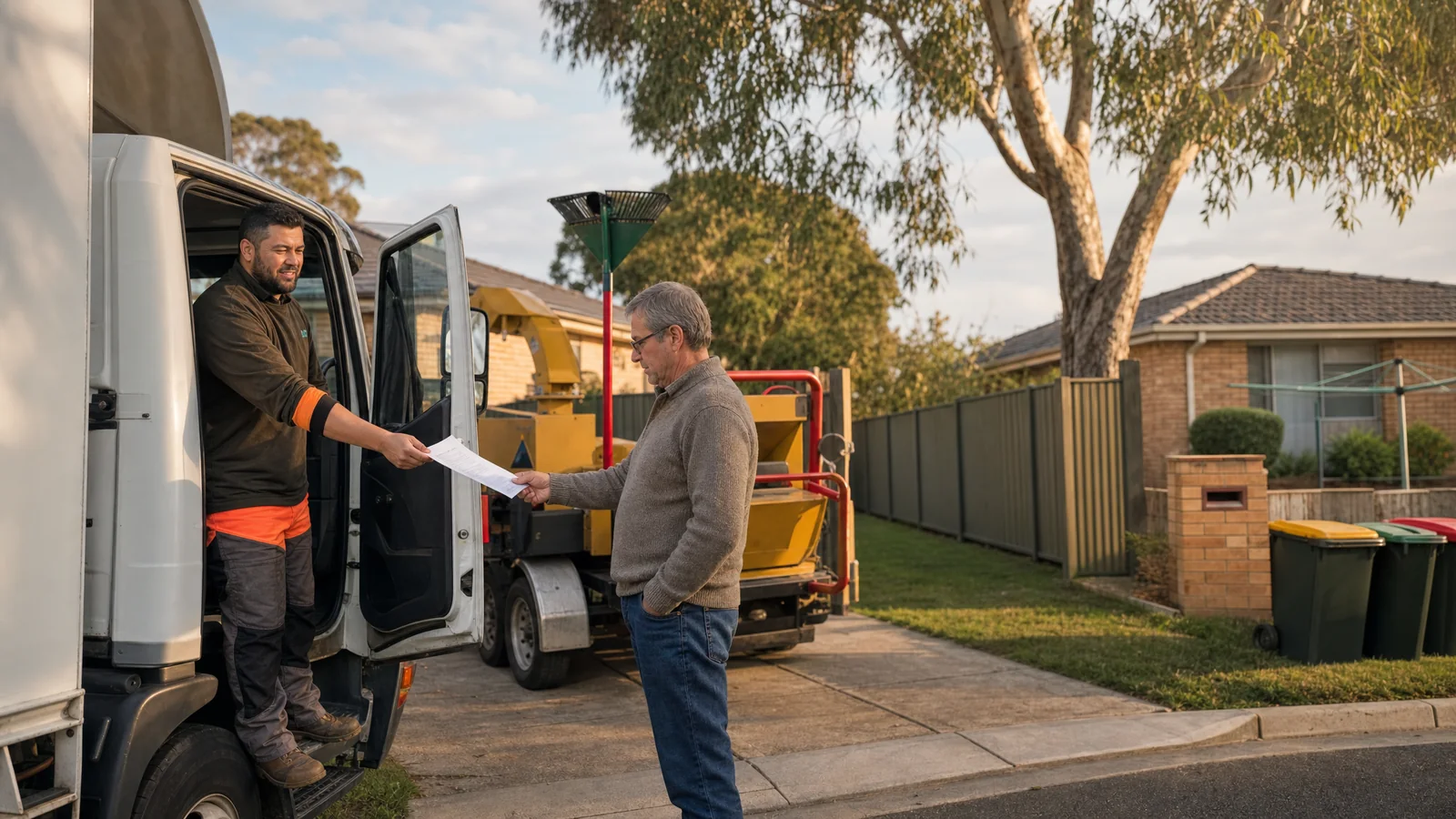
That does not stop a make-safe. It means the site is photographed first, the insurer is told what is about to happen, and the arborist writes down what was done and why. Api's crew photographs the tree before, during and after for exactly this reason, and those photos go to you.
Most home and contents policies cover storm damage, including lightning, strong wind, rainwater and hail, and if you are unsure what you hold the answer is in the product disclosure statement [7]. The detail of what your policy covers and what it does not is worth reading once, on a dry day, because a tree that has damaged something insured is a claim and a tree you simply want gone is an invoice. If the storm has left you in urgent financial need, you can ask the insurer to fast-track the claim and make an advance payment within five business days of showing that need, and you do not need your policy papers, only your name, address and date of birth [6].
What to photograph before anything is moved
- The whole tree from a safe distance, showing where it came from and where it landed
- Every point of contact: roof, gutter, fence, carport, car, shed, pergola
- The base of the tree or the split, so the insurer can see why it failed
- Any powerline or service line involved, taken from well back
- Damage inside the house where water is getting in
- The same shots after the make-safe, so the before and after line up
How fast emergency tree removal help comes
Here is the part nobody likes to hear: on the night of a big storm, every arborist in Melbourne is getting the same call at the same time. Api takes calls 7 days from 6am and prioritises hazards, which means the tree on the house goes ahead of the tree on the lawn, and the limb over the footpath goes ahead of the one in the back corner. He does not promise same-day work to anyone, because a promise like that is only kept by pushing someone else's dangerous tree down the list.
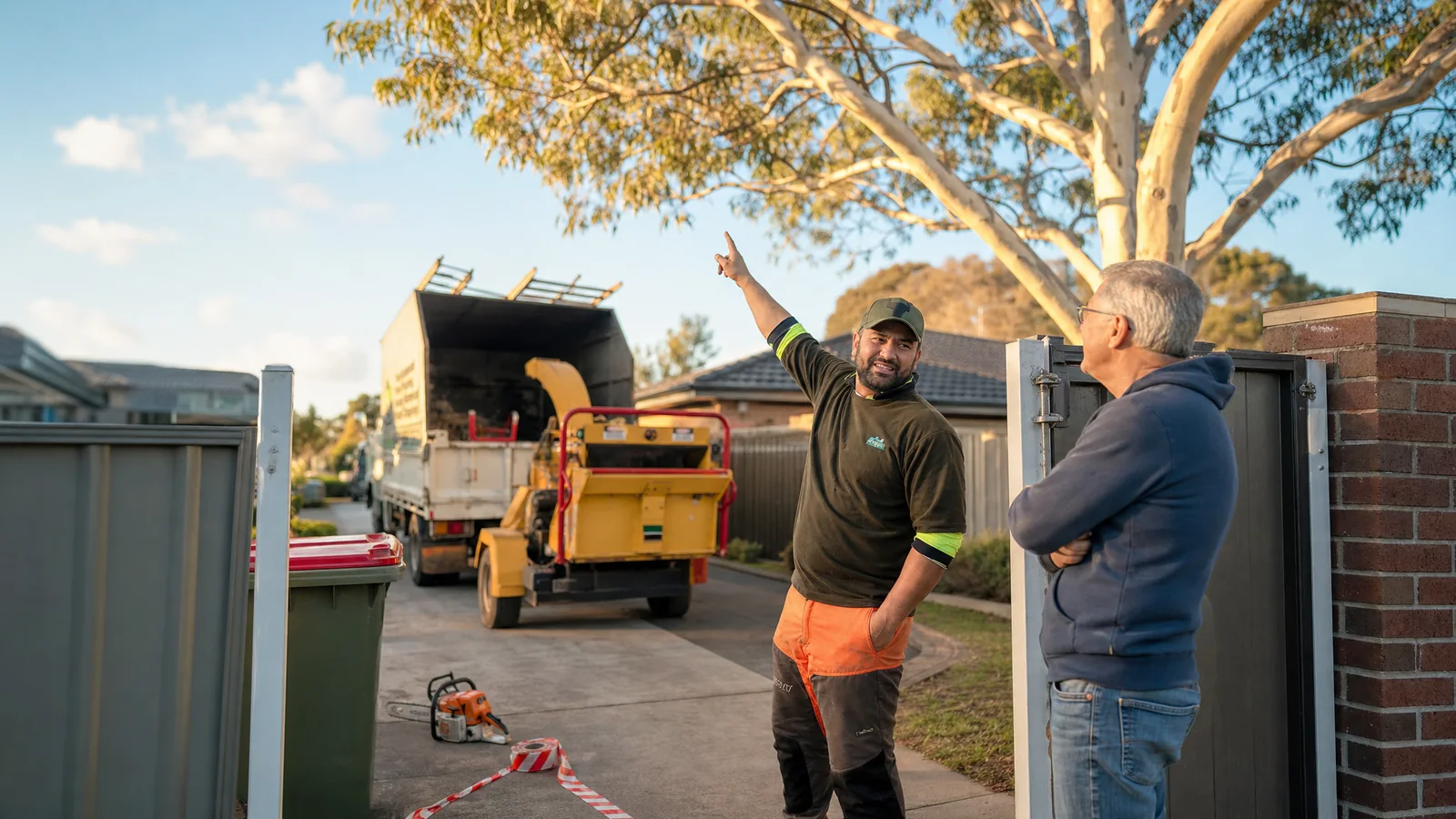
What speeds emergency tree removal up is the information you give on the phone. Api can sort a job from a description and three photos sent by text: what the tree is resting on, whether there is a powerline near it, whether it is still standing, and whether the chipper and truck can get to it. A tree lying stable on a lawn is a different call from a tree hung up over a bedroom, and telling him which one you have gets the right one seen first.
There is also the weather itself. Energy Safe Victoria's advice is to avoid pruning in high winds, and no responsible crew puts a climber or an EWP up while the storm that broke the tree is still blowing [3]. The first jobs go in as the wind drops, so a tree that comes down at midnight is usually looked at from first light, and Api will tell you honestly where you sit rather than guess.
I had some large trees at the front of my property that needed to be removed and also two small stumps . I contacted Ap’s tree removal on Wednesday and within the hour he replied wanting to come out and have a look but that day didn’t suit for myself. We then organised a time that suited and on Friday it was a quick decisions from myself there and then and he started to remove the trees. I couldn’t speak highly enough of this business , He is professional, he goes above and beyond, the quality of work is outstanding, they also clean up the mess afterwards. Api was on time both Friday and today and all round such a great friendly guy. He also had a little cheer squad who were watching him cut down the trees and he even gave them a pair of ear muffs each to protect their little ears. So if you need trees cut, and stumps grinded this company is the one . 😄😄 thank you Api and crew
How an urgent make-safe runs on the day
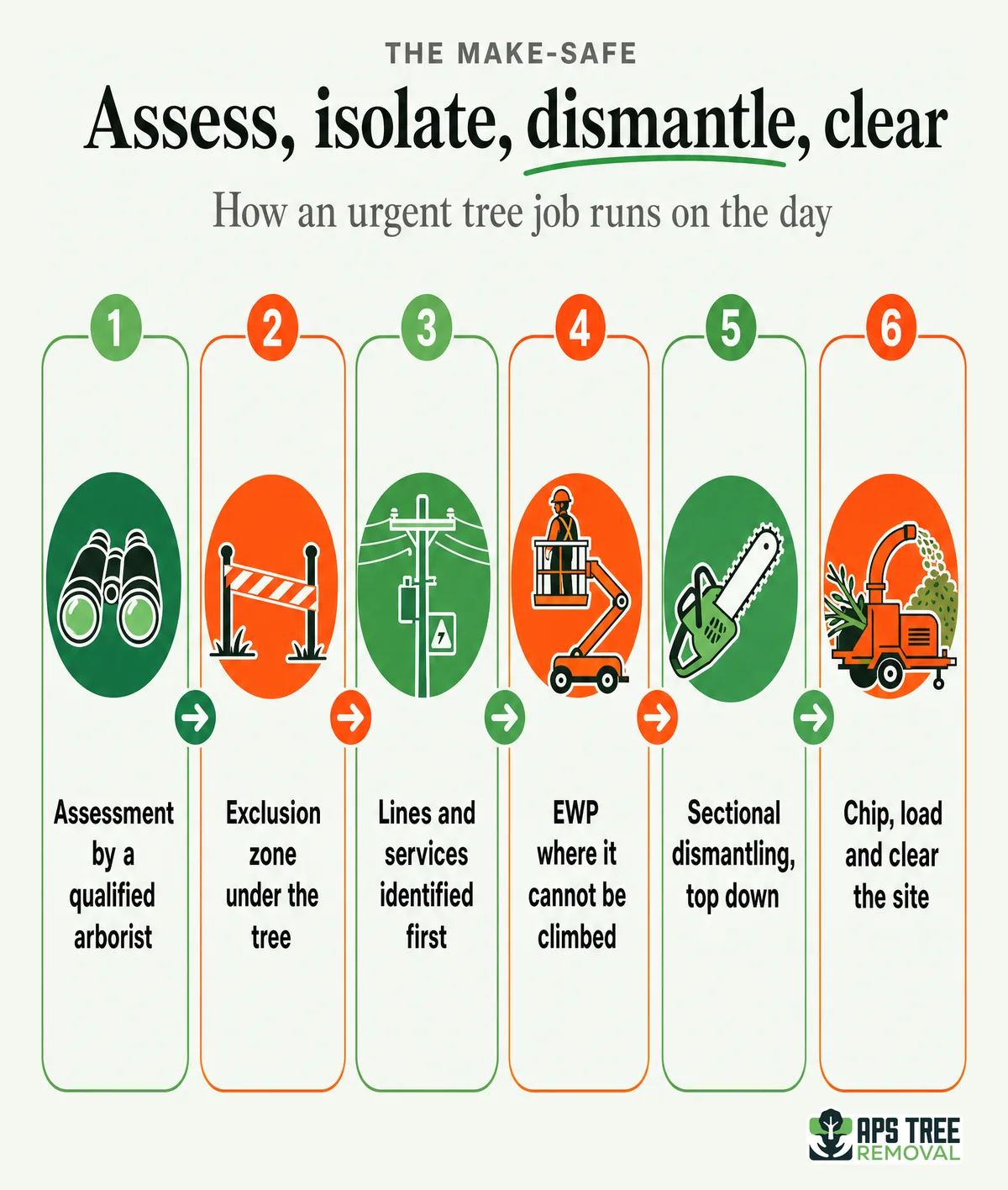
A make-safe is a removal done in a different order, with a different set of questions. Safe Work Australia's guide says that before anyone accesses a tree, a competent person such as a qualified arborist should carry out a visual assessment of its overall condition and structural integrity, and that an exclusion zone should be set up below and near the tree, with signs, barriers and supervised access [5]. WorkSafe Victoria says the same thing from the other direction: plan and prepare, and inspect each tree individually to decide the safest method [8]. On a storm job that assessment is most of the job, because the tree is no longer the shape it was.
An urgent make-safe, in order
- AssessmentApi walks the tree from a distance first: what is holding it, what it is loading, where the tension sits in the split timber, and whether the root plate has lifted.
- Exclusion zoneTape, cones and a crew member on the gate. The drop zone is cleared of cars, bins and furniture.
- Lines and servicesAny powerline is identified and, if one is involved, the distributor is called and the job waits. Gas and water near the base are located before any grinding.
- Access methodA storm-damaged tree is rarely climbed. Where it cannot be climbed safely the EWP goes in and the cuts are planned from the platform. Never from a ladder.
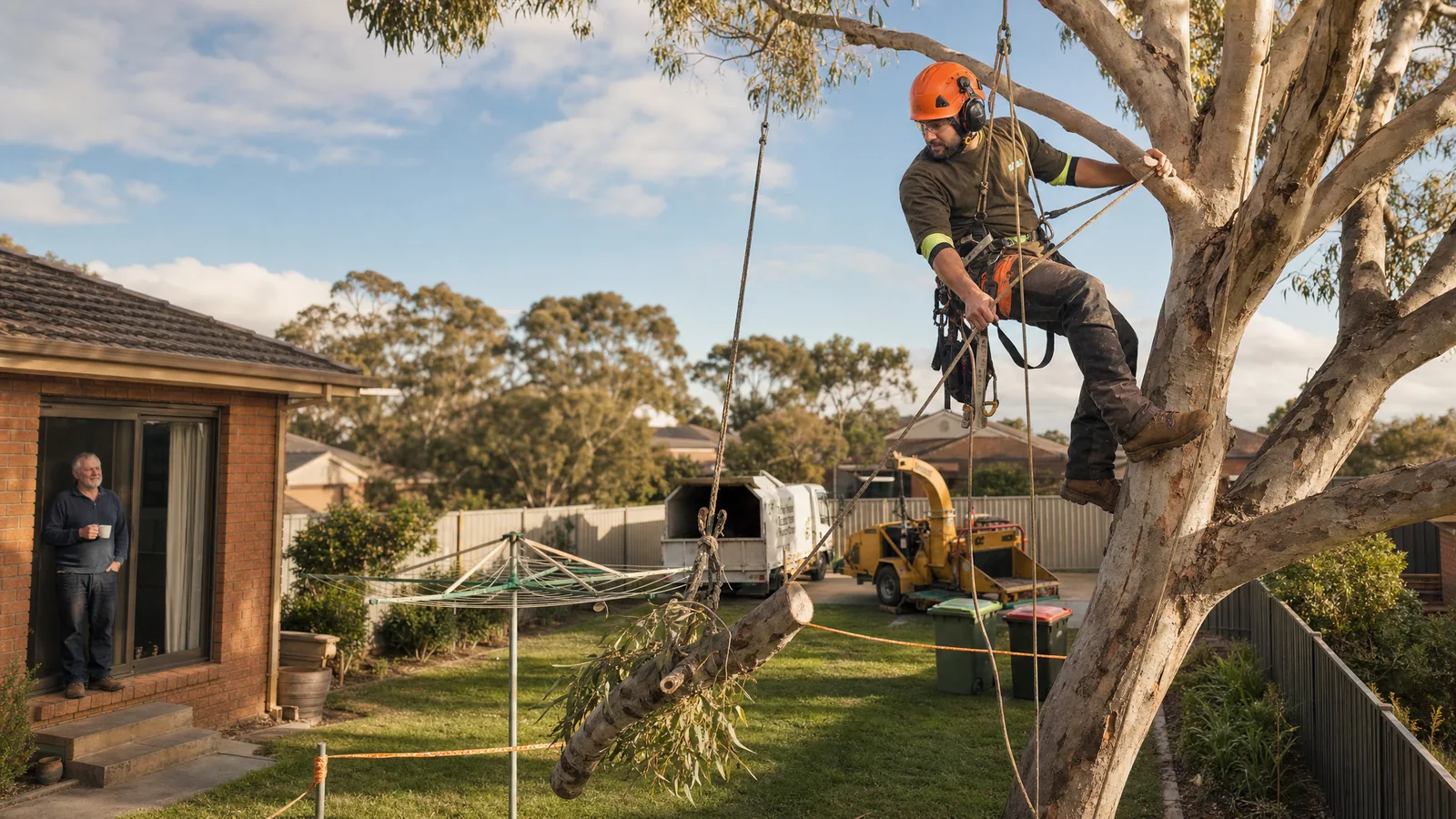
- Sectional dismantlingThe tree comes apart from the tip down, in pieces sized to the rigging, each one roped and lowered where there is something under it.
- Chip and clearBranches go through the chipper, timber is stacked or loaded, and the site is swept before the crew leaves.
Two rules from that guide come up on every storm job. Tree trimming and removal work should not be done from ladders, and on a broken tree the ladder is leaning on the very thing that is about to move [5]. And the woodchipper gets the same respect as the tree: the operator stands to the side of the infeed chute and feeds branches butt end first, because the hazards include being drawn in by the rollers and struck by ejected material [5].
Got a tree down, a limb hanging or a trunk leaning where it should not be? Api takes calls 7 days from 6am, hazards first, and quotes on site for free.
Making a hanging limb safe
The most dangerous thing after a storm is often the one that has not fallen yet. A limb that has split at the trunk but is caught in the canopy, or is resting on the roof with its weight held by a few centimetres of green timber, is what the trade calls a hanger, and it is more likely to hurt someone than the tree already on the ground. It looks stable. It is not.
Making a hanger safe is rigging work. The limb is tied off from above or from the EWP before the holding timber is cut, so the crew controls the drop. The cut is made knowing which side of the break is in tension and which is in compression, because a limb under load can pinch the saw, kick, or swing back into the operator. This is the difference between a lopper and an arborist in a single job: a lopper with a ladder cuts the limb where they can reach it and hopes; an arborist works out where the weight goes before touching it.
The stakes are not theoretical. WorkSafe Victoria reported a coroner's finding that 31 people died in Victoria from tree felling or related activity between January 2012 and September 2018, and that 13 of those deaths were at work, which leaves 18 people who were not on the job at all [8]. WorkSafe's guidance note lists the reasons the industry loses workers every year: working at height, chainsaws, falling objects, chippers and overhead powerlines [9]. Every one of those is worse on a broken tree.
What a storm-damaged tree does to the method
A healthy tree is removed the way it grew: climb it, take the canopy off in sections, drop the trunk in lengths. A storm-damaged tree has been loaded by the wind in ways nothing planned for, and three things change.
First, the tree is usually not climbable. Split stems, cracked unions and a lifted root plate mean the trunk cannot be trusted to hold a climber, so the crew works from the EWP or from the ground, and a tight side gate can decide whether the tree comes down in a morning or across two days.
Second, the timber is under load. A trunk resting on a roof is a beam with a house holding one end up. Cut it in the wrong place and it rolls, drops or springs, so the crew cuts in an order that releases the load gradually, often taking the weight off the structure with rigging before the first cut.
Third, everything is wet and everything is in the way. Chainsaw operators wear cut-resistant leg protection and hearing protection as standard, and on a storm site they are working on wet timber with debris underfoot [5]. VICSES warns that heat, fire or recent storms make trees unstable and more likely to fall in the next one, which is why Api looks at the standing trees around a fallen one before the crew packs up [1]. The tree that came down is the one you can see. The one next to it took the same wind.
After the storm: what helps and what makes it worse
Helps the crew
- Photos sent by text before the visit, showing what the tree is on
- Cars, bins and the trampoline moved out of the drop zone
- The side gate unlocked and the path to the tree clear
- The insurer told, with permission in writing to make safe
Makes it worse
- Cutting the "easy" branches off first and changing how the load sits
- Standing under a hung-up limb to take a closer photo
- Dragging the tree off the fence with a car and a rope
- Leaving the standing trees next to it unchecked
Used to clear fallen trees and remove shrubs. Left the yard clean and tidy. Fitted in with a time which suited me. Prompt contact.
After the make-safe: the clean-up, the stump and the paperwork
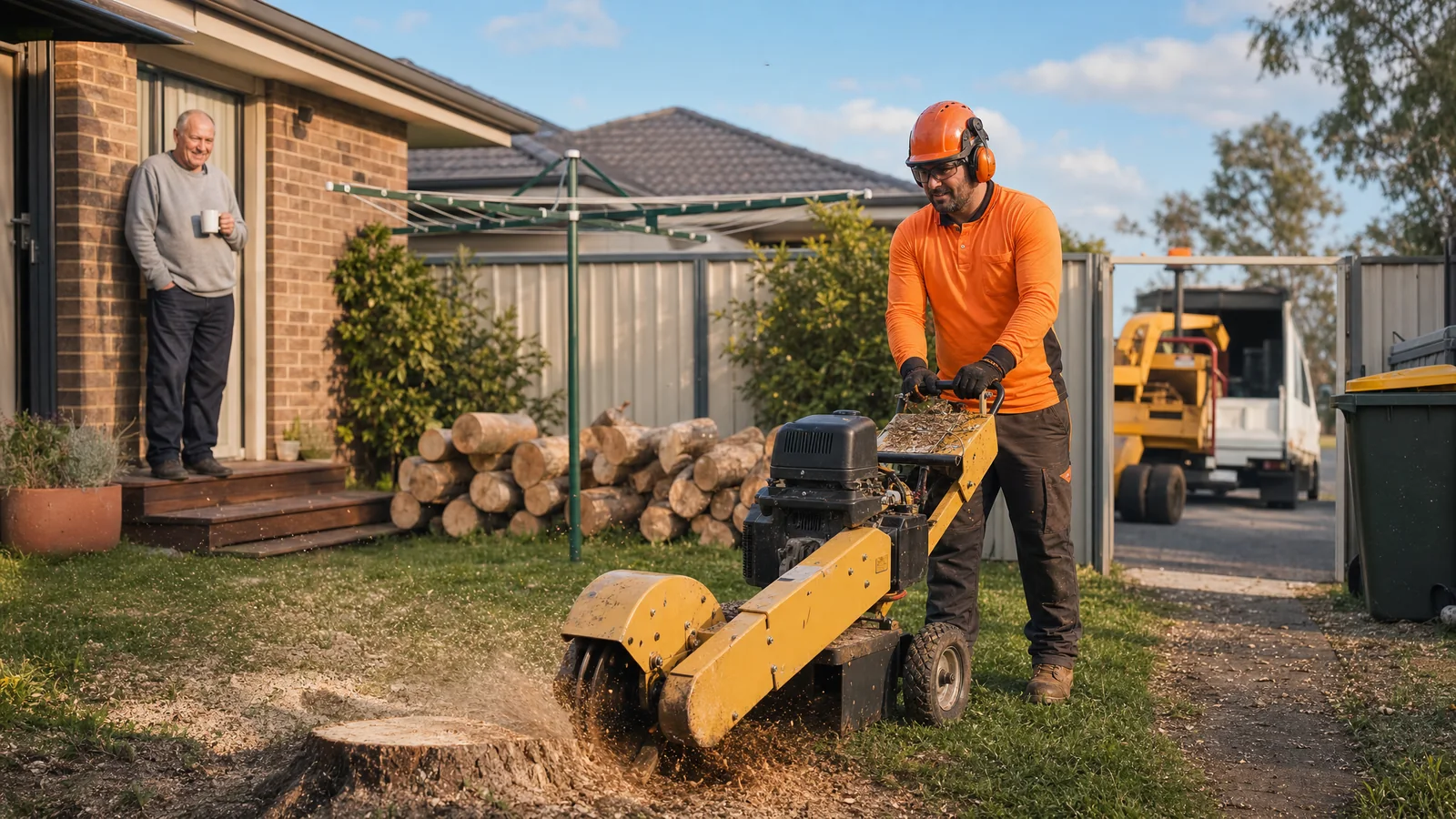
Once the tree is safe the rest is an ordinary job: chip the branches, load the timber, sweep the site, and grind the stump. There is a real saving in having the stump ground out at the same time, because the grinder is already on the truck. Storm jobs produce more green waste than a planned removal, because the whole canopy comes down at once.
The paperwork is where storm jobs surprise people. A tree that has already fallen is a different conversation from a damaged tree that is still standing, and Api still checks the council position on your title before a standing tree is removed. Since 15 September 2025 every Victorian planning scheme has carried the canopy-tree clause, which requires a permit to remove, destroy or lop a canopy tree (over 5 metres tall, a trunk over 0.5 metres around at 1.4 metres, a canopy at least 4 metres across) anywhere on a vacant residential lot, or within 6 metres of the street frontage or 4.5 metres of the rear boundary of a lot with a house on it [10]. A storm-damaged tree that has to come down for safety is exactly where the council and the arborist need to be talking, and Api would rather make that call than have you find out later.
Whose tree it was does not change the make-safe, but it changes who pays, and that is between the two households and their insurers. Where a neighbour's tree has come through your fence and the conversation is getting difficult, the Dispute Settlement Centre of Victoria offers free, voluntary and confidential mediation on 1300 372 888 [11].
One more warning. Consumer Affairs Victoria's advice is to be wary of people who knock on your door offering cheap deals on jobs around your home, and after a storm those door-knockers are out in numbers [12]. Ask for a certificate of currency for public liability insurance, a full name and a physical address before anyone starts a saw [12]. The same guide to what tree removal costs in Melbourne applies to a storm job as to a planned one: the tree, the access and the hazards set the price, not the emergency.
Before the next storm: what Api would do now
Melbourne's storm damage is not spread evenly through the year. At Melbourne Airport the wettest months on average are November at 62.4 mm and October at 55.7 mm, against a July average of 35 mm [13]. Spring is when the calls come, and the work that prevents them is done in the months before, when the calendar is quieter.
VICSES's advice is to trim back trees and branches away from the home and to park the car under cover or away from trees [1]. Energy Safe Victoria adds that trees and shrubs should be cleared before they grow to within one metre of the insulated service line to your house, and that only low-growing species belong near powerlines [3]. None of that is complicated, and all of it is cheaper in August than in November.
Storm-proofing your trees before spring
- Have any large tree near the house, the carport or the neighbour's roof looked at by a qualified arborist
- Deal with dead wood, split unions and limbs hanging over rooflines before the wind finds them
- Keep trees clear of the service line to your house, well before they are within a metre of it
- Move the trampoline, the outdoor setting and the wheelie bins somewhere they cannot fly
- Save 0422 856 090 and VICSES 132 500 in your phone now
What Api's storm call-out includes
Every urgent job from our tree and palm removal service starts with the same conversation: what is the tree on, is there a line near it, and is anyone in danger. From there Api gives an honest answer on timing, assesses the tree himself, and makes it safe with the gear the tree needs: rigging, the EWP where it cannot be climbed, the chipper and the truck. The site is photographed for the insurer, the work is a fixed written price covering the make-safe, the removal, the chipping, the clean-up and the green waste unless it says otherwise, and the stump is listed separately. Fully insured, the crew that quotes is the crew that turns up, and the standing trees next to the fallen one are looked at before anyone leaves.
That is how emergency tree removal should work in Melbourne: not a promise of minutes, but the right calls in the right order, and a qualified crew that makes a dangerous tree safe without anyone getting hurt.
How you get a dangerous tree made safe and cleared without anyone getting hurt
Getting a dangerous tree made safe and cleared without anyone getting hurt does not have to be complicated. At Aps Tree Removal we look at the job with you, tell you what actually needs doing and what does not, and put a fixed price on it before anything is cut.
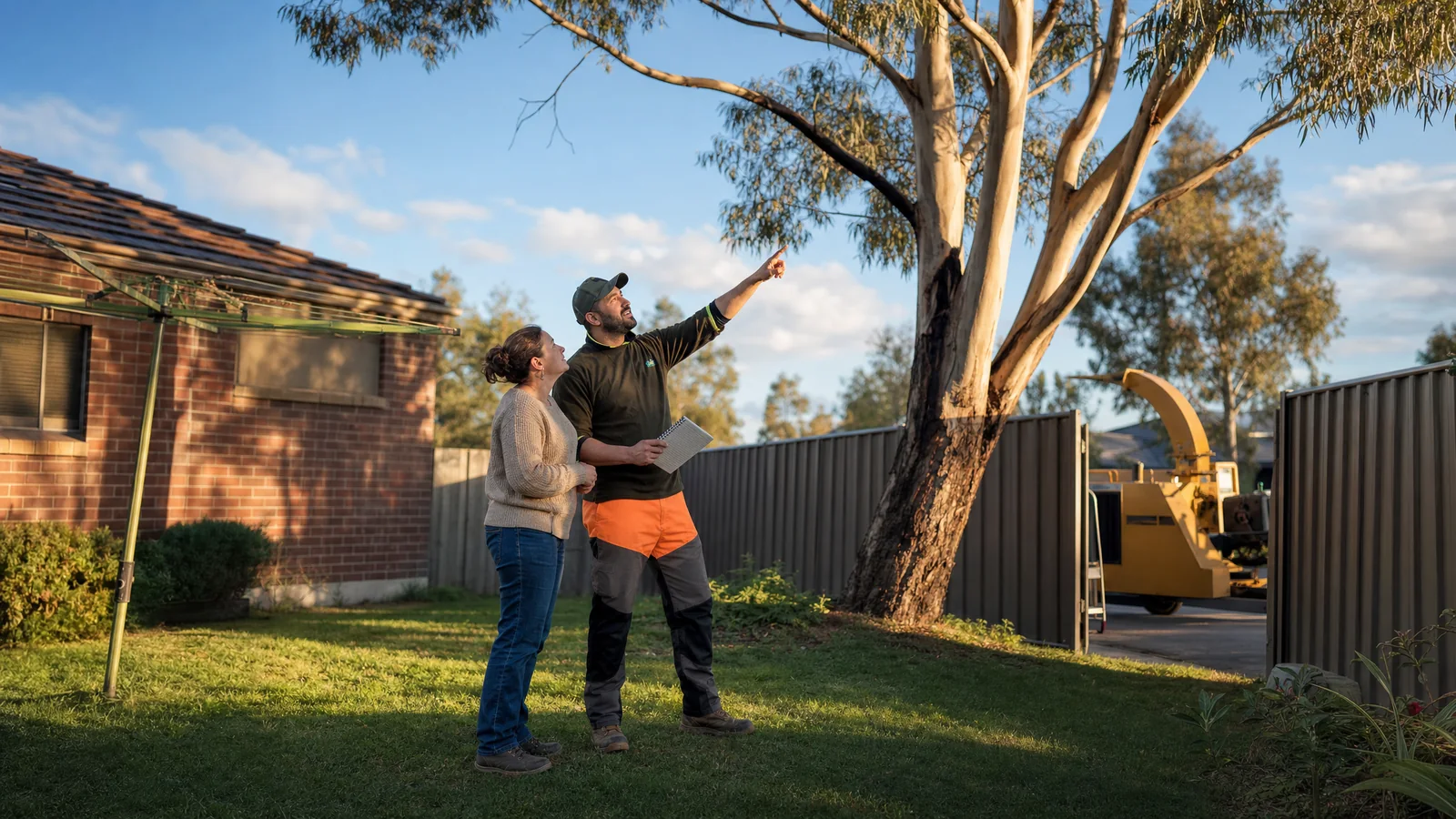
No pushy sales. Api comes out, walks the property with you, explains the options and what each one means for the result, the risk and the price. You decide at your own pace. People choose us because they understand the job before they book it, and the crew that quotes is the crew that turns up.
We will tell you if a council permit applies and what the process is, we will point out anything near powerlines or the neighbour's boundary that changes the method, and we will say plainly when a cheaper option is the better one. Every job is done by a qualified arborist, fully insured, and the site is left cleaner than we found it.
Get in touch today. Api quotes for free, 7 days, 6am to 5pm, across Melbourne's west, the inner city and Geelong.
How we work with you
We talk and answer your questions
Call 0422 856 090 or send the form. Api asks what is worrying you about the tree, hedge or stump, what access is like, and whether anything sits near powerlines or a fence line.
We look and give you a fixed price
Api visits, inspects the tree or hedge, checks the permit position for your council, and quotes in writing. The price covers the job, the clean-up and the green waste unless we say otherwise.
You decide what works best
Remove, reduce, prune or wait: we explain the difference and what each costs. No pressure, no expiring offers. The choice is yours.
We do the job and stay in touch
The crew arrives when we said, works to the plan, and leaves the site clean. If the tree throws a surprise on the day, we tell you before we change anything.
Frequently asked questions
Who do I call first for emergency tree removal in Melbourne?
If anyone is hurt or a powerline is down, triple zero. If a tree is threatening people or property, VICSES on 132 500. If a tree or limb is down on your property and nobody is in danger, ring your insurer and then Api on 0422 856 090, and he will tell you honestly where you sit in the queue.
Can Api come out the same day after a storm?
Sometimes, but it is never promised. Api takes calls 7 days from 6am and puts hazards first, so a tree on a roof or over a footpath goes ahead of a tree lying on a lawn. Send photos by text and he can tell you straight away which kind of job you have.
Is it safe to cut a fallen tree off my fence myself?
A tree that has come down is under load in ways you cannot see, and cutting the wrong piece first can make it roll, drop or spring. Most of the people killed by tree work in Victoria were not on the job at all. Leave the saw in the shed and get it assessed.
What if the tree is on the powerline?
Keep everyone at least 8 to 10 metres back and assume the line is live even if the power is out. Call 000 if anyone is hurt or the line is arcing, then the electricity distributor for your area. Nobody, including an arborist, cuts near that line until the distributor says it is safe.
Will my home insurance pay for emergency tree removal?
Most home and contents policies cover storm damage, and the tree that caused it is usually part of the claim. Photograph everything first, tell the insurer before you authorise work, and ask for their permission in writing. A tree you simply want gone is not a storm claim, so check the PDS.
Do I still need a council permit for a storm-damaged tree?
A tree that has already fallen is a different conversation from a damaged tree that is still standing. Api checks the council position on your title before a standing tree is removed, because since 15 September 2025 every Victorian planning scheme has carried the canopy-tree clause, and he will tell you what applies before the job is booked.
What should I have ready when I ring?
What the tree is resting on, whether there is a powerline anywhere near it, whether it is still standing or fully down, and whether a truck and chipper can get to it. Three photos sent by text answer most of that in one go.
My neighbour's tree came through my fence. Who pays?
Whose tree it was does not change the make-safe, but it does change who pays, and that is between the two households and their insurers. If the conversation gets difficult, the Dispute Settlement Centre of Victoria offers free mediation on 1300 372 888.
Sources
- Victoria State Emergency Service (VICSES): Storms: plan and stay safe
- Energy Safe Victoria: Trees and vegetation FAQ (reviewed 16 March 2026)
- Energy Safe Victoria: Managing trees near powerlines
- Energy Safe Victoria: No Go Zones: working around energy assets
- Safe Work Australia: Guide to managing the risks of tree work (March 2023)
- Insurance Council of Australia: What to do if your property has been impacted by severe storm
- Moneysmart (ASIC): Storm, flood and fire insurance (updated 18 August 2026)
- WorkSafe Victoria: Controlling the risks of working with trees (news, 28 January 2020)
- WorkSafe Victoria: Working safely with trees (guidance note, 13 January 2020)
- Planning Victoria (Department of Transport and Planning): Protecting and enhancing our tree canopy for a greener Victoria
- Dispute Settlement Centre of Victoria: Neighbour disputes: trees
- Consumer Affairs Victoria: Home improvements costing $10,000 or less: checklist
- Bureau of Meteorology: Climate statistics for Australian locations: Melbourne Airport
Information about tree work, council permits and insurance changes often, and every property is different: figures here are general guidance and linked pages may change or become outdated. For a price on your own tree, hedge or stump, call Api on 0422 856 090 for a free quote.