By Aps Tree Removal · · Updated
Api Mariner, Qualified Arborist · 21 min read

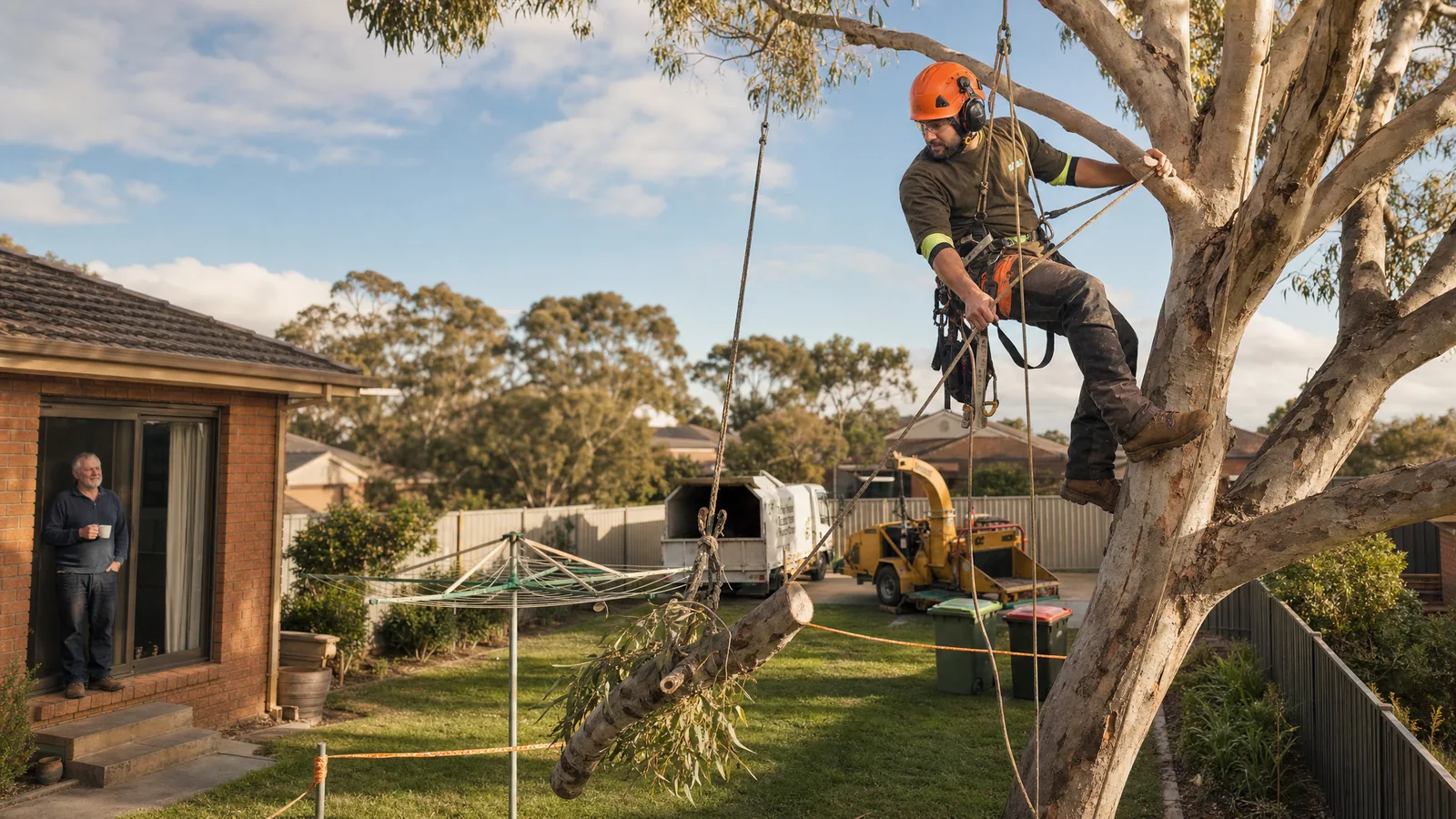
Search for "tree lopping Melbourne" and the results fill with utes, chainsaws and prices. Search for professional tree removal and you get the same utes with different signwriting. To a homeowner the two look like one trade, and that is the problem this guide fixes. Lopping and arboriculture use the same saw, but one cuts limbs back to stubs and leaves the tree to cope, and the other takes a tree apart in a planned order so nothing lands on the house, the fence or the person holding the rope. The method is the whole difference, and it is what you are actually paying for.
Api Mariner is a qualified arborist who has been climbing, rigging and removing trees across Melbourne's west, the inner suburbs and Geelong for more than 16 years. This is his explanation of why the word on the ute matters, what a proper crew does on the day, what the safety numbers say about the cheap version, and how to check that the person quoting is what they claim to be.
Why lopping is not the same as removal
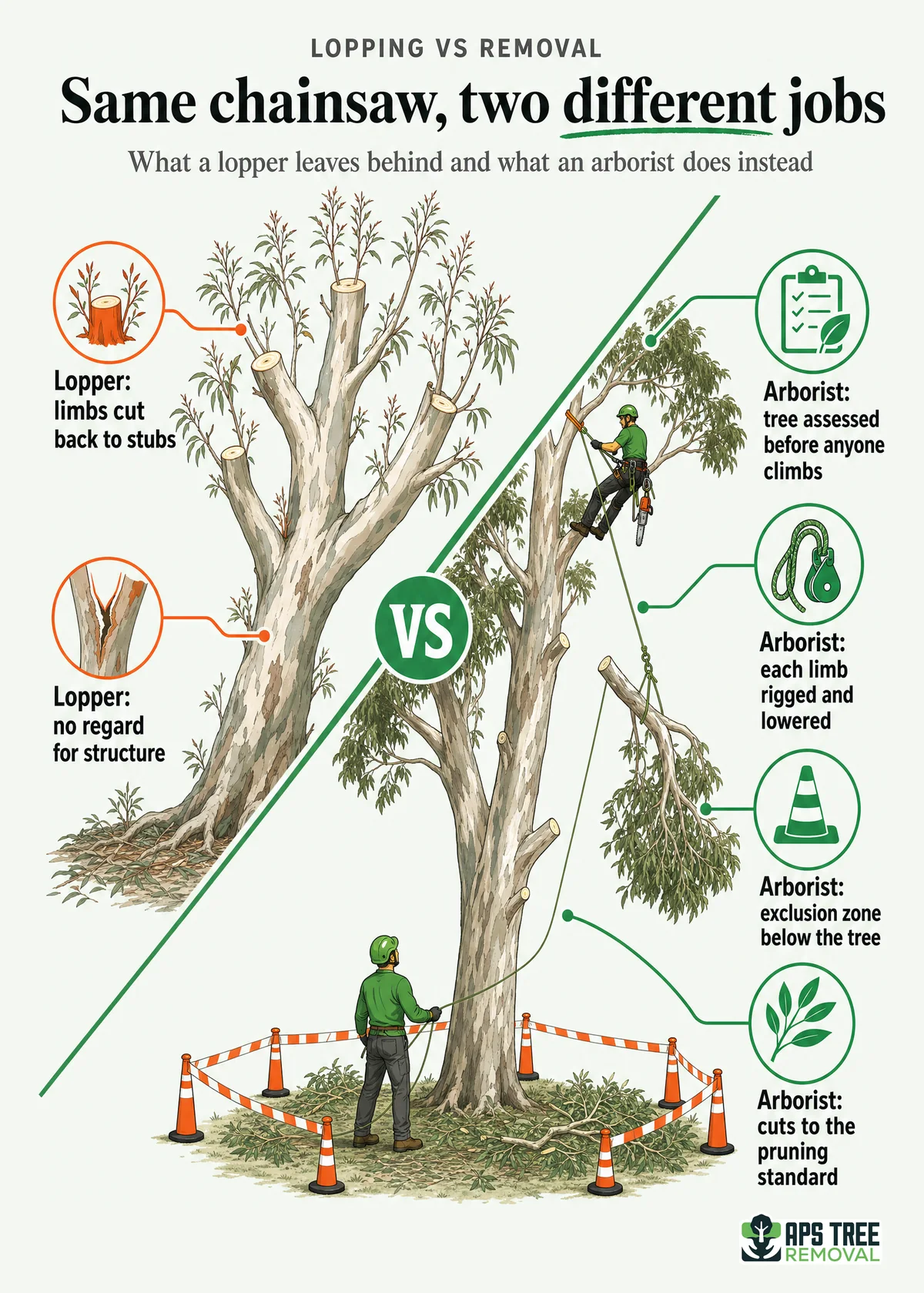
Lopping means cutting a limb back to a stub at whatever point is convenient for the saw, with no thought for how the tree will respond, how the wound will close, or what the rest of the crown will do once that weight is gone. On a big gum the result is a row of bare posts with a mess of weak shoots sprouting from each stub within a season, each one attached at the surface rather than grown from the structure, and each one heavier every year. The stubs do not seal, so decay gets in behind them. A lopped tree is not a smaller tree; it is a tree with more hazards than it started with, and it usually comes down properly a few years later at a higher price.
Arboriculture is the opposite discipline. Australia has a standard for pruning amenity trees, AS 4373, which specifies the methods for making a cut and sets out correct and uniform practice; it was published in 2007 and reconfirmed in 2020 [1]. Every cut a qualified arborist makes on a living tree, whether it is a light reduction or the first cut of a full removal, is placed where the standard says it should go, so the tree either recovers cleanly or comes apart under control. A lopper's cut lands wherever the saw reaches, and that is the practice the standard's methods exist to replace.
The law draws the same line. Victoria's canopy-tree planning clause, in force since 15 September 2025, requires a permit to remove, destroy or lop a canopy tree in the circumstances it lists, putting lopping in the same sentence as destroying the tree [2]. That tells you how the planners see a lopped tree.
The difference between a lopper and an arborist
What an arborist does
- Assesses the tree's condition and structure before anyone leaves the ground
- Prunes or dismantles to the pruning standard, cut by cut
- Rigs heavy limbs on ropes so they land where planned
- Sets an exclusion zone under the tree and keeps people out of it
- Carries a trade qualification and a certificate of currency for insurance
What a lopper does
- Cuts limbs back to stubs wherever the saw reaches
- Leaves the tree to sprout weak growth from every wound
- Drops limbs and hopes the fence is not under them
- Works off a ladder because it is quicker than climbing
- Has a chainsaw, a ute and a phone number, and not much else
Because "tree lopping" is still what most people in Melbourne type when they want a tree gone, plenty of genuine arborists advertise under the word, so the word alone does not condemn anyone. What separates the two trades is everything after the phone call: whether the tree is inspected, how it is cut, what is under it, and who is carrying the risk.
Professional tree removal: how a professional crew brings a tree down
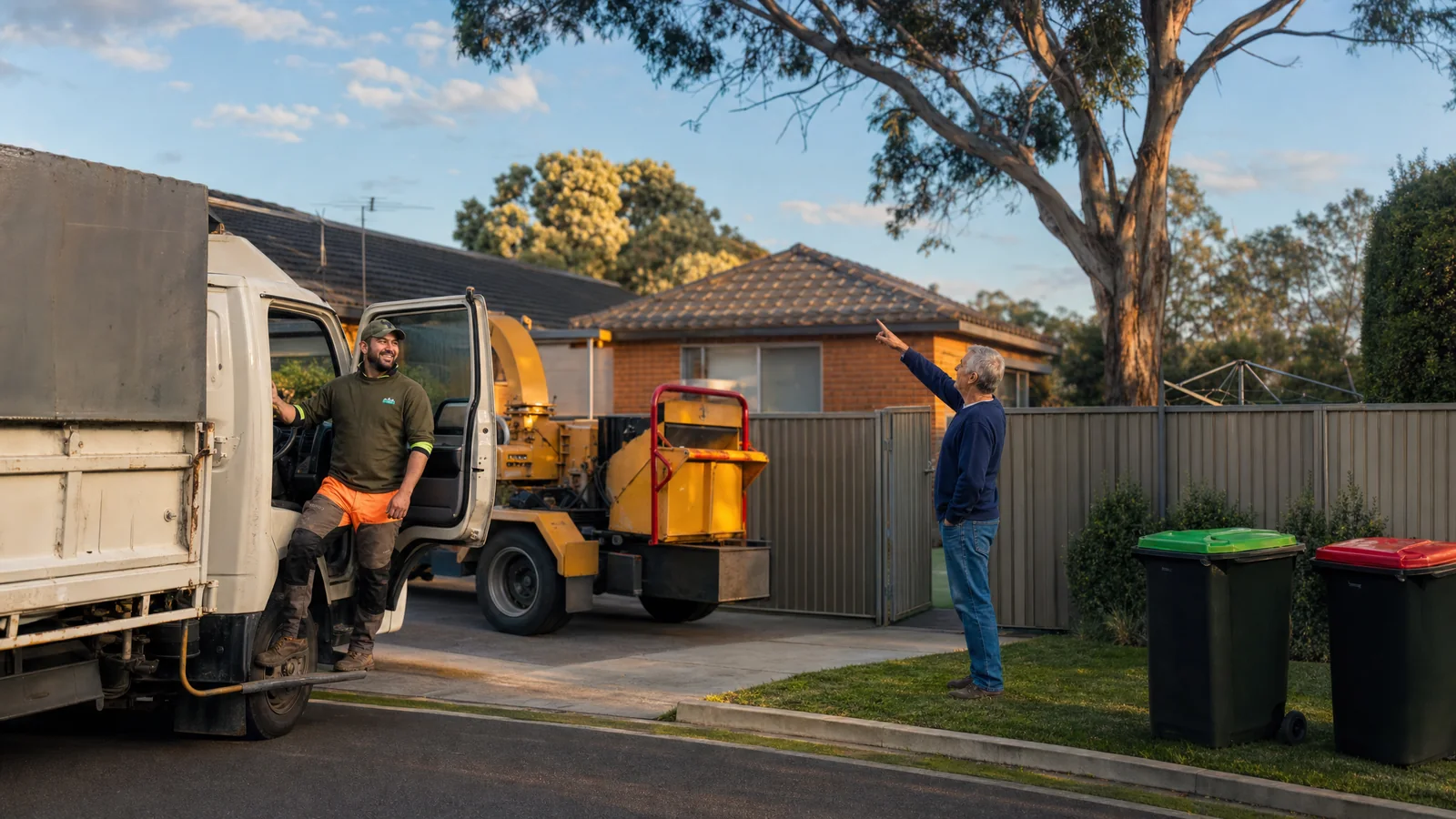
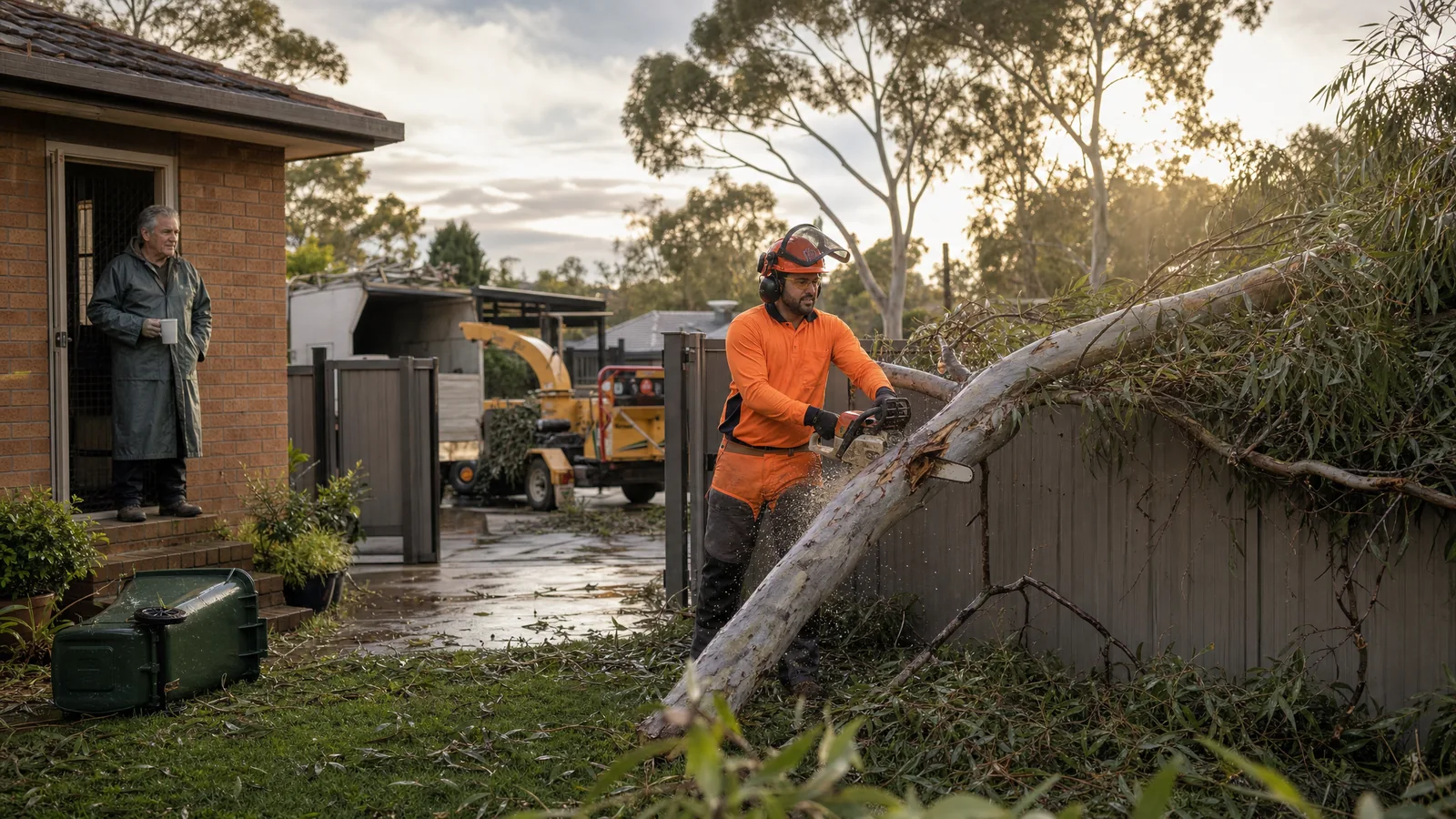
The mental picture most people have of tree removal is a felling cut and a big tree hitting the ground. In a Werribee or Point Cook backyard with a house on one side, a Colorbond fence on the other and a neighbour's carport behind, nothing gets felled. The tree is taken down from the top, piece by piece, and every piece is either dropped into a clear zone or lowered on a rope. That is sectional dismantling, and it is what you are paying a professional crew for.
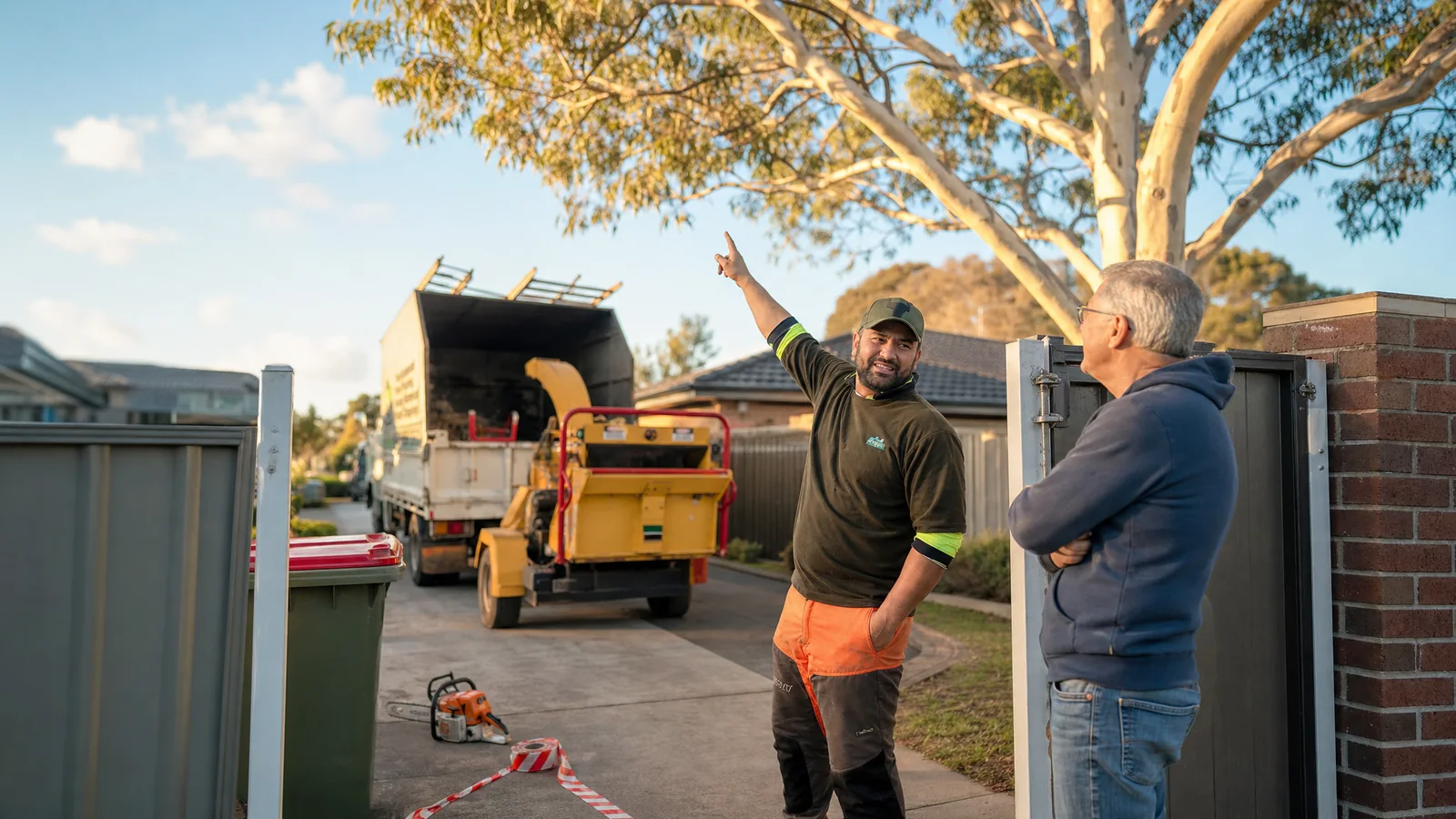
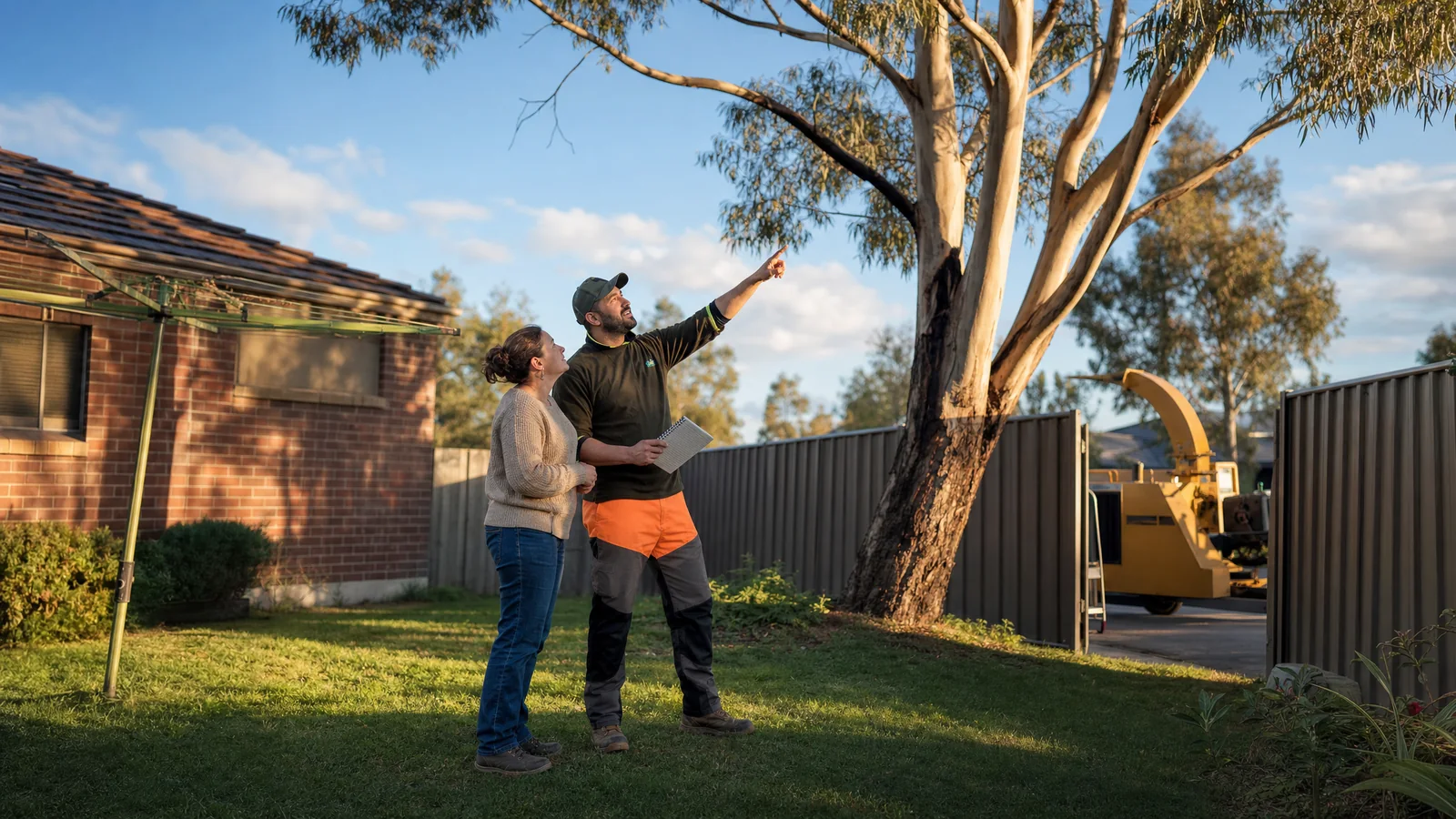
Safe Work Australia's guide to tree work spells out the two things that happen before anyone goes up: a visual assessment of the tree's condition and structural integrity by a competent person such as a qualified arborist, and an exclusion zone below and around the tree with signs, physical barriers and supervised access [3]. WorkSafe Victoria's guidance makes the same point, stressing planning and preparation and the need to inspect each tree individually to work out the safest method for the job [4]. A dead limb, a split fork or a hollow trunk changes how a tree can be climbed, and the crew has to know that from the ground.
How a professional crew brings a tree down
- 1AssessApi walks the tree from the ground: the lean, the deadwood, the forks, and what sits underneath and beside it. This decides whether it is climbed or reached from a platform.
- 2Set the siteThe drop zone is cleared and taped off, the chipper and truck get as close as the access allows, and the ground crew knows where to stand.
- 3Get upOn a sound tree the climber goes up on ropes and a harness, tied in at all times. On a tree that cannot be climbed safely, an EWP does the same job from a basket.
- 4Take the crownSmall limbs drop into the clear zone. Anything that could reach the house, the fence or a line is cut, held on a rigging rope and lowered to a chosen spot.
- 5Block the trunkWith the crown gone the trunk comes down in short sections, each one dropped or lowered so the base stays under control.
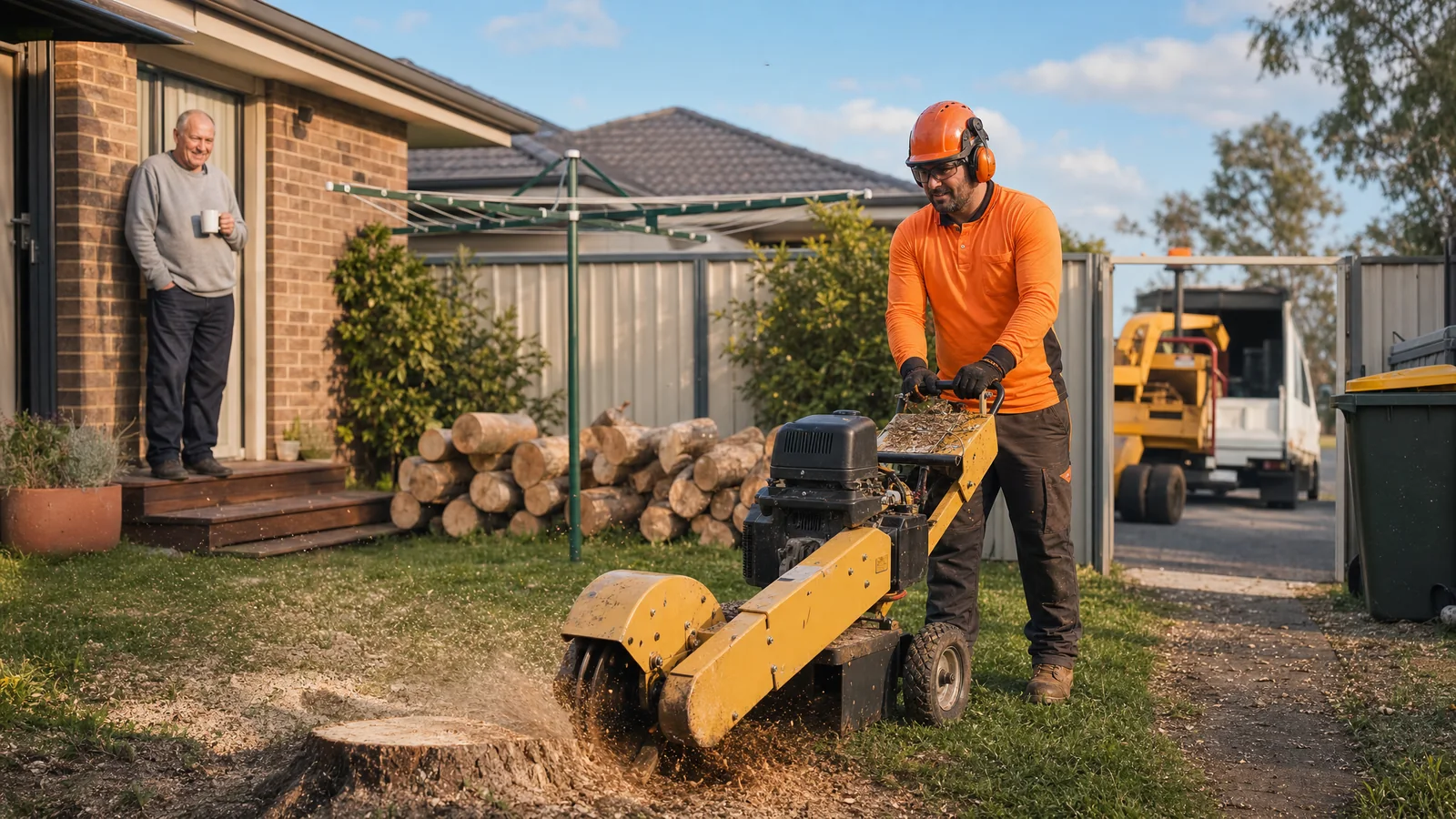
- 6Chip and grindBranches go through the chipper, the timber is stacked or removed, and the stump is ground out below ground level if it is in the quote.
The rigging is the part that looks like magic from the back step and is really just physics and practice. A limb over the roof gets a rope attached above the cut, run through a friction device at the base of the tree, and held by a ground worker who lets it down at walking pace. Nothing free-falls over anything that matters.
Api and his team tackled a 20m high gum tree situated in very precarious position on my property and to watch the boys bring it down piece by piece was magical, from houses to fences and everything in between in there way they managed to remove it with absolute precision. I could not recommend this business anymore. Absolute utter professionals. Thanks again guys much appreciated.
That job shows why what is under the tree drives the method, and why the method drives the price. hipages puts the top end of tree removal at $10,000 or more precisely for the case where a large tree must be removed from the top down and branches cannot be allowed to fall to the ground [5]. The extra money is not the tree; it is the hours of rigging that keep the house intact. The tree removal cost guide walks through how the size, the access and the hazards combine into a number.
The gear, and why it is more than a ladder and a chainsaw
Ask a lopper what they climb with and the answer is often a ladder. Safe Work Australia is blunt about that: there are significant risks in accessing trees using ladders, and tree trimming or removal work should not be done from ladders [3]. A ladder leaning on the limb you are about to cut has nothing holding it up a second later.
Professional tree removal runs on three sets of gear, and each one exists because of a specific way people get hurt. The first is climbing gear: harness, ropes, friction devices and spikes for removals, with the climber tied in at all times so that a slip is a swing rather than a fall. The second is the EWP, or cherry picker, which Api brings in when a tree cannot be climbed, usually because it is dead, split or otherwise unsound. hipages gives an indicative rate of around $170 an hour for a truck hoist, which is why a platform is used when the tree demands it rather than by default [5]. The third is the chipper, on Api's crew a Vermeer BC900 that turns a crown into mulch on the day. Safe Work Australia lists the woodchipper's own hazards, including being drawn in by the in-feed rollers, contact with the blades, entanglement in branches or ropes and being struck by ejected material, and says the operator should stand to the side of the chute, feed tree waste butt end first and use a push-stick for short branches [3].
Then there is what the crew wears. Chainsaw operators should have cut-resistant leg protection and hearing protection as a minimum [3]. It sounds basic, and it is exactly the kind of basic that is missing on a cheap job, where the person running the saw is in shorts.
Absolutely fantastic service! Very quick, efficient, and super professional - Api and his team is the best for any tree job. He was able to prune and take down trees in very tricky narrow and up high places. Left the place tidy and they are just great people and professionals pleasant to deal with. Highly and absolutely recommend! Hire them without any hesitation. They are the arborists you can trust.
Narrow and high is where the gear earns its keep. A tree hemmed in by a house, a fence and a shed cannot be dropped anywhere, so it is climbed, rigged and lowered in small pieces, and each piece is walked out through the side gate to the chipper. The tools make that possible; the training makes it safe.
The numbers behind the price of professional tree removal
The safety talk is not marketing. WorkSafe Victoria published a coroner's finding that 31 people died in Victoria from tree felling or related activity between January 2012 and September 2018, and that 13 of those deaths happened at work [4]. The update followed the death of a worker killed by a falling branch while cutting down a tree at Lal Lal, near Ballarat, in 2017 [4]. WorkSafe's guidance note on working safely with trees opens by saying that every year workers in the amenity tree industry are killed or seriously injured, and it covers the risks a crew manages daily: planning, overhead powerlines, working at height, chainsaws, falling objects, wood chippers and emergency procedures [6].
What the safety record says
Read the second number again. Thirteen of 31 means 18 of those deaths were not at work. The finding does not say who those people were, but the obvious reading is people cutting trees on their own property or helping someone else with theirs. That is the DIY and lopper end of the trade, and the gap between the cheapest quote and the rest is usually the cost of the things that keep that number from growing: the second person on the ground, the rope, the platform, the insurance, and the hour spent assessing the tree before the saw starts.
Why this matters to you, not just the crew
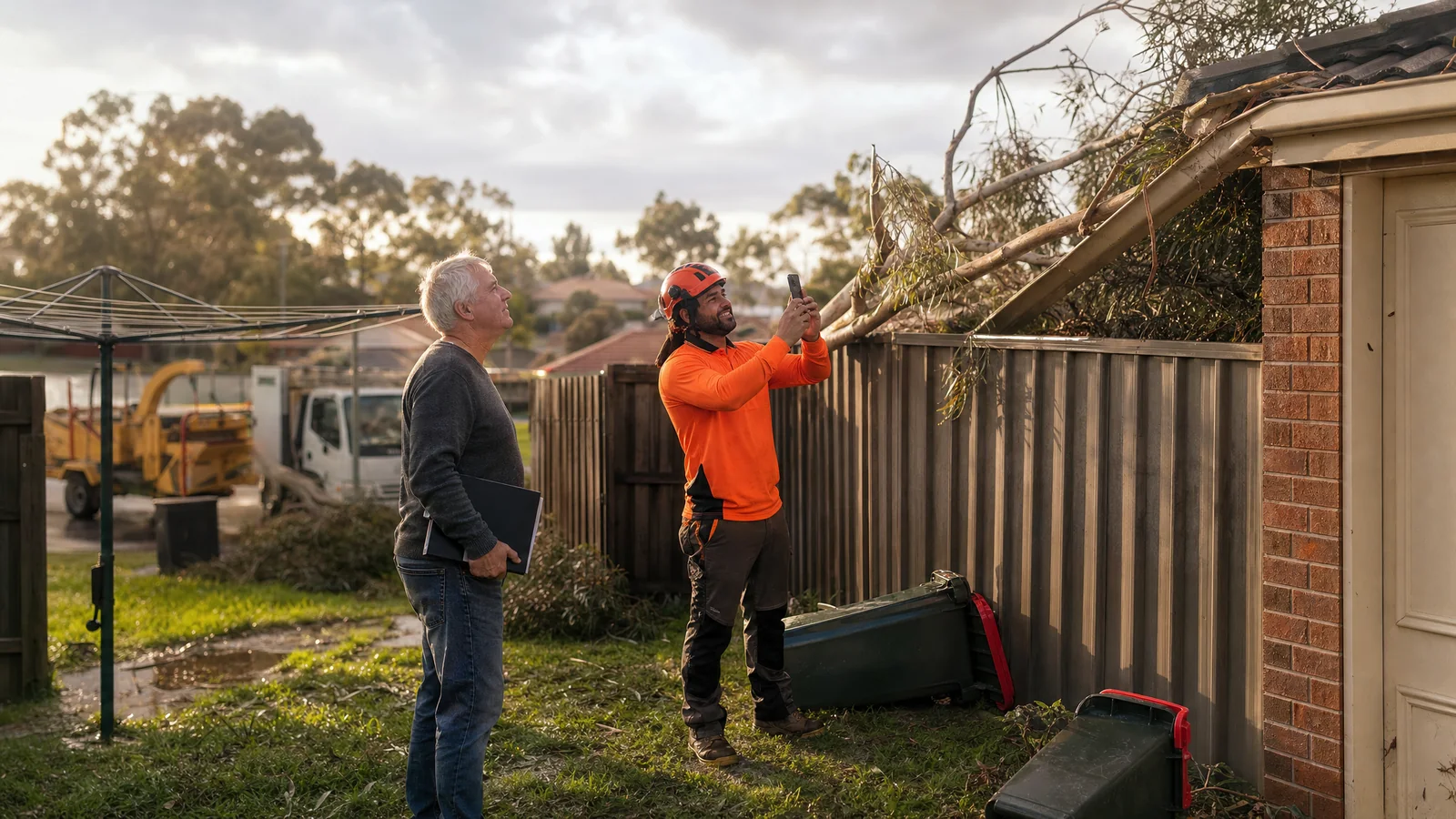
When a worker is hurt on your property, or a limb goes through a neighbour's roof, the question becomes who is insured. A contractor with public liability cover carries that. A lopper without it leaves you to sort it out with your own insurer and, sometimes, your neighbour's lawyer. Consumer Affairs Victoria's standing advice for any home job is to ask to see a certificate of currency for public liability insurance before work starts.
Powerlines: the line a lopper crosses without knowing
Much of Melbourne's west still has its power overhead, and the service line to the house comes off the street pole and lands on the fascia, often straight through the canopy of whatever was planted decades ago. That line is where a lot of cheap tree work goes badly wrong.
Energy Safe Victoria's rule is simple: only authorised powerline pruning contractors should prune trees that are touching or close to power lines [9]. For the insulated service line to your own house, keeping the tree clear is your responsibility, and the pruning should be done before the tree grows to within one metre of the line in any direction [7]. Trees near the powerlines outside your boundary, and near the service line to a neighbour's house, are the electricity distributor's job to clear, not yours and not your arborist's [7].
The physics is why. Safe Work Australia notes that contact with an electric line can be fatal whether it carries 400,000 volts or 230, that you do not have to touch a line to be electrocuted, and that a flashover or arc can reach a person who is merely close to a conductor [3]. Energy Safe Victoria adds a detail that catches people on hot days: powerlines sag in the heat, so the gap between a limb and a line can be smaller than it looks [10]. If someone does hit a line, stay at least eight metres away and call 000 [10].
A qualified arborist prices this in before the job. Api looks for the service line on the quote visit, tells you if the tree needs the line dropped or an authorised contractor for the part near the wire, and plans the rigging so no limb swings towards it. A lopper finds the line with the saw.
Got a tree you want taken down properly rather than hacked? Api quotes on site for free, 7 days from 6am, and explains the method before a cut is made.
Why DIY tree removal goes wrong
Every arborist has been called to finish a job the owner started. The pattern is the same each time, because the tree in the backyard looks a lot more manageable from the kitchen window than it does from twelve metres up it.
| The DIY move | What actually happens | What a professional crew does instead |
|---|---|---|
| Climb a ladder with a chainsaw | The limb shifts as it is cut, or the ladder does; Safe Work Australia says tree work should not be done from ladders at all [3] | Climbs on ropes, tied in at all times, or works from an EWP |
| Fell the whole tree at the base | The tree goes where its weight and the wind decide, and takes the fence with it | Dismantles from the top down in sections, each one dropped or lowered to a chosen spot |
| Cut a heavy limb off in one piece | It swings back into the trunk, the climber or the roof, because nothing is holding it | Rigs the limb on a rope above the cut and lowers it at walking pace |
| Work near the service line | A flashover from a line does not need contact to kill [3] | Identifies the line first and brings in an authorised contractor for anything close to it |
| Do it on a windy Saturday | The wind moves the limb and the drop; Energy Safe Victoria's advice is to avoid pruning in high winds [9] | Reschedules, because the tree will still be there on Monday |
The storm case deserves its own word, because that is when the temptation is strongest. VICSES responds to around 20,000 requests for assistance from storms each year, close to 80 per cent of everything it attends, and much of the damage is tree branches becoming projectiles, cars parked under trees and overhanging branches coming down [11]. The SES also warns that heat, fire and recent storms can leave a tree unstable and more likely to fall [11]. When a limb splits over the roof at ten at night, the job is a make-safe, not a removal, and it is emergency tree removal work that a crew with the right gear does from the ground in the dark and finishes in daylight. Api takes storm calls 7 days from 6am and prioritises hazards; he does not send anyone up a wet tree in the wind, and neither should you.
A lopped tree is not a smaller tree. It is a tree with more hazards than it started with, and it usually comes down properly a few years later at a higher price.
What "qualified arborist" actually means
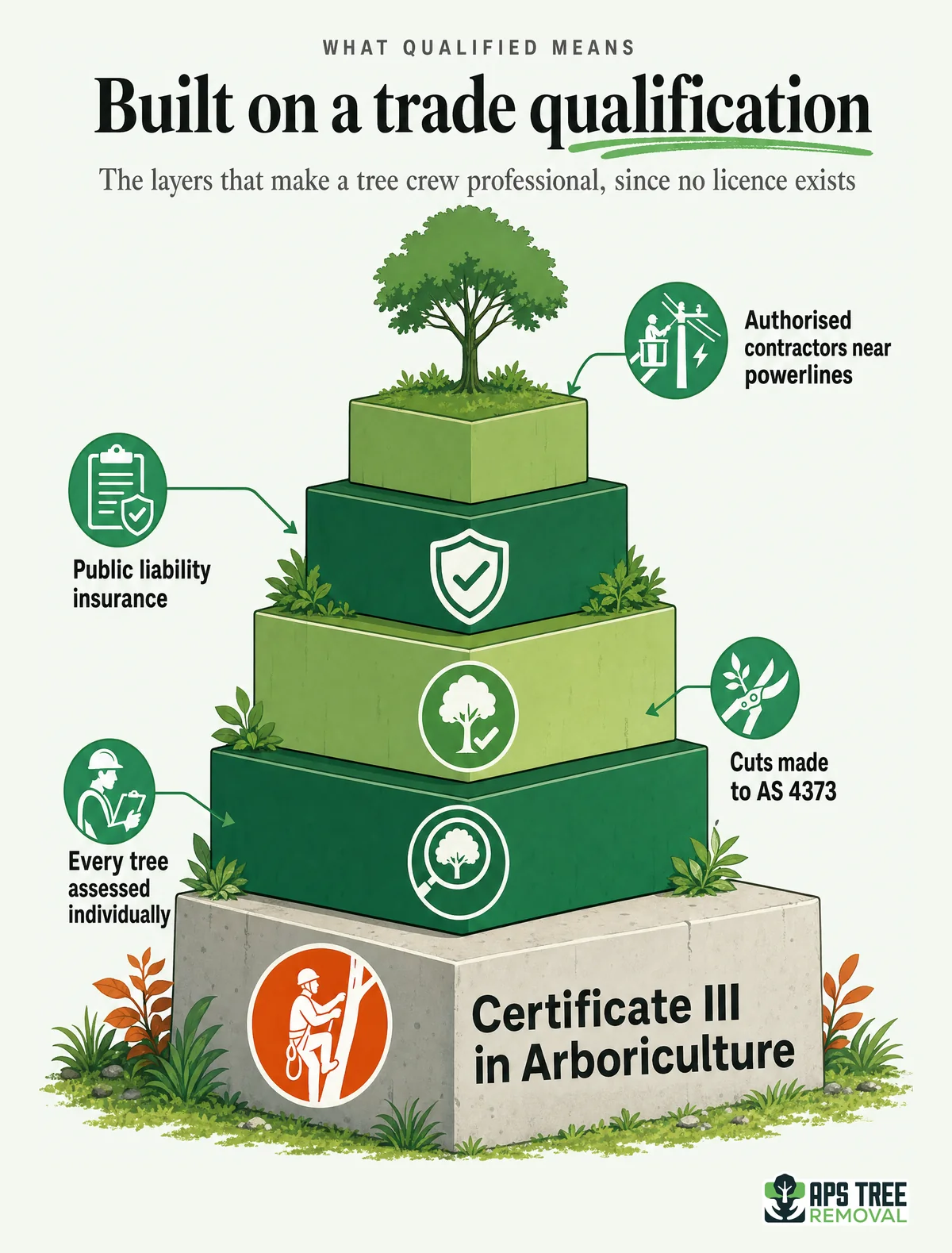
Here is the part that surprises most homeowners: arborists are not licensed in Australia. hipages says it directly, and it is why the site tells readers to be careful choosing one [5]. There is no licence number to look up and nothing stopping anyone with a chainsaw from calling themselves an arborist, a tree surgeon or a lopper. So the checks that matter are the qualification, the insurance and the industry body, because those are the things a person cannot simply claim.
The qualification is the Certificate III in Arboriculture, AHC30820, which training.gov.au describes as the trade-level qualification for climbing arborists, EWP arborists, crane specialists and works coordinators, covering canopy management, tree health, and tree dismantling and removal, in work that involves high-risk operations at height [12]. hipages draws the line the same way: a Certificate II in Horticulture (Arboriculture) for basic work and a Certificate III for the tricky jobs, alongside public liability insurance and membership of a body such as Arboriculture Australia [13]. Arboriculture Australia, the national industry body, says the trade's skills shortage is at critical levels, and it is proposing an industry verification system that recognises arborists on qualifications, experience and conduct [14]. Until something like that exists, the homeowner does the verifying.
Api is a qualified arborist, is fully insured, and has spent more than 16 years doing the climbing, which is why he is comfortable calling his work professional tree removal rather than lopping. He will show you the paperwork on the quote visit without being asked twice. If the person quoting your job cannot, that is your answer.
Before you hire a tree crew
- Ask whether the person doing the climbing holds a Certificate III in Arboriculture, and who else will be on site
- Ask for a certificate of currency for public liability insurance, and read the expiry date
- Get the tradesperson's full name, physical address and registered business name, not a first name and a mobile
- Get three quotes on the same written description and compare what each one includes
- Ask how the tree will come down, where the drop zone is, and what happens to the timber, the chips and the stump
- Ask whether the service line has been looked at and whether any part of the job needs an authorised powerline contractor
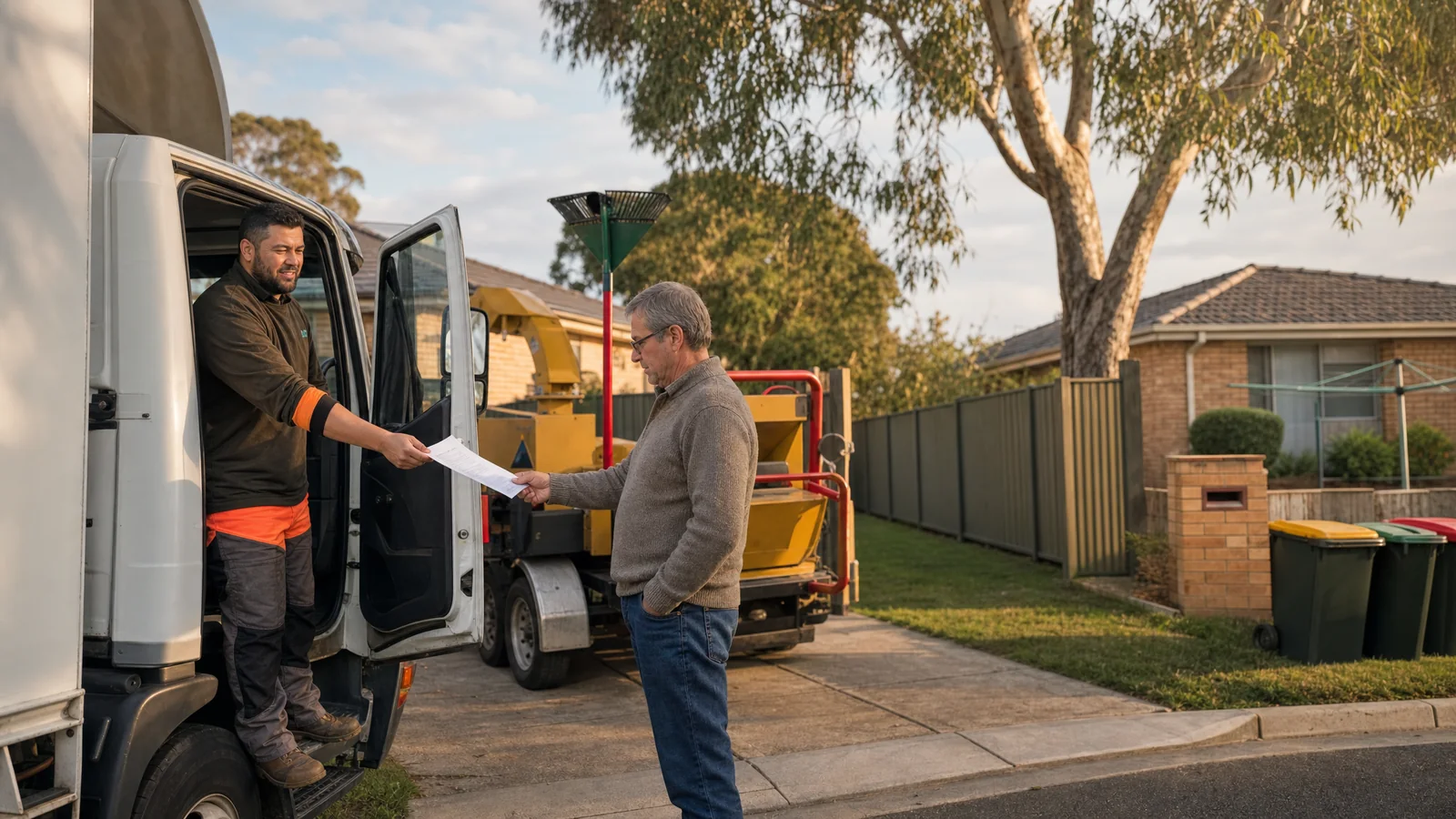
Most of that list comes straight from Consumer Affairs Victoria's checklist for smaller home jobs: three quotes on the same detailed description, a written contract even for small work, the tradesperson's full name and a physical address rather than a post office box, the certificate of currency, and a warning about people who knock on the door or telephone unexpectedly offering a cheap deal [8]. The rest is tree-specific, and it takes five minutes on the phone. A search for tree removal near me will give you the names; the list is how you sort them. There is more on the phone questions and what a good written quote looks like in the guide to choosing a local tree company.
When the tree does not need to come down at all
The final difference between a lopper and an arborist is the advice. A lopper sells the cut. An arborist reads the tree and tells you whether it needs a reduction, a deadwood prune, a lift over the driveway, or the whole thing gone, and prices the option that fits. Api quotes a prune instead of a removal on plenty of visits, because a healthy tree with one bad limb is a pruning job, and because the canopy-tree clause means a tree more than five metres tall, with a trunk more than half a metre around at 1.4 metres above the ground and a canopy at least four metres across, can need a planning permit to remove, destroy or lop when it sits near a boundary on a residential lot [2]. Api checks the council position on your title before the quote, and if a prune to the standard solves the problem without a permit, he will say so.
That is a reduction, not a lop. A reduction takes the crown back to growth points chosen so the tree keeps its shape and the wounds close; a lop takes it back to stubs. From the street the two can look similar for a month. A year later one is a tree and the other is a problem.
What our crew does on a removal
Every job through our tree and palm removal service starts with Api on site, looking at the tree, the access, the lines and what sits underneath. You get a fixed written price that covers the removal, the chipping, the clean-up and the green waste unless it says otherwise, with the stump listed separately so you can see what it adds. The crew that quotes is the crew that turns up, fully insured, with the climbing gear, the rigging, the EWP where the tree needs one and the chipper on the truck. The site is taped off, every piece that could reach something is lowered rather than dropped, and the block is left cleaner than it was found.
That is what professional tree removal is. It is not a bigger chainsaw or a fancier ute. It is a qualified person deciding, before anything is cut, exactly how a tree will come apart, and then making it happen in that order.
How you get a tree taken down safely, to the standard, with nothing damaged
Getting a tree taken down safely, to the standard, with nothing damaged does not have to be complicated. At Aps Tree Removal we look at the job with you, tell you what actually needs doing and what does not, and put a fixed price on it before anything is cut.
No pushy sales. Api comes out, walks the property with you, explains the options and what each one means for the result, the risk and the price. You decide at your own pace. People choose us because they understand the job before they book it, and the crew that quotes is the crew that turns up.
We will tell you if a council permit applies and what the process is, we will point out anything near powerlines or the neighbour's boundary that changes the method, and we will say plainly when a cheaper option is the better one. Every job is done by a qualified arborist, fully insured, and the site is left cleaner than we found it.
Get in touch today. Api quotes for free, 7 days, 6am to 5pm, across Melbourne's west, the inner city and Geelong.
How we work with you
We talk and answer your questions
Call 0422 856 090 or send the form. Api asks what is worrying you about the tree, hedge or stump, what access is like, and whether anything sits near powerlines or a fence line.
We look and give you a fixed price
Api visits, inspects the tree or hedge, checks the permit position for your council, and quotes in writing. The price covers the job, the clean-up and the green waste unless we say otherwise.
You decide what works best
Remove, reduce, prune or wait: we explain the difference and what each costs. No pressure, no expiring offers. The choice is yours.
We do the job and stay in touch
The crew arrives when we said, works to the plan, and leaves the site clean. If the tree throws a surprise on the day, we tell you before we change anything.
Frequently asked questions
What is professional tree removal and how is it different from lopping?
Professional tree removal is a tree taken apart by a qualified arborist in a planned order: assessed from the ground, climbed or reached from a platform, dismantled in sections with the heavy pieces lowered on ropes, then chipped and cleared. Lopping is cutting limbs back to stubs wherever the saw reaches, with no regard for the tree's structure or what is underneath. Same tool, completely different job.
Is tree lopping illegal in Melbourne?
Lopping is not banned outright, but Victoria's canopy-tree planning clause treats lopping a canopy tree the same as removing or destroying it, so in a residential zone near a boundary a permit can be needed for either. Api checks the council position on your title before quoting. Beyond the law, lopping is simply not how a qualified arborist works, because it leaves stubs, weak regrowth and decay.
Do arborists need a licence in Australia?
No. There is no arborist licence in Australia, so anyone can use the word. The checks that matter are a Certificate II or III in Arboriculture, a current certificate of currency for public liability insurance, and membership of an industry body such as Arboriculture Australia. Ask for all three before anyone climbs.
Can I remove a tree myself to save money?
Safe Work Australia says tree trimming and removal should not be done from ladders, and WorkSafe Victoria reported 31 deaths from tree felling in Victoria over six and a half years, more than half of them away from work. A small shrub is one thing. Anything you need a ladder or a rope for, or anything near a service line, is a job for a crew with the gear and the training.
How does a professional crew actually bring a tree down?
Api assesses the tree from the ground, clears and tapes off a drop zone, then climbs on ropes or works from an EWP if the tree cannot be climbed safely. The crown comes off first, with anything that could reach the house or fence rigged and lowered by the ground crew, then the trunk is blocked down in sections, the branches go through the chipper and the stump is ground if it is in the quote.
Can any arborist work on a tree near powerlines?
No. Energy Safe Victoria says only authorised powerline pruning contractors should prune trees touching or close to power lines. For the insulated service line to your own house, the tree is your responsibility and should be kept more than a metre clear. Api looks for the line on the quote visit and tells you if part of the job needs an authorised contractor.
Will you prune my tree instead of removing it?
Often, yes. A healthy tree with one bad limb or a crown that has outgrown the block is usually a pruning job, done to the Australian pruning standard so the tree keeps its shape and the cuts close properly. Api quotes the option that fits the tree, and a reduction is frequently cheaper than a removal and avoids the permit question entirely.
What should I ask before hiring a tree removal company?
Ask for the climber's qualification, a certificate of currency for public liability insurance, the tradesperson's full name and physical address, and how the tree will come down. Get three quotes on the same written description and compare what each one includes. Be wary of anyone who knocks on the door after a storm with a cheap price if you book today.
Sources
- Standards Australia: AS 4373-2007 Pruning of amenity trees
- Planning Victoria (Department of Transport and Planning): Protecting and enhancing our tree canopy for a greener Victoria
- Safe Work Australia: Guide to managing the risks of tree work (March 2023)
- WorkSafe Victoria: Controlling the risks of working with trees (news, 28 January 2020)
- hipages: How much does an arborist cost? [2026] (updated 6 January 2026)
- WorkSafe Victoria: Working safely with trees (guidance note, 13 January 2020)
- Energy Safe Victoria: Trees and vegetation FAQ (reviewed 16 March 2026)
- Consumer Affairs Victoria: Home improvements costing $10,000 or less: checklist
- Energy Safe Victoria: Managing trees near powerlines
- Energy Safe Victoria: No Go Zones: working around energy assets
- Victoria State Emergency Service (VICSES): Storms: plan and stay safe
- training.gov.au (Australian Government): AHC30820 Certificate III in Arboriculture
- hipages: How much does tree removal cost? [2026] (updated 22 January 2026)
- Arboriculture Australia: Arboriculture Australia (national industry body)
Information about tree work, council permits and insurance changes often, and every property is different: figures here are general guidance and linked pages may change or become outdated. For a price on your own tree, hedge or stump, call Api on 0422 856 090 for a free quote.