By Aps Tree Removal · · Updated
Api Mariner, Qualified Arborist · 20 min read

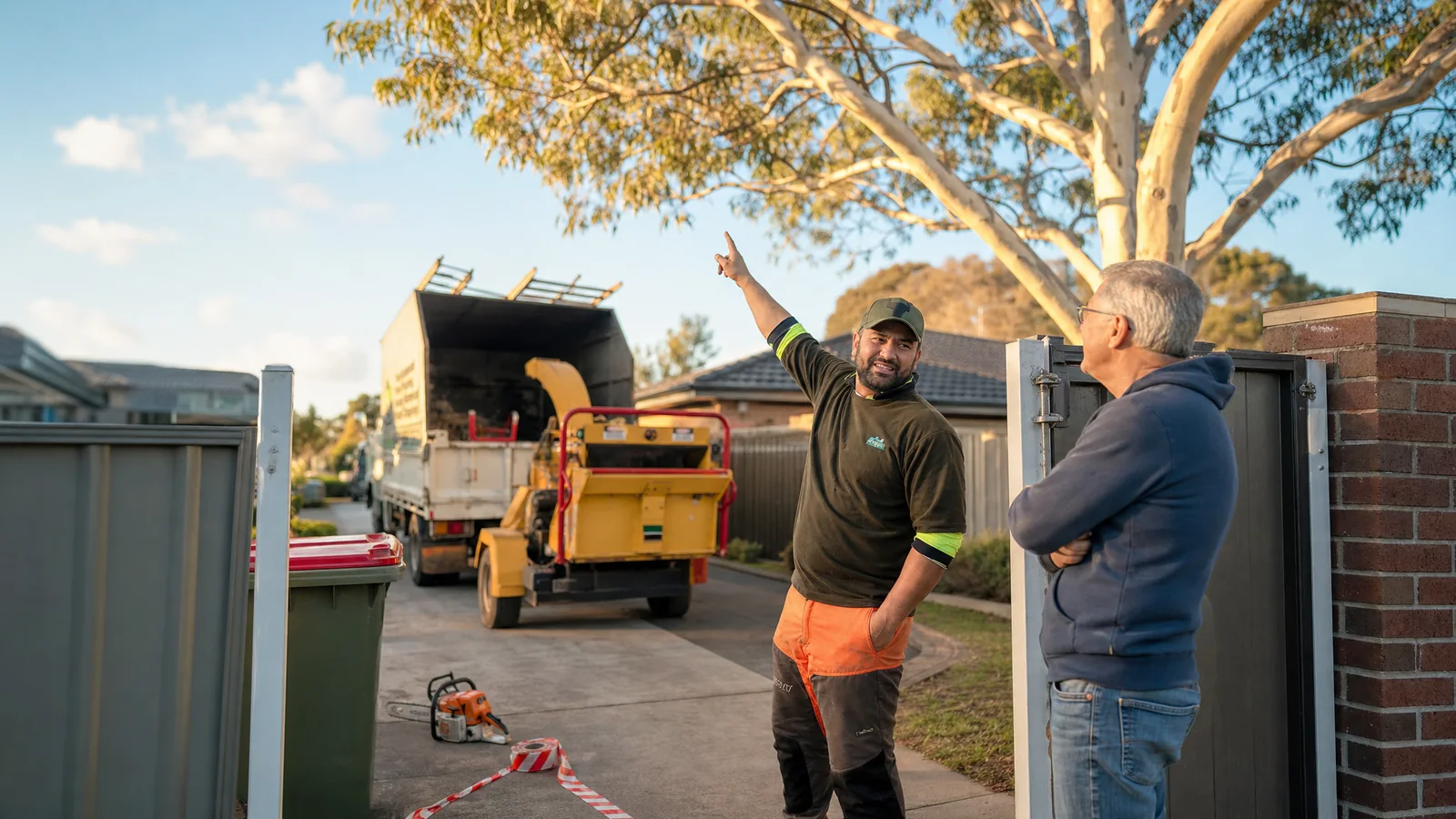
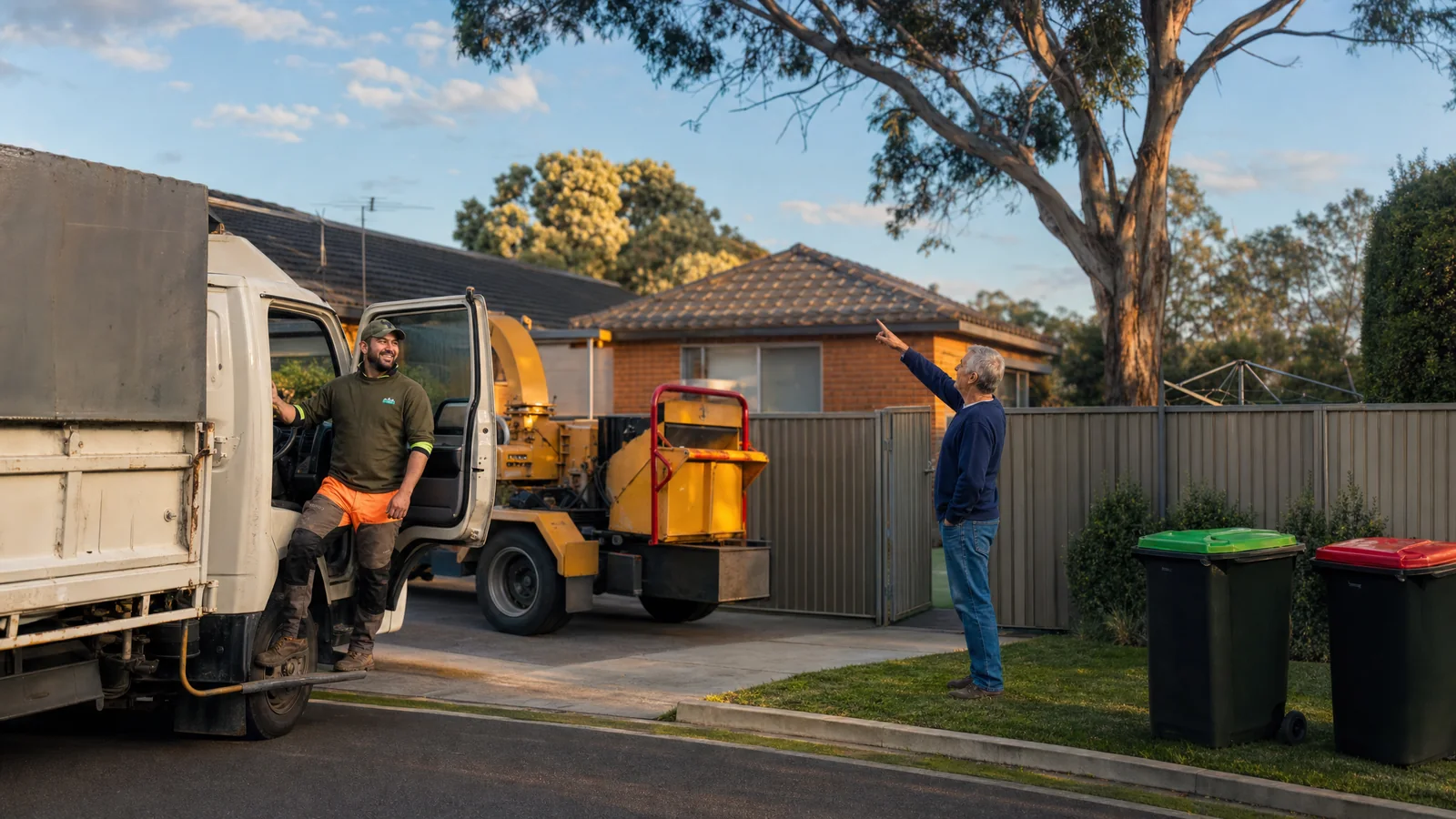
Type tree removal companies into a search from anywhere in Melbourne's west and the first screen is a mix of businesses that are not the same kind of business at all. Some are crews with a truck, a chipper and a person whose name is on the insurance. Some are franchises that sell a territory and send whoever is free that week. Some are not tree companies in any sense: they are lead-generation websites that take your details and sell the enquiry to a contractor who pays for it. From the results page they all look alike. On the day, in your backyard, they are not.
Api Mariner is a qualified arborist who has run Aps Tree Removal for more than 16 years, working Werribee, Point Cook, Hoppers Crossing, Tarneit, Melton, Sunshine, Footscray, the inner city and Geelong. What follows is what a good local company actually does on a removal, what it should already know about your council, and why the person who quotes your tree should be the one who takes it down.
Why the tree removal companies in the search results are not all companies
There are three kinds of name on that first page. The first is a local crew: based in the suburbs it serves, run by a person you can name, with its own truck, chipper and climbing gear and its own public liability policy. When you ring, you speak to the person who will quote, and usually to the person who will climb.
The second is a franchise or a large multi-crew company. Some are very good. The catch is that the person who answers the phone is rarely the person who quotes, and the person who quotes is rarely on the crew that turns up, so a job priced from the driveway by a salesperson is handed to a crew that sees the tree for the first time on the morning of the work.
The third is not a company at all. Lead-generation sites are built to rank for phrases like tree removal companies, collect your name, number and suburb, and sell that enquiry to whichever contractor is buying leads in your postcode. You may get a good operator. You may get three calls from three strangers. Either way, the website has no truck, no chipper and no insurance, and it will not be there if something goes wrong. Consumer Affairs Victoria's advice to be wary of anyone who telephones unexpectedly offering a cheap deal on a job around your home is worth remembering when the callbacks start [1].
Directories and marketplaces are different and have their place: 151 of Api's reviews came through hipages, every one five stars, and a marketplace that shows verified reviews next to a real trading name is a fair way of finding tree removal near you. The test is not where you found the name. It is whether the name belongs to a crew.
The numbers behind hiring a proper crew
Those first two figures are why the rest of this guide exists. The coronial finding behind WorkSafe Victoria's 2020 guidance led it to stress planning, preparation and inspecting each tree individually to decide the safest method for the work [2]. A company that quotes from a photo has not inspected anything.
What a good local tree removal company does on the day
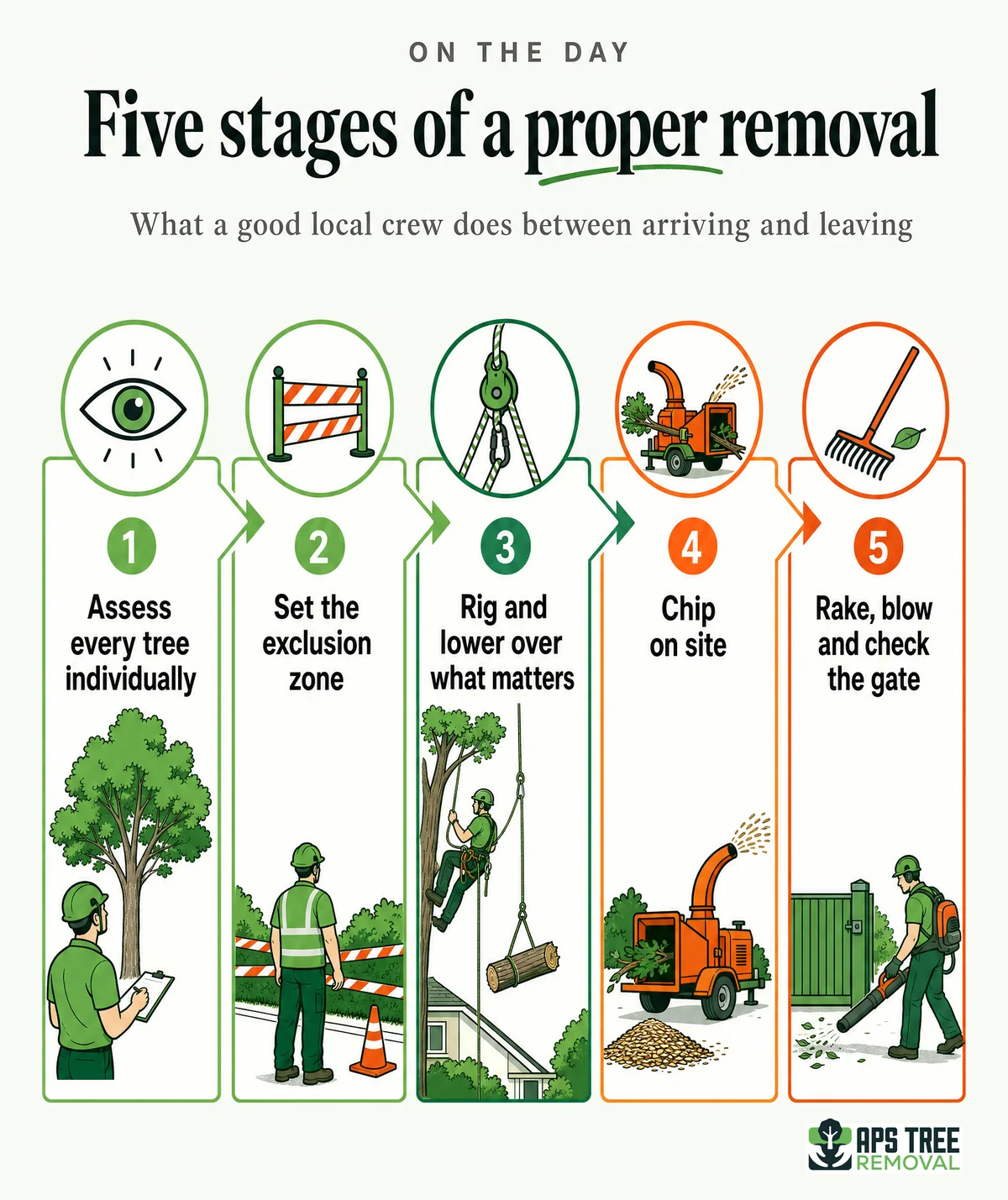
A proper removal has five stages, and each one has a reason behind it.
How a removal day runs with a proper crew
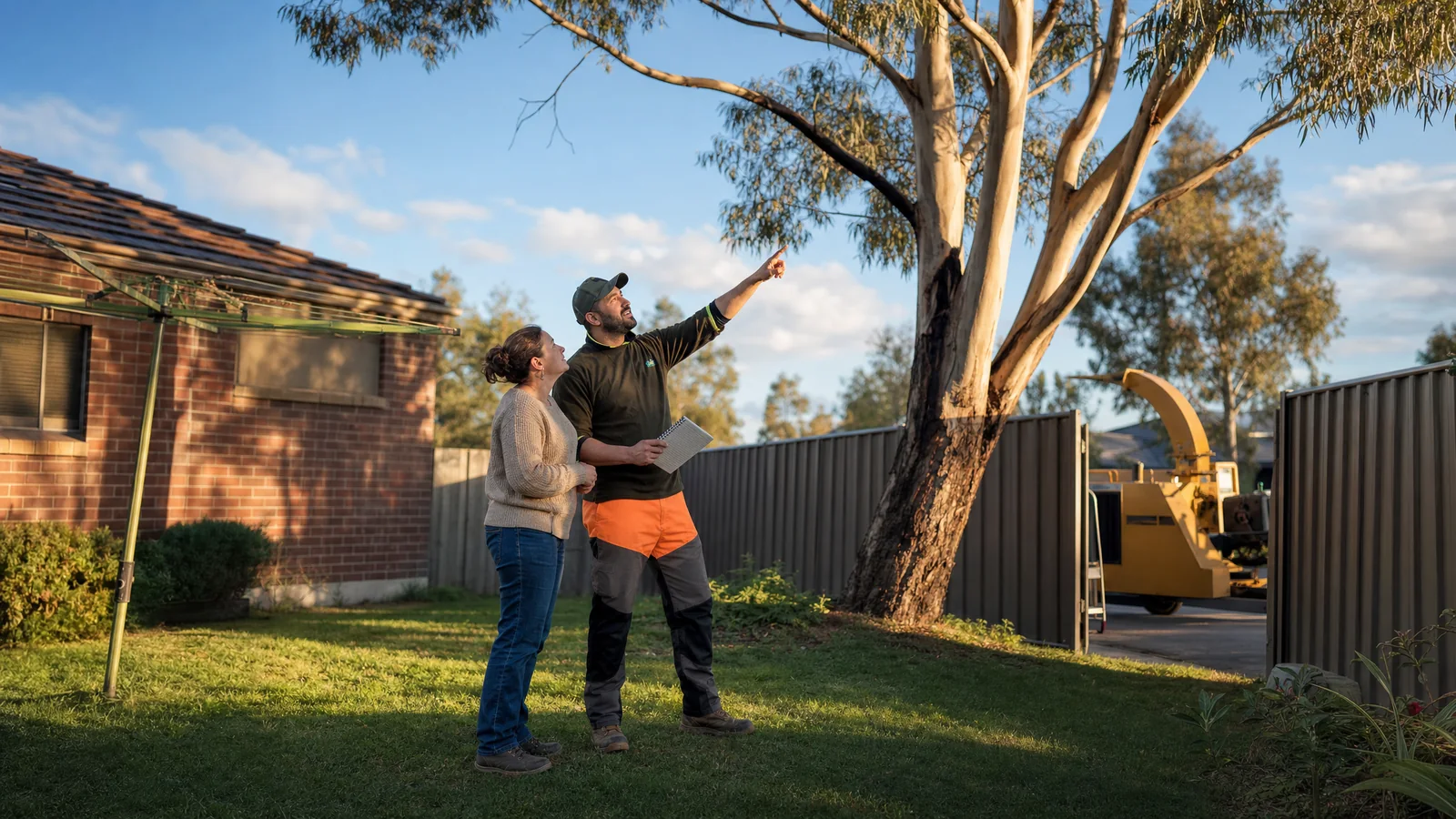
- 1AssessmentThe arborist walks the tree before anyone touches it: condition, lean, dead wood, what it can fall on, where the lines are.
- 2Exclusion zoneThe drop zone is marked and closed. Nobody who is not part of the job stands inside it, the homeowner included.
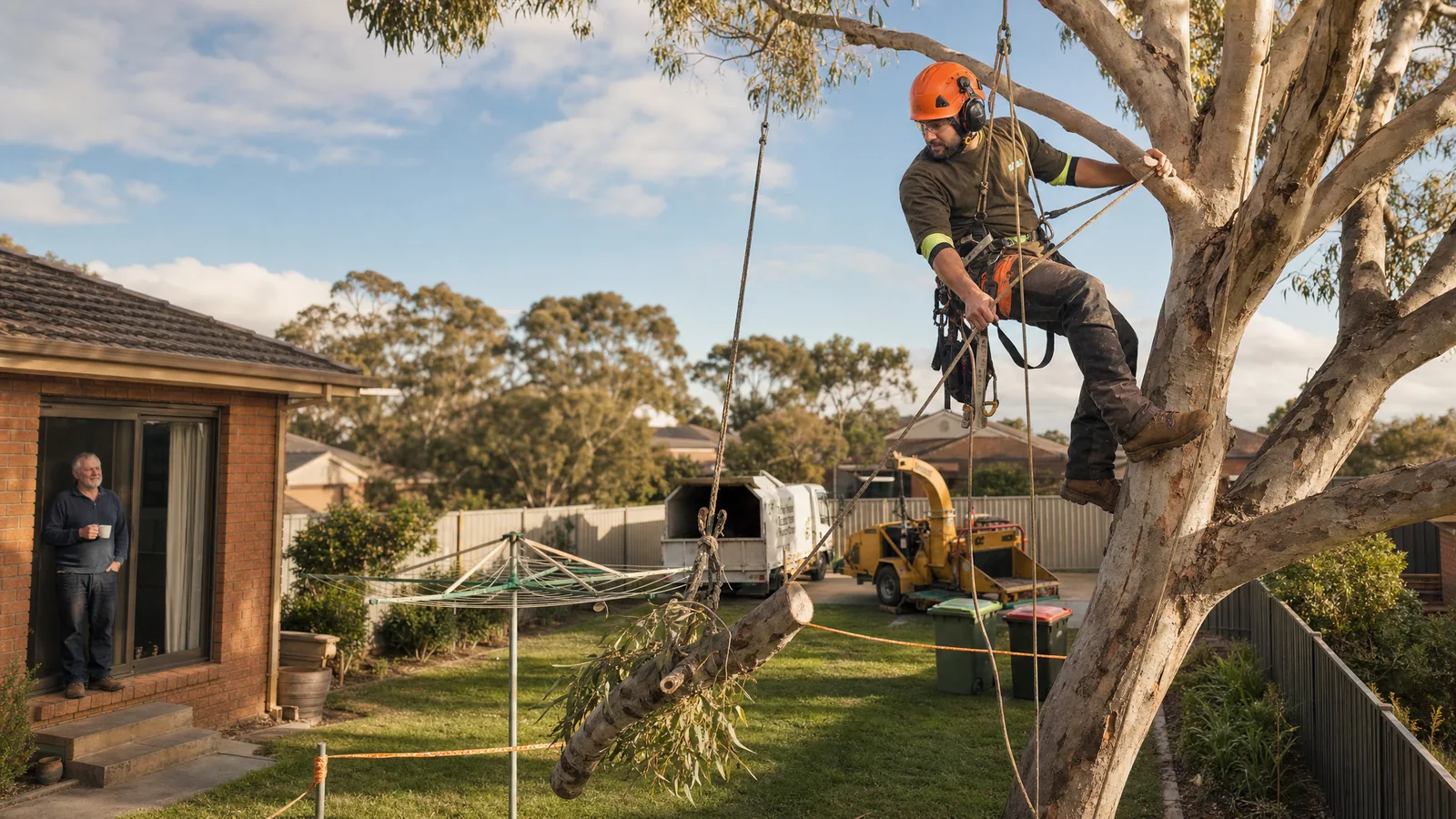
- 3RiggingLimbs over the roof, the fence or the neighbour's shed are roped and lowered in pieces rather than dropped.
- 4ChippingBranches go through the chipper on site, butt end first, with the operator to the side of the chute.
- 5Clean-upLawn raked, driveway blown, mulch left or carted, gate checked before the truck pulls out.
The assessment
Safe Work Australia's guide to tree work says that before anyone works on or accesses a tree, a competent person such as a qualified arborist should visually assess its overall condition and structural integrity [4]. Api does that on the quote visit and the crew does it again on the morning of the job, because a tree can change between the two: a storm, a split limb, a branch that has died back. The assessment decides the method, and the method is what you are paying for. Where a tree cannot be climbed safely, the crew brings in an elevating work platform instead.
The exclusion zone
The same guide calls for an exclusion zone below or near any tree being worked on, with signs, physical barriers and supervised access [4]. On a suburban block that means tape across the side gate, cars off the driveway, the trampoline shifted, and the kids and the dog inside. It looks like fuss until you remember that the finding behind WorkSafe's guidance was the death of a worker killed by a falling branch while cutting down a tree at Lal Lal, near Ballarat, in 2017 [2]. A crew that lets you stand under the tree with a coffee has not set one.
Rigging and lowering
Over open lawn, sections of a tree can be dropped. Over a house, a pool or a boundary fence, every limb is roped and lowered from an anchor point higher in the tree, and the trunk comes down in short lengths. This is where a qualified climber earns the price. Safe Work Australia is blunt that tree removal should not be done from ladders, and that contact with any electric line, whether it carries 230 volts or 400,000, can kill without the line being touched [4]. Trees touching or close to powerlines are for authorised powerline contractors only [3], and a good local crew says so on the quote rather than discovering it on the day.
Chipping on site
A chipper turns a tree into a load you can drive away, and it is the machine the safety guides worry about most: being drawn in by the in-feed rollers, contact with the blades, entanglement in branches or ropes, and being struck by ejected material [4]. The rules are simple: stand to the side of the in-feed chute, feed waste butt end first, and use a push-stick for short branches [4]. Api runs a Vermeer BC900 off the truck, so the green waste is dealt with as the tree comes down rather than piled on your lawn for a second visit, and the chips make good garden mulch if you want them [5].
Clean-up
Clean-up is the part you judge the job on a week later, and the part a subcontracted crew paid by the tree has the least reason to care about. A local company with its name on the truck is paid partly in the recommendation you give your neighbour, so the lawn is raked, the driveway blown, the sawdust out of the pool and the gate shut. Api's quotes include the clean-up and the green waste unless they say otherwise.
Api was easy to deal with - prompt service - professional and good price - left the site clean and tidy - highly recommend
Council knowledge across the west: what a local company should already know
This part of the job happens before the chainsaw starts, and it is where a company that works your suburbs every week is worth more than one covering the whole state from a call centre.
Since 15 September 2025, every Victorian planning scheme has carried clause 52.37, the canopy-tree rule: a planning permit is needed to remove, destroy or lop a canopy tree (taller than 5 metres, a trunk more than 0.5 metres around at 1.4 metres, a canopy at least 4 metres across) anywhere on a vacant residential lot, or within 6 metres of the narrowest street frontage or 4.5 metres of the rear boundary where a house already stands [6]. It applies only in certain residential and mixed-use zones, fast-tracked applications should be decided in 10 business days, and many permits carry a condition to plant a replacement tree [6].
That is the state layer. Under it, each council treats trees on private land differently, and the tree removal companies that quote across all of them should know which rule applies to your block without looking it up.
| Council | Trees on private land |
|---|---|
| Wyndham | No local law, so most exotic garden trees need no council permit; native vegetation normally needs a planning permit under clause 52.17 unless an exemption applies, such as a lot under 4,000 square metres with no tree restriction on the title [7]. |
| Hobsons Bay | Local law protects any tree or palm with a trunk 110 cm or more around at 1.5 metres, stems added together, including one overhanging from next door; the fee is $137, the council asks for 15 business days, and the nature strip tree needs a permit too [8]. |
| Melton | On the Victorian Volcanic Plain, where only about one per cent of the original grasslands survive, so native vegetation is tightly controlled under clause 52.17; a planted exotic near a boundary falls under the state canopy clause [9]. |
| Brimbank | Private trees are the owner's to look after and neighbour disputes are civil matters; trees on the Significant Tree Register are protected, with an infringement per tree [10]. |
| Maribyrnong | A Significant Tree Register adopted in September 2021 lists 73 individual trees and three pairs; a registered tree needs a planning permit to remove or prune significantly [11]. |
| Moonee Valley | Any tree 110 cm or more around at 1.5 metres, or 150 cm at ground level, needs a Tree Removal Permit, and the council may ask for an arborist's or engineer's evidence [12]. |
| Hume | Private land sits outside the council's tree policies, so there is no size test for a garden tree; native vegetation needs a planning permit, and the council's property-information service reports the zones and overlays on an address [13]. |
| City of Melbourne | No authority over private trees except the 268 on its Exceptional Tree Register, where pruning, lopping, removal or works inside the tree protection zone need a planning permit [14]. |
| Greater Geelong | No local law; a 2024 review recommended a state-wide approach, so clause 52.37 is the test, with a replacement tree at least 6 metres tall and 4 metres wide the usual condition [15]. |
Read across the table and the pattern is obvious. In Wyndham, Hume and Geelong a planted garden tree is mostly a state-rule question. In Hobsons Bay and Moonee Valley there is a tape-measure test at 1.5 metres. In Brimbank, Maribyrnong and the City of Melbourne the question is whether your tree is on a register, and in Melton whether it is native. A company that does not know which of those you are in will either quote a job it cannot legally do, or tell you a permit is needed when it is not and charge you for the paperwork. Consumer Affairs Victoria is plain about whose responsibility that is: as the homeowner, it is your job to make sure any planning permit is obtained [1].
Whose job is the permit?
The permit is yours, but the knowledge is the company's. A good local crew does the part you cannot: it knows which council and which clause, it measures the trunk at the right height, and it tells you before the job is booked whether a permit sits in the price. Api checks the council position on your title as part of every quote.
One more thing a company working these suburbs brings up unasked. Where the tree causing the trouble is next door's, the Dispute Settlement Centre of Victoria offers free, confidential mediation between neighbours over overhanging branches, dropped foliage and root damage on 1300 372 888 [16], which is a better first call than a chainsaw at the fence line.
A small local crew versus a big franchise
None of this makes a small company automatically better than a large one. The two are good at different things, and for a residential removal in the west the small crew's strengths line up with what you need.
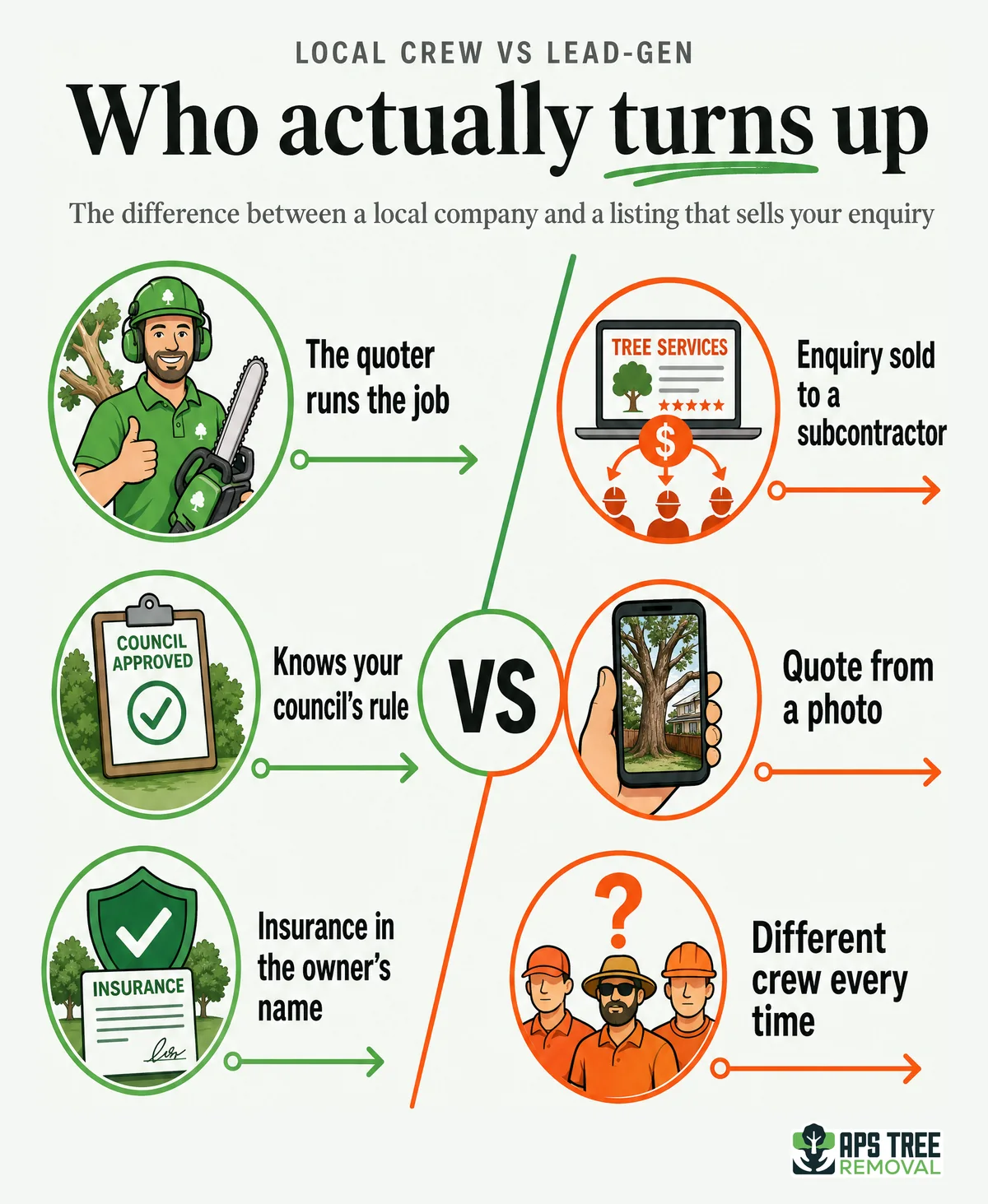
Local crew or franchise and lead-gen listing
What a local crew brings
- The person who quotes is the person on site, so nothing is lost in the handover
- Knows your council's position from last week's job, not a lookup
- Insurance in the owner's own name, with a certificate of currency to show
- Reviews attached to one name, one truck and one crew
- Paid partly in your recommendation, so the clean-up matters
What to watch for with a franchise or lead-gen listing
- A quote from a photo or a salesperson, then a crew that meets the tree on the day
- Your enquiry sold on, so three strangers ring and none of them owns the job
- A trading name with no truck, no chipper and no policy behind it
- A different crew every visit, with no memory of your access or your fence
- A cheap price if you book today, before anyone has looked under the tree
The honest case for a large company is capacity: a 20 metre gum over three properties that needs a crane may be on a bigger outfit's books where a smaller one hires it in. The honest case for a local crew is everything else on the list. Api works with a small crew, and his wife works alongside him on some jobs, which is the opposite of a call centre: the person you spoke to is the person who quoted, and the person who quoted is the person up the tree.
What a job should cost is a separate question, and we cover what tree removal costs in Melbourne in its own guide. The short version is that the cheapest of three quotes is usually the one that left something out, and Consumer Affairs Victoria's advice to understand exactly what each quote covers, because the cheapest may not include some items, applies to trees more than most trades [1].
Want a quote from the person who will actually do the job? Api visits for free, 7 days a week, and the price is fixed in writing before anything is cut.
Why the person who quotes should do the job
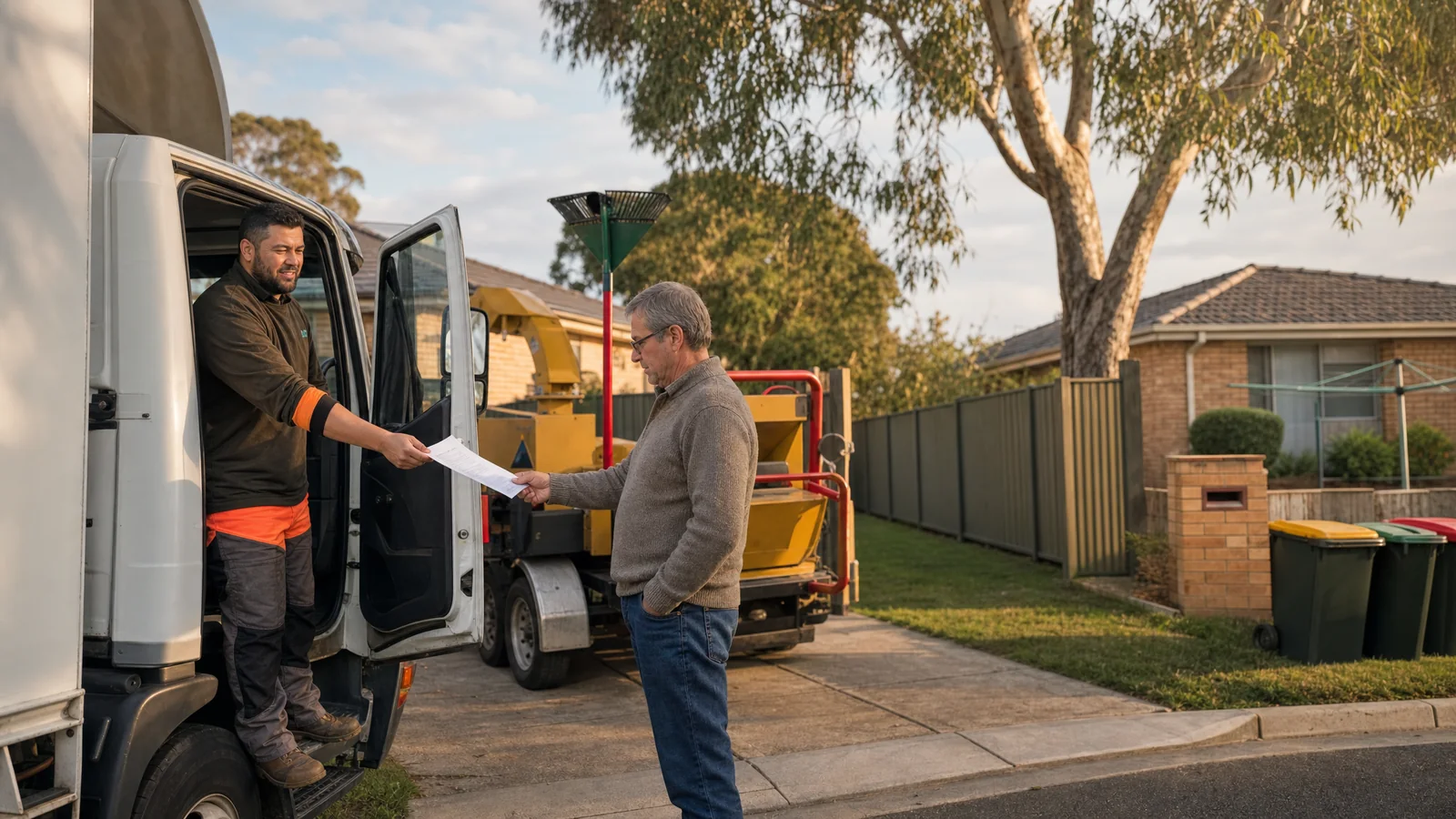
This is the single most useful test when you are choosing a local tree company. A tree removal quote is not a price for a tree. It is a price for a method: how the tree will be climbed or reached, in what order the limbs come off, what is roped and what is dropped, where the chipper sits, and what happens to the stump. When the person who worked that out is the person running the job, the plan survives contact with the morning. When it is handed from a salesperson to a crew, the plan is a number on a job sheet, and the crew either re-quotes the job in their heads at 7am or does what the number allows.
Two things follow. The quoter's assessment is the one the safety guides mean, and it has to be of the actual tree, not a photo of it [4]. And the person who promised the clean-up is the person who has to face you when it is not done. Consumer Affairs Victoria suggests checking references for exactly this: did the tradesperson start and finish on time, communicate clearly, and was any price increase reasonable and agreed to [1]. Those questions have a better answer when one person owns the job from the first call to the last rake.
Api removed 3 tree stumps and cut down 1 tree at my home in Werribee. Api is a very polite person, reliable, hard working, professional and very reasonably priced I am extremely happy with the service he has provided and would highly recommend Aps Tree Removals to anyone requiring garden services Nives
A quote is a price for a method, and the method only survives the morning if the person who wrote it is the person running the job.
The checks before you hire
Most of the paperwork side is covered in the checks before you hire a contractor, so here is the short list for local tree removal companies specifically.
Before you say yes to a local tree company
- Full name, physical address and registered business name, not a first name and a mobile
- A certificate of currency for public liability insurance
- Who will be on site, and whether that person is the one quoting
- What qualification the climber holds
- Whether the company knows your council's position, with a specific answer
- The quote in writing, with the stump, the mulch and the green waste each marked in or out
- Two recent jobs nearby you could look at from the street
The qualification question matters more in this trade than most, because arborists do not need a licence in Australia, so the choosing is on you [17]. Look for a Certificate II in Horticulture (Arboriculture) for basic work and a Certificate III for anything tricky, public liability insurance, and membership of a body such as Arboriculture Australia [18]. The Certificate III is the trade-level qualification: it describes the climbing arborist, the EWP arborist and the crane specialist, and the work it covers is high-risk work at height [19]. Arboriculture Australia says skills shortages are at critical levels and is proposing a verification system that recognises arborists on qualifications, experience and conduct [20], which tells you how much unqualified work is being sold.
The insurance question is the one people skip because it feels awkward. A certificate of currency for public liability is what protects you and your neighbours against any damage the workers may cause [1], and a properly covered company hands it over without a pause. Api is fully insured, and the question gets a straight answer.
The written quote is the last check. Consumer Affairs Victoria tells tradespeople a quote should say whether it includes transport, what the labour covers and how it is calculated, any call-out fee and any weekend or public holiday rates [21]. Add the tree-specific lines: the stump, the mulch, the green waste and the permit. If the quote is silent on any of them, that is the line that turns up as an extra.
When the tree cannot wait
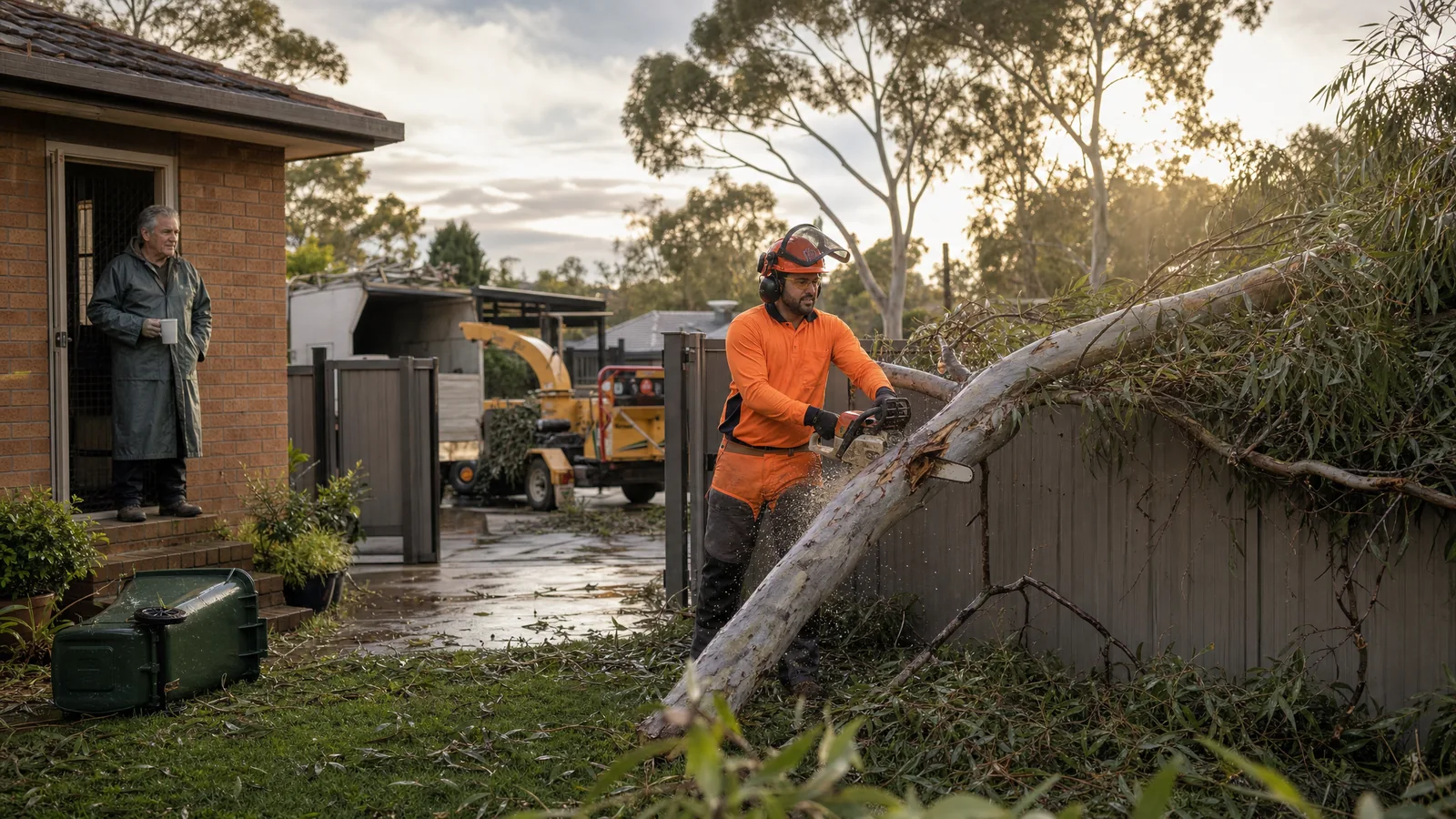
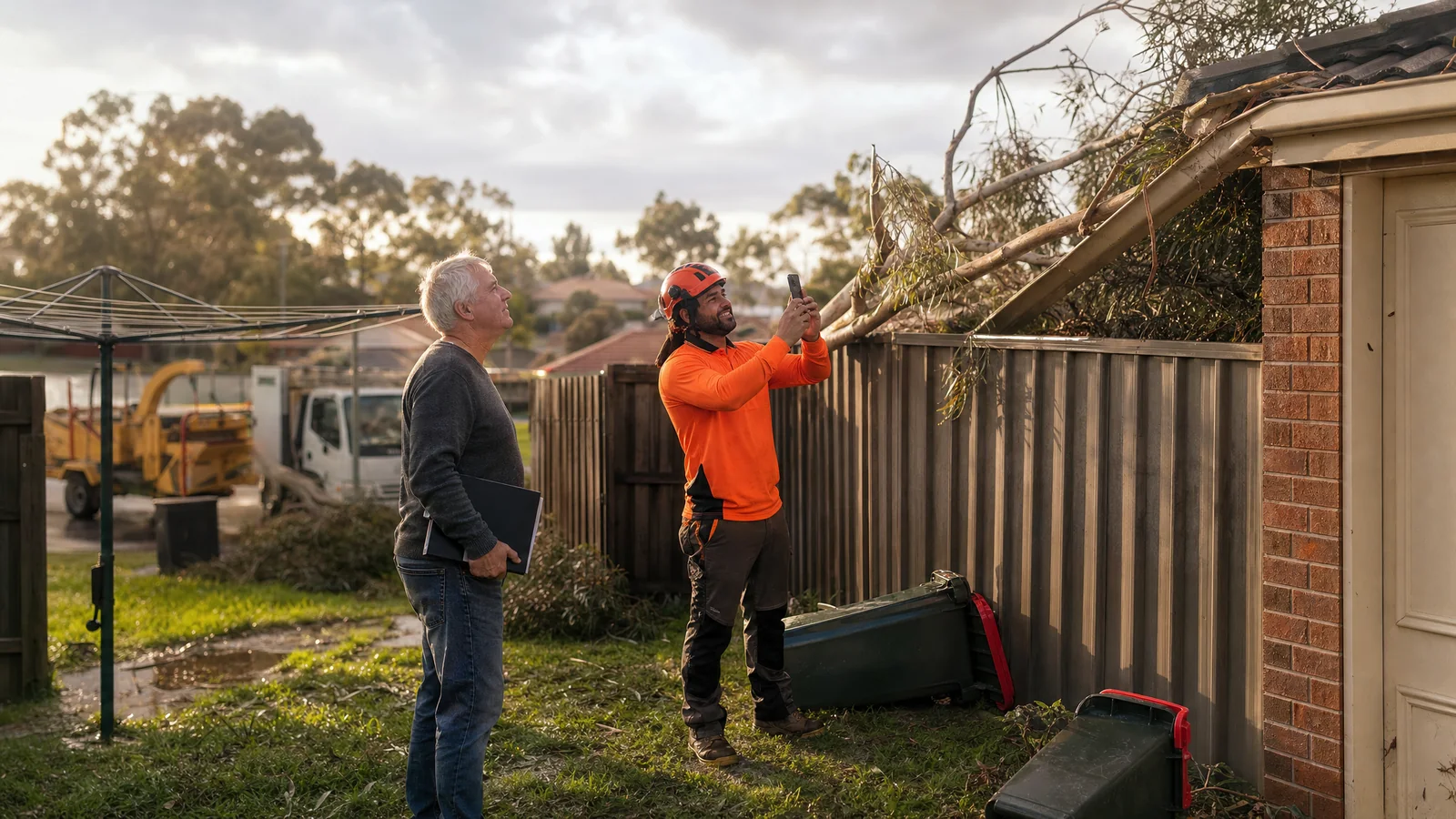
A planned removal gives you time to run every check above. That time disappears with a storm-damaged tree, and this is where the lead-gen sites do their best business, because a frightened homeowner at 6am rings the first number that answers. A few things still hold. Keep everyone at least 8 to 10 metres from any fallen powerline, because a line does not need to be touched to deliver a shock [22]. Photograph the damage, call your insurer before authorising work, and for a tree on a house or blocking a road ring VICSES on 132 500, or 000 if life is at risk [23].
Api takes calls 7 days from 6am and puts hazards first. He will not promise a time he cannot see, but a make-safe on a split limb over a roof goes to the top of the day, and the person who takes the call is the person who arrives with the truck.
From the first call to the last rake: how a job with Api runs
- The callApi answers 7 days from 6am, asks about the tree, the access, what is under it and whether anything is near a line, and books a time to look.
- The quote visitApi walks the tree and the block, measures what the council would measure, and gives a fixed written price with the stump, the mulch and the waste each marked in or out.
- Council checkWhere the tree is near a boundary or over a size test, Api tells you before booking whether a permit applies and what it does to the timing.
- Job dayThe same person arrives with the crew, re-assesses the tree, sets the exclusion zone, rigs what needs rigging and chips on site.
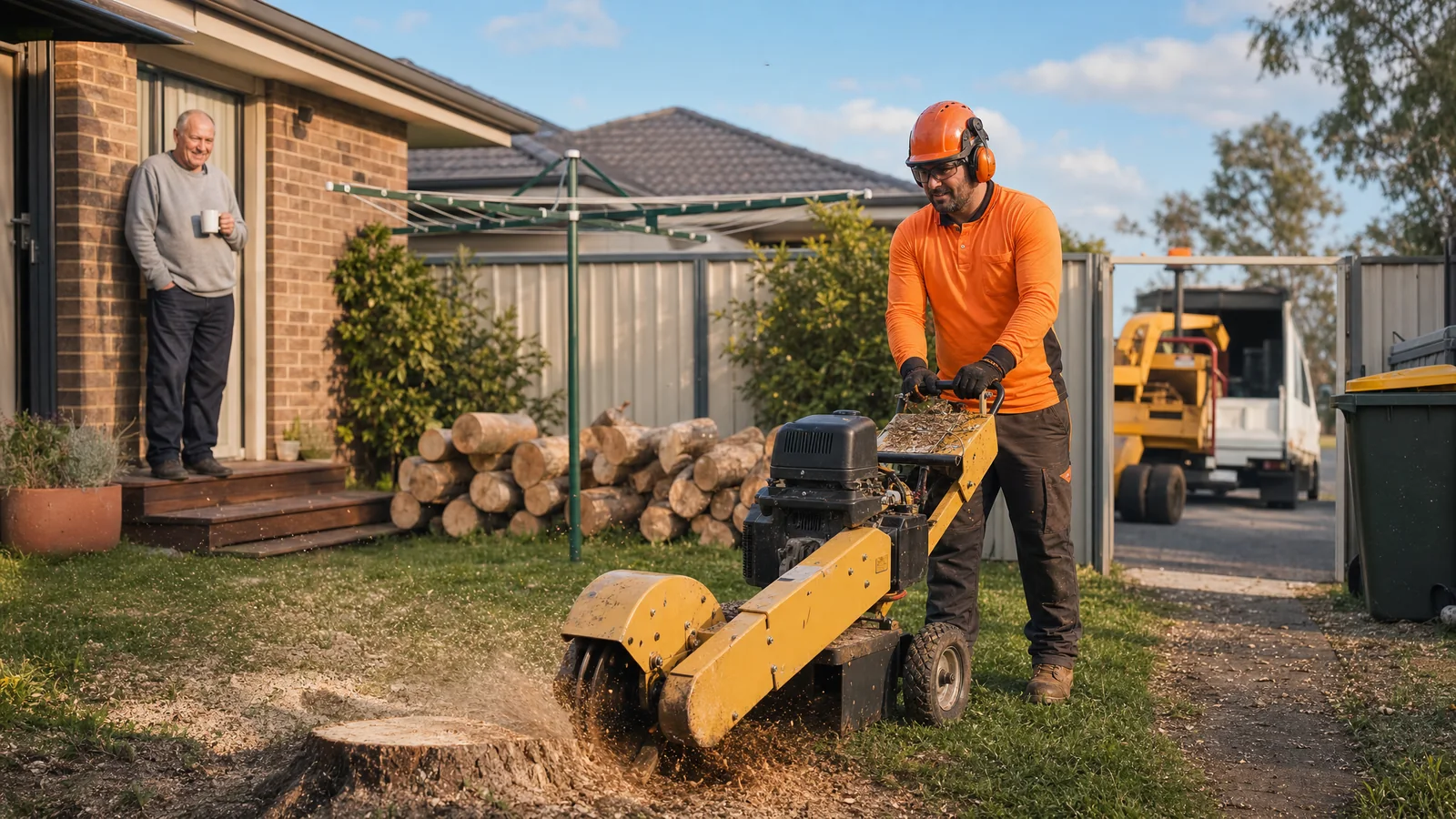
- AfterRaked, blown, gate shut, mulch left or gone. The stump, if it is in the quote, is ground on the same visit.
What our tree and palm removal service includes
Every job through our tree and palm removal service starts with Api on site, for free, and ends with the same person checking the gate. The quote is fixed and in writing, it covers the removal, the chipping, the clean-up and the green waste unless it says otherwise, and the stump is its own line so you can see what it adds. Api checks the council position on your title, points out anything near a service line, and tells you straight if a prune would do what you want for less than a removal. That is how it has worked for more than 1,400 customers across the west, and the 5.0 rating from 97 Google reviews is what they think of it.
That is what separates local tree removal companies from the rest of the search results: not the size of the logo, but whether the name belongs to a person who will stand in your backyard, assess your tree, and take responsibility for what happens next. Ring Api on 0422 856 090 or ask for a free quote and he will come and look.
How you get a local tree company that does the whole job properly
Getting a local tree company that does the whole job properly does not have to be complicated. At Aps Tree Removal we look at the job with you, tell you what actually needs doing and what does not, and put a fixed price on it before anything is cut.
No pushy sales. Api comes out, walks the property with you, explains the options and what each one means for the result, the risk and the price. You decide at your own pace. People choose us because they understand the job before they book it, and the crew that quotes is the crew that turns up.
We will tell you if a council permit applies and what the process is, we will point out anything near powerlines or the neighbour's boundary that changes the method, and we will say plainly when a cheaper option is the better one. Every job is done by a qualified arborist, fully insured, and the site is left cleaner than we found it.
Get in touch today. Api quotes for free, 7 days, 6am to 5pm, across Melbourne's west, the inner city and Geelong.
How we work with you
We talk and answer your questions
Call 0422 856 090 or send the form. Api asks what is worrying you about the tree, hedge or stump, what access is like, and whether anything sits near powerlines or a fence line.
We look and give you a fixed price
Api visits, inspects the tree or hedge, checks the permit position for your council, and quotes in writing. The price covers the job, the clean-up and the green waste unless we say otherwise.
You decide what works best
Remove, reduce, prune or wait: we explain the difference and what each costs. No pressure, no expiring offers. The choice is yours.
We do the job and stay in touch
The crew arrives when we said, works to the plan, and leaves the site clean. If the tree throws a surprise on the day, we tell you before we change anything.
Frequently asked questions
What should I look for in local tree removal companies?
A named person who quotes on site and runs the job, a qualification you can ask about, public liability insurance you can see on a certificate of currency, and a written quote that says whether the stump, the mulch and the green waste are in or out. Reviews attached to one trading name, one truck and one crew are the other tell.
Do tree removal companies need a licence in Victoria?
No specific licence exists for arborists in Australia, which is exactly why the checks matter. Look for a Certificate III in Arboriculture for anything that involves climbing, public liability insurance, and a person whose name is on the business and on the policy.
How do I know whether a website is a real local company or a lead-gen site?
Ask who will be on site and whether that person is the one quoting. A real company gives you a full name, a physical address and a registered business name, as Consumer Affairs Victoria recommends, and the person who visits to quote is the person who turns up with the truck.
Will a local company know whether my council needs a permit?
A good one will, because it works the same councils every week. Wyndham has no local law for trees on private land, Hobsons Bay and Moonee Valley each have a trunk size test, and the state canopy-tree rule sits under all of them. Api checks the council position on your title before the job is booked.
Does the crew clean up and take the green waste?
It should, and the quote should say so. Api's quotes cover the removal, the chipping, the clean-up and the green waste unless they say otherwise, and you can keep the chips as garden mulch if you want them.
Is a bigger company safer than a small local crew?
Size is not the safety signal. What matters is whether the tree was assessed on site by a competent person, whether an exclusion zone was set, and whether the crew climbs or uses a hoist rather than a ladder. A small crew that does those things is safer than a large one that does not.
How quickly can a local company get to a storm-damaged tree?
Api takes calls 7 days from 6am and puts hazards first, but nobody can honestly promise a time before seeing the tree. Keep everyone at least 8 to 10 metres from any fallen powerline, photograph the damage, and speak to your insurer before authorising work.
Sources
- Consumer Affairs Victoria: Home improvements costing $10,000 or less: checklist
- WorkSafe Victoria: Controlling the risks of working with trees (news, 28 January 2020)
- Energy Safe Victoria: Managing trees near powerlines
- Safe Work Australia: Guide to managing the risks of tree work (March 2023)
- hipages: How much does stump grinding cost? [2026] (updated 6 January 2026)
- Planning Victoria (Department of Transport and Planning): Protecting and enhancing our tree canopy for a greener Victoria
- Wyndham City Council: Planning frequently asked questions
- Hobsons Bay City Council: Tree protection laws and permits
- Melton City Council: Environment and the law
- Brimbank City Council: Street and park trees / trees on private property
- Maribyrnong City Council: Significant Tree Register
- Moonee Valley City Council: Trees (private property tree permits)
- Hume City Council: Property information on planning controls
- City of Melbourne: Exceptional Tree Register
- City of Greater Geelong: Canopy trees: clause 52.37
- Dispute Settlement Centre of Victoria: Neighbour disputes: trees
- hipages: How much does an arborist cost? [2026] (updated 6 January 2026)
- hipages: How much does tree removal cost? [2026] (updated 22 January 2026)
- training.gov.au (Australian Government): AHC30820 Certificate III in Arboriculture
- Arboriculture Australia: Arboriculture Australia (national industry body)
- Consumer Affairs Victoria: Giving quotes: tradespeople and small works (updated 8 July 2025)
- Energy Safe Victoria: Trees and vegetation FAQ (reviewed 16 March 2026)
- Victoria State Emergency Service (VICSES): Storms: plan and stay safe
Information about tree work, council permits and insurance changes often, and every property is different: figures here are general guidance and linked pages may change or become outdated. For a price on your own tree, hedge or stump, call Api on 0422 856 090 for a free quote.