By Aps Tree Removal · · Updated
Api Mariner, Qualified Arborist · 18 min read

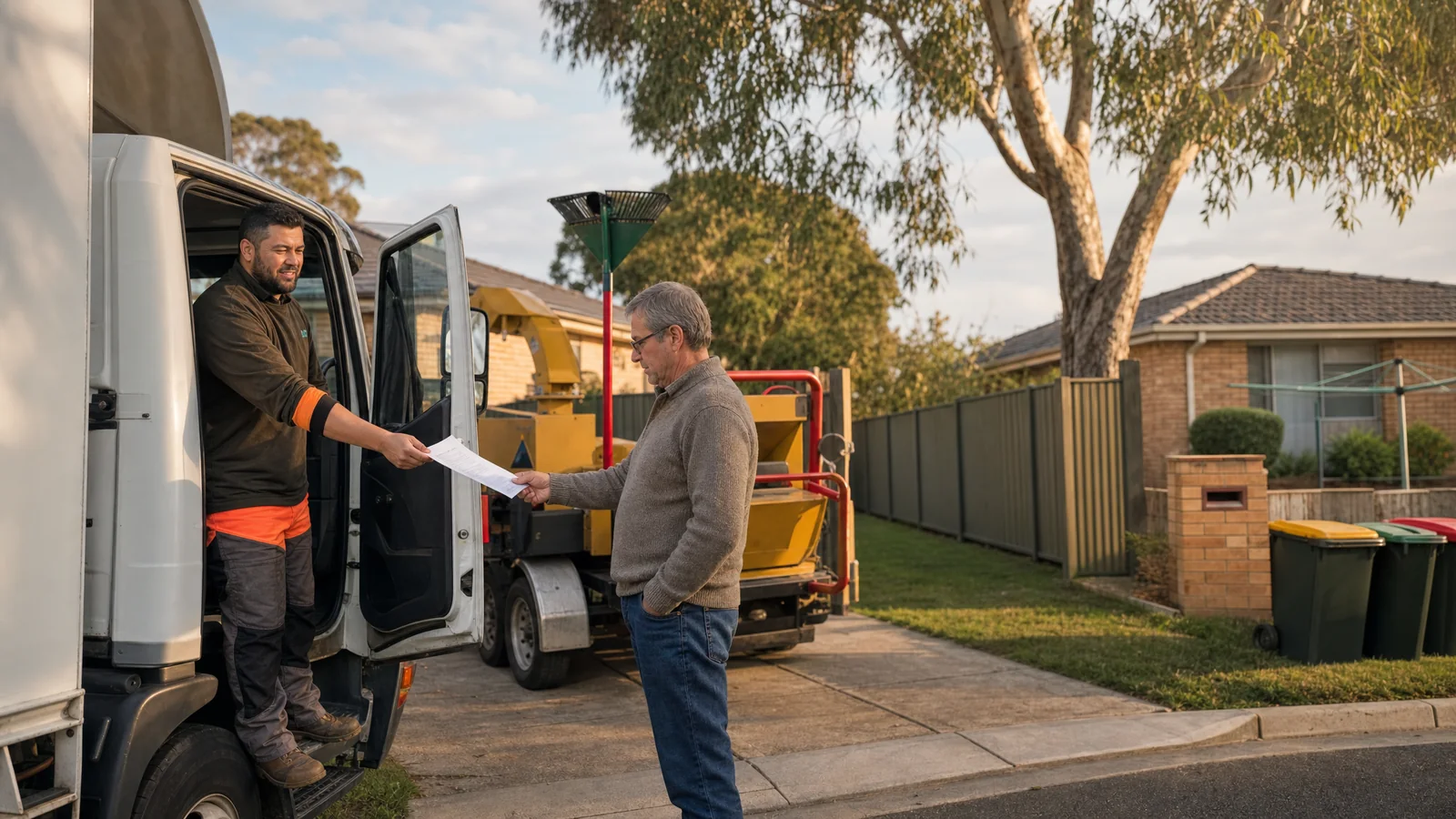
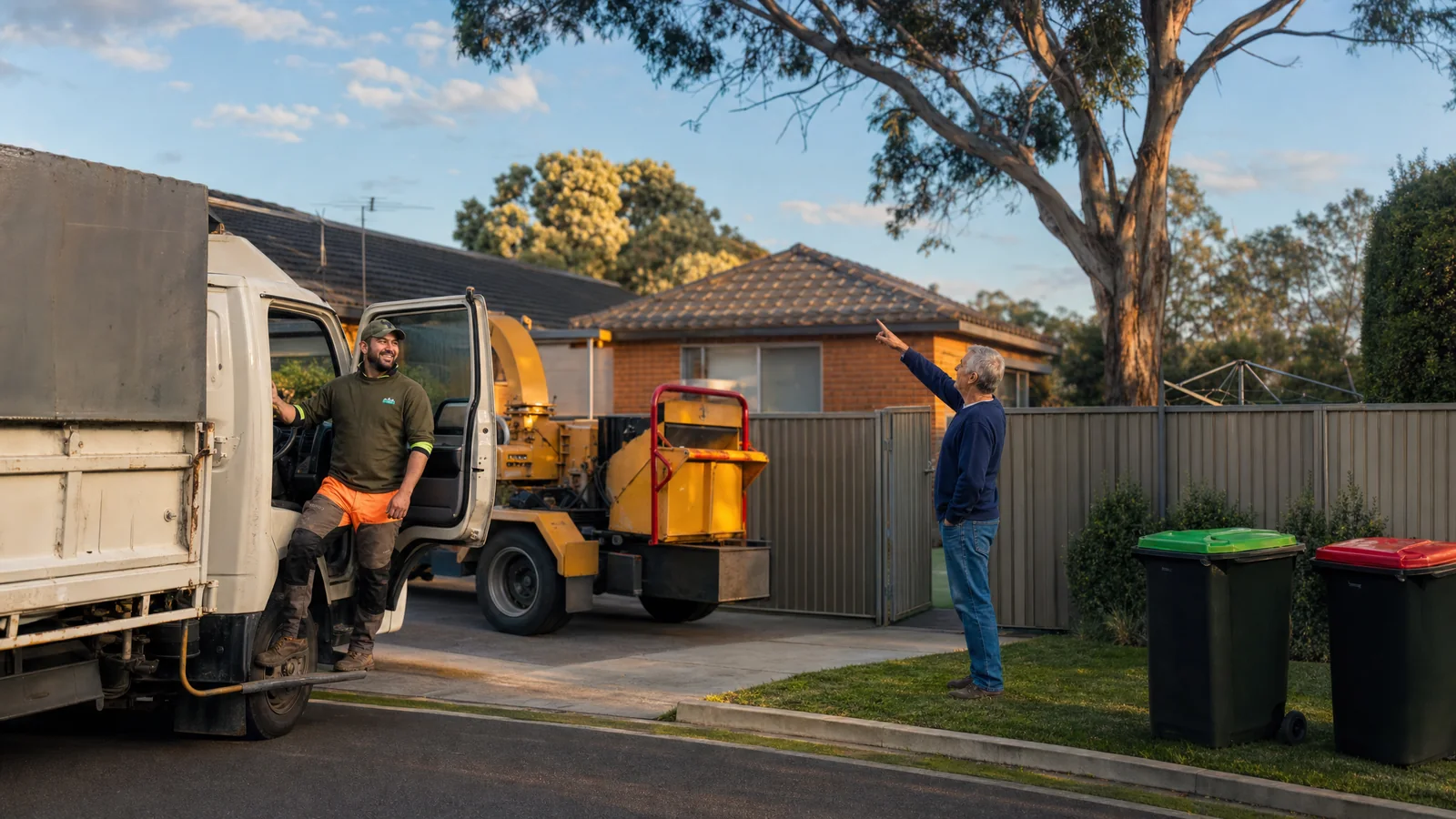
Every storm season Api gets calls from people who have already been burnt. A bloke with a ute and a chainsaw knocked on the door, quoted a cheap price, took a deposit, and either never came back or left half a tree and a pile of branches on the lawn. Choosing between tree removal contractors is not like choosing a plumber, because in Australia anyone can call themselves an arborist, and the cost of getting it wrong is not just money: it is a fence, a roof, a powerline, or somebody in hospital. This guide sets out the checks to make before you sign anything, in the order a careful homeowner in Melbourne's west would run them.
Api Mariner is a qualified arborist with more than 16 years in the trade, and he has quoted against every kind of operator across Wyndham Vale, Werribee, Point Cook and the inner west. This is what he would want a family member to ask before letting anyone near a tree on their block.
Why tree removal contractors need checking at all
The first thing most people do not know is that there is no licence for tree work in Australia. hipages notes that arborists do not need a specific licence, so the things to look for instead are qualifications, insurance and membership of a body such as Arboriculture Australia [1]. That leaves the checking to you, and the industry's own numbers show why it matters. WorkSafe Victoria reported a coroner's finding that 31 people died in Victoria from tree felling or related activity between January 2012 and September 2018, and that 13 of those deaths happened at work [2]. Arboriculture Australia, the national industry body, says skills shortages are at critical levels and is proposing an industry verification system based on qualifications, experience and conduct, but it is a proposal, not something you can look up today [3].
Why the checks matter
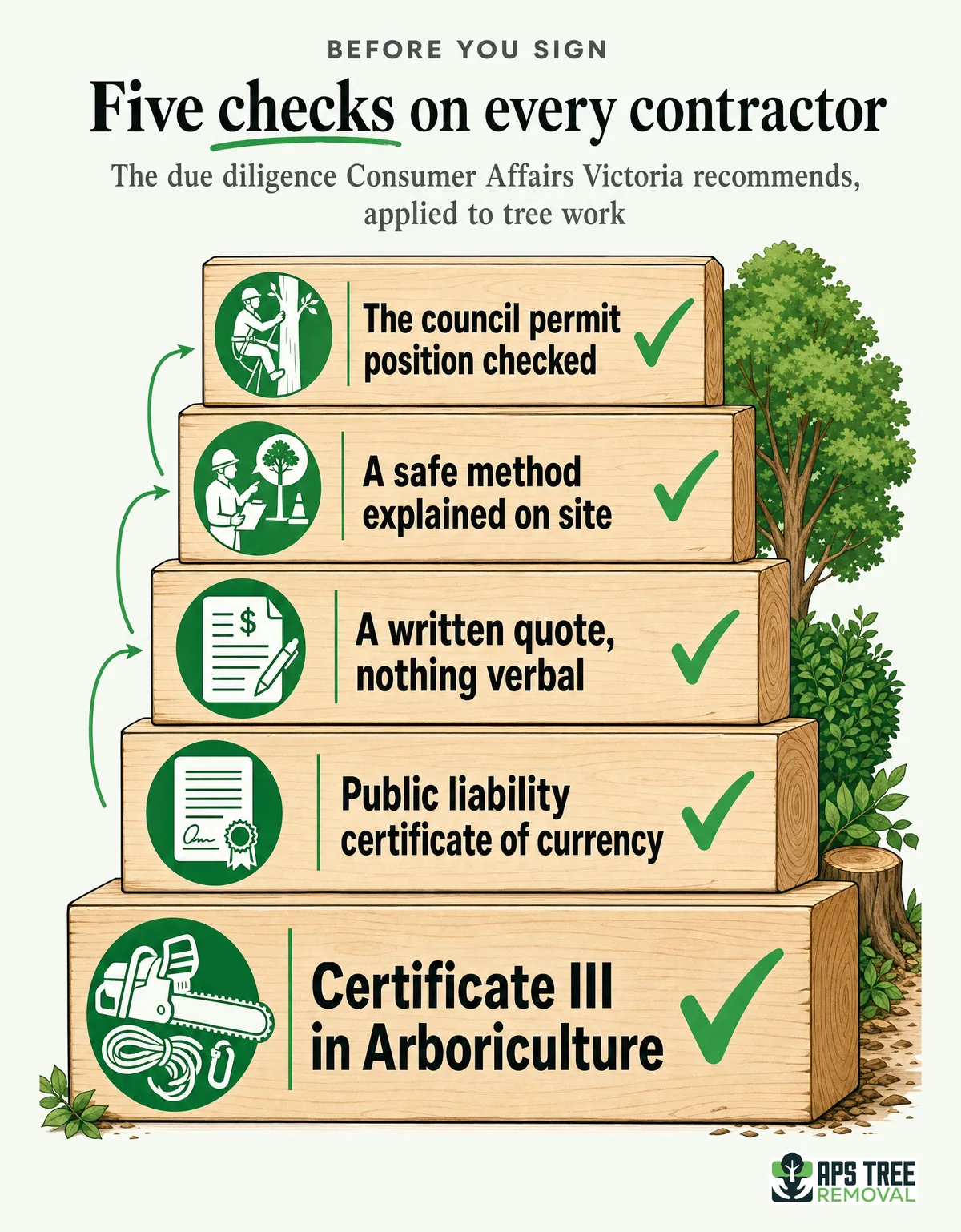
The gap between a qualified crew and a lopper with a chainsaw is invisible from the kerb. Both turn up in a truck, both own a chipper, and the cheaper one is usually friendlier on the phone. The five checks below are how you see the difference before the first cut.
Check one: qualifications, and what Cert III actually means
Ask what qualification the person running the job holds. The trade-level qualification in Australia is the Certificate III in Arboriculture (AHC30820), which training.gov.au describes as covering climbing arborist, EWP arborist, crane specialist and works coordinator roles, and which includes tree dismantling and removal as high-risk work at height [5]. hipages puts it plainly: a Certificate II covers basic work and a Certificate III is what you want for the tricky jobs, along with public liability insurance and membership of a recognised body [6].
Why does the paper matter when the bloke has been doing this for years? Because the qualification is where the method comes from. A Cert III arborist has been trained to assess a tree before climbing it, to rig a limb so it lands where it is meant to, and to know when a tree cannot be climbed at all and needs an elevating work platform instead. Experience teaches you what worked last time. The qualification teaches you why, and what to do when this tree is different.
Ask to see it. A qualified arborist is proud of the certificate and will have a copy on the phone. Ask who will be on site too, because on some crews the qualified person quotes and a different crew turns up. Api is the qualified arborist and he is on every job.
Check two: public liability insurance, and the certificate of currency
This is the check people skip because it feels awkward, and it is the one that protects your house. Consumer Affairs Victoria's checklist for home improvements says to ask to see a certificate of currency for public liability insurance, which protects you or third parties against any damage the workers may cause [7]. hipages says the same for arborists specifically: they should carry public liability insurance and personal insurance, because nobody licenses them [1].
A certificate of currency is a one-page document from the insurer that shows the policy is live today, who it covers, what it covers and when it runs out. A line on a website saying fully insured is not a certificate of currency. Ask for the document, check that the business name on it matches the quote, and check the expiry date is after your job date. If the contractor hesitates, that is your answer.
What happens without it
If a limb goes through your roof or the neighbour's carport and the contractor has no public liability cover, there is nothing to claim against except the contractor personally. Your own home insurance may cover your property, but not the neighbour's, and the insurer may ask why you hired an uninsured operator. The certificate of currency is the difference between a bad day and a bad year.
Aps Tree Removal is fully insured, and Api will show the certificate to anyone who asks, before the quote if you like.
Check three: a written quote that says what is in and what is out
Consumer Affairs Victoria's advice for any home job under ten thousand dollars applies neatly to tree work: get at least three quotes on the same detailed description of the job, have a written contract even for small work, ask for the tradesperson's full name, physical address and registered business name, and understand exactly what each quote covers, because the cheapest may leave things out [7]. The same agency tells tradespeople what a quote should spell out: whether transport is included, how the labour is costed, and any call-out, weekend or public holiday rates [8].
For tree removal contractors the things most often left out are the stump, the green waste and the chipping, and you find out on the day when the crew packs up and the branches are still on the lawn. A quote that does not mention them is not cheaper, it is incomplete, and leaving a stump behind is the part people regret first.
What the written quote should say
- Which tree, or which trees, so there is no argument later
- Whether the stump is ground out or left, and how deep
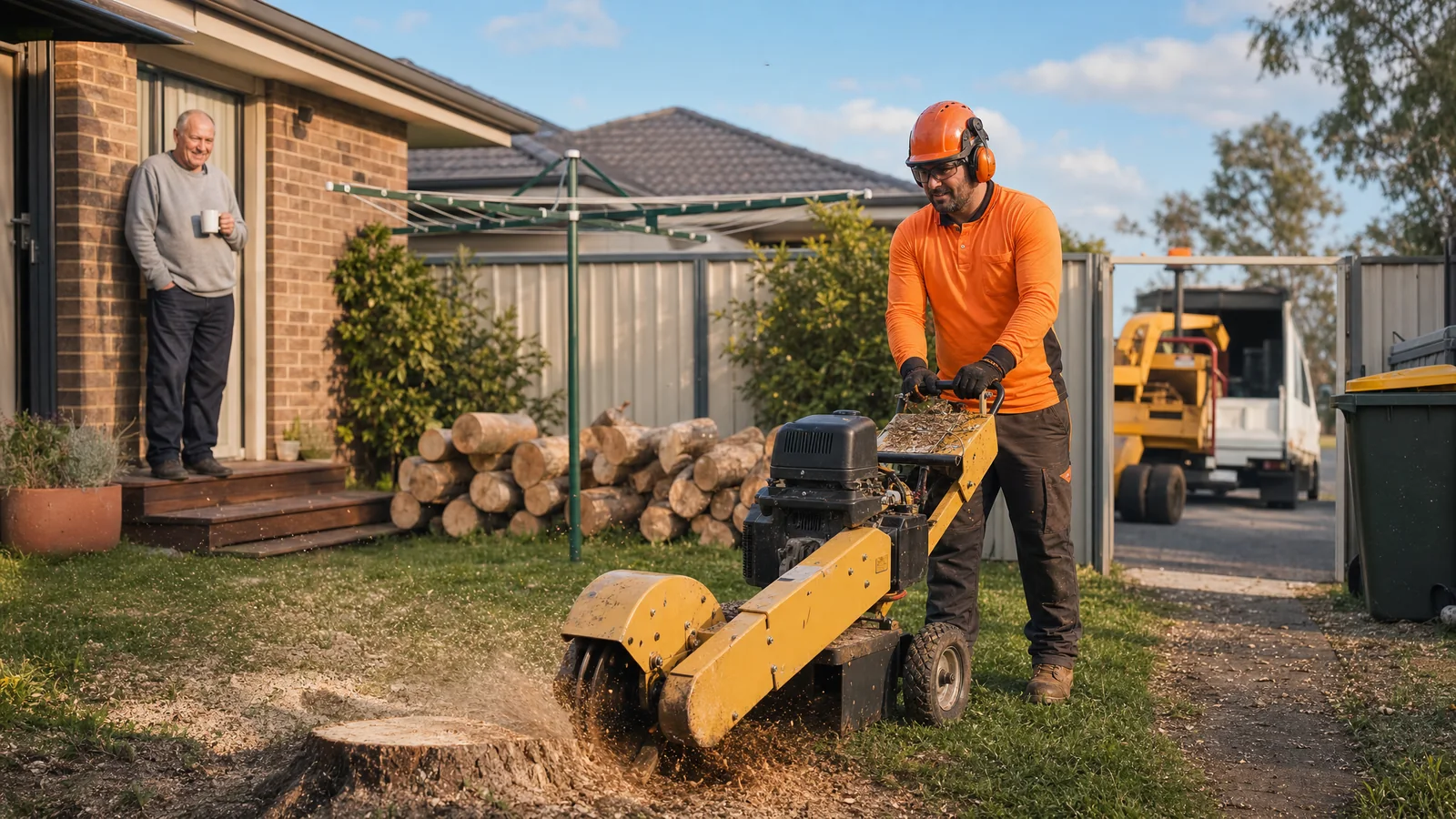
- Whether the green waste is taken away, chipped on site or left as mulch
- Whether the site is cleaned and raked before the crew leaves
- The method in plain words: felled, dismantled in sections, or done from an elevating work platform
- Whether a council permit is needed and who is applying for it
- Who is on site and whether the person quoting is running the job
- The business name, a physical address and a phone number
Consumer Affairs Victoria also points out that you have a contract with the tradesperson whether the agreement was verbal or written, and that they guarantee to work with due care and skill and within a reasonable time [8]. A verbal deal still binds them. The problem is proving what the deal was.
| What to ask | Why it matters | What Api's quote says |
|---|---|---|
| Is the stump included? | Stump grinding is a separate machine and usually a separate line, so a quote that is silent on it has left it out | Listed separately, ground 300 to 400 mm below ground, so you can see what it adds |
| Is the green waste included? | Disposal is a real cost; a quote that leaves it out leaves it on your lawn | Chipping, clean-up and green waste are in the price unless the quote says otherwise |
| Will this price change? | A verbal price can grow on the day when the tree turns out harder than it looked | Fixed on site, in writing, before the first cut |
| Who is turning up? | The quoter and the crew are not always the same people | Api quotes it and Api runs it |
| Do I need a permit? | The homeowner is responsible for getting the permits, not the contractor | Api checks the council position on your title as part of quoting |
Very happy, Api and his team went above and beyond expectations. Trees cut down, removed, stump removal and cleanup, very professional and honest. Definitely recommend and will use in the future
Check four: what a safe method looks like, and how to tell
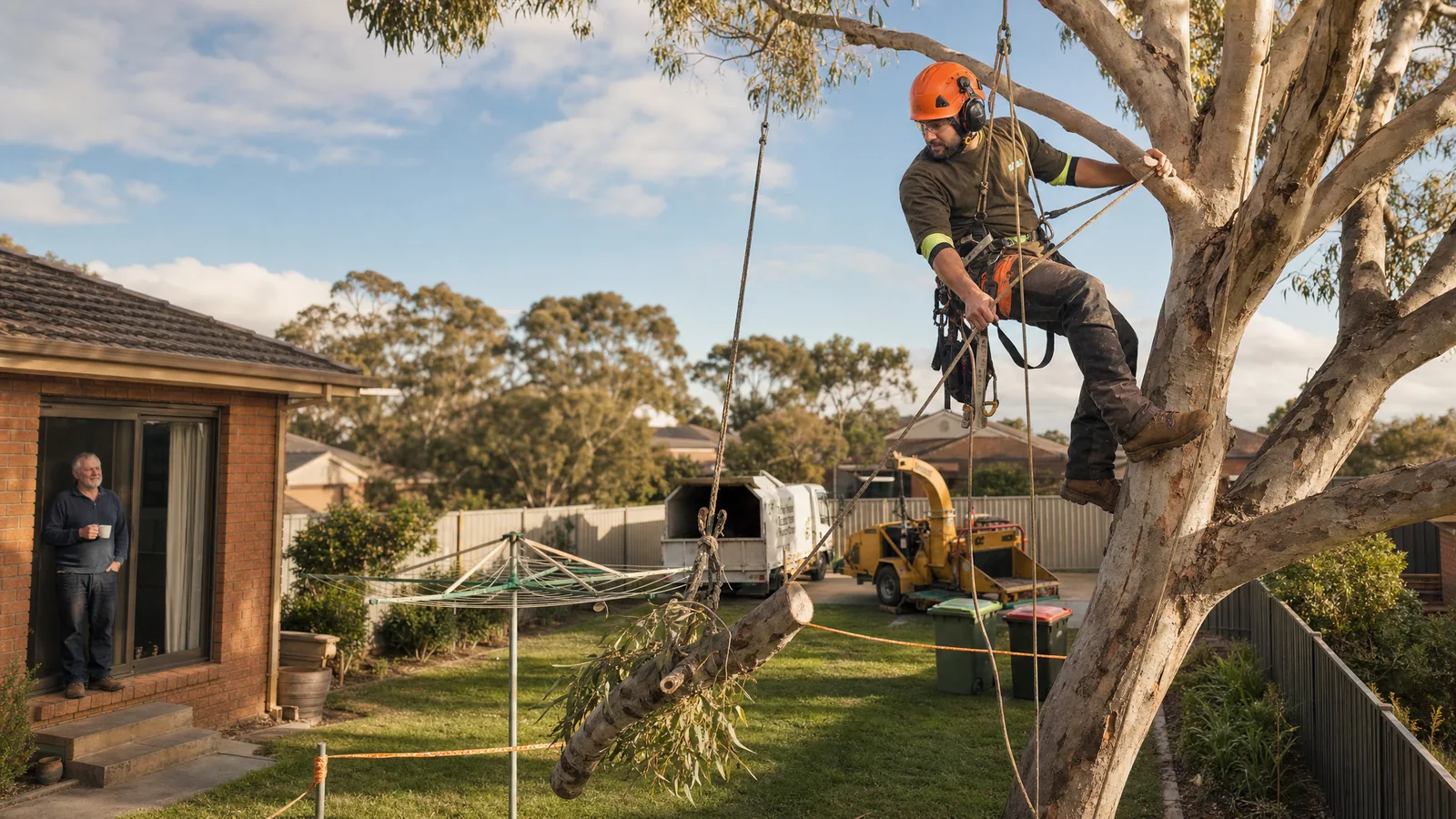
You do not need to be an arborist to recognise a safe crew. Safe Work Australia's guide to tree work describes the shape of it: before anyone goes up, a visual assessment of the tree by a competent person such as a qualified arborist, covering its condition and structural integrity, and an exclusion zone under the tree with barriers and supervised access so nothing lands on a person or a property [9]. WorkSafe Victoria's guidance makes the same point from the other side: plan and prepare, and inspect each tree individually to decide the safest method for the work [2].
How a professional crew runs a removal
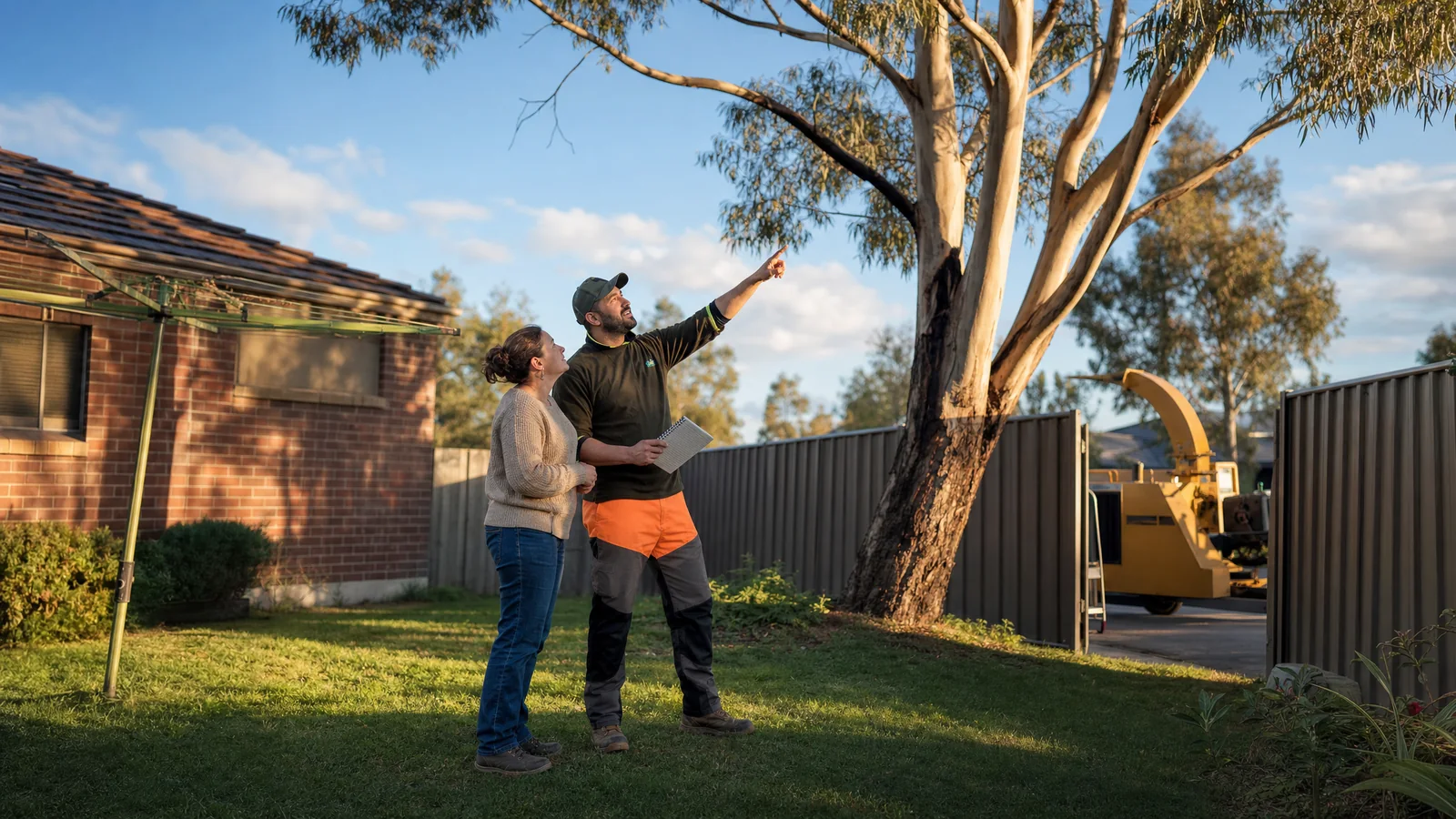
- 1Look before climbingThe arborist walks around the tree, checks for dead wood, cracks, fungus and lean, and looks up for powerlines and down for what the tree can fall on.
- 2Set the exclusion zoneCars, pots, trampolines and people are moved out of the drop zone, and the side gate or driveway is closed off while limbs are coming down.
- 3Choose the methodOpen lawn under the tree means it can be felled or dropped in sections. A roof, a pool or a fence means every limb is roped and lowered. A tree that cannot be climbed is done from an elevating work platform.
- 4Rig and lowerThe climber works from the top down, cutting limbs to a size the ground crew can handle and lowering anything that cannot be dropped clean.
- 5Chip and clearThe ground crew feeds the chipper butt end first and rakes as they go, so the site is clean when the last piece comes down.
The short version is in the same guide: tree trimming and removal should not be done from ladders, and contact with any electric line, whether it carries 400,000 volts or 230, can be fatal without the line ever being touched, because an arc can jump to a person standing close to it [9]. If the quote involves a ladder and a tree near a line with no mention of either, you are looking at the wrong operator. Energy Safe Victoria adds that only authorised powerline pruning contractors should prune trees touching or close to powerlines, and that trees should be cleared before they grow within one metre of an insulated service line [10]. A contractor who shrugs about the line to your house is telling you something.
Api takes the site walk seriously because it is where the price and the method are decided together. The long version of how a professional crew brings a tree down, from the first look at the trunk to the last rake of the lawn, is worth reading before you compare quotes, because it tells you what to listen for.
⭐⭐⭐⭐⭐ 5 Stars I recently hired Aps tree removal company and couldn’t be more impressed with their work. From start to finish, Api and team was professional, punctual, and highly skilled. They removed a large tree from my front yard quickly and safely, leaving the area spotless afterward. Communication was clear throughout the whole process, and they made sure we were completely satisfied before wrapping up. Their attention to detail and care for the surrounding property really stood out. Highly recommend them to anyone in need of tree services—an absolutely amazing job!
Check five: the permit, and whose job it is
Consumer Affairs Victoria's checklist is direct on this: contact your local council to find out whether the work needs a permit, because as the homeowner it is your responsibility to make sure planning and building permits are obtained [7]. A good contractor checks anyway, because a tree removed without a permit is a fine and a replacement tree for you.
Since 15 September 2025 every Victorian planning scheme has carried the canopy-tree clause: a permit is needed to remove, destroy or lop a canopy tree (taller than 5 metres, with a trunk more than 0.5 metres around at 1.4 metres above ground and a canopy at least 4 metres across) anywhere on a vacant residential lot, or within 6 metres of the street frontage or 4.5 metres of the rear boundary of a lot with a house on it [11]. Some councils add a local law on top, and some, like Wyndham, have no local law for trees on private land at all, so the position depends on where you are [12]. Api checks the council position on your title as part of every quote and tells you before the job is booked. A contractor who cannot tell you whether the tree needs a permit has not looked, and if they have not looked at that, ask what else they missed.
Want the checks done for you? Api quotes on site for free, 7 days a week, shows his insurance on request, and puts the whole job in writing before a single cut.
The red flags, starting with the knock on the door
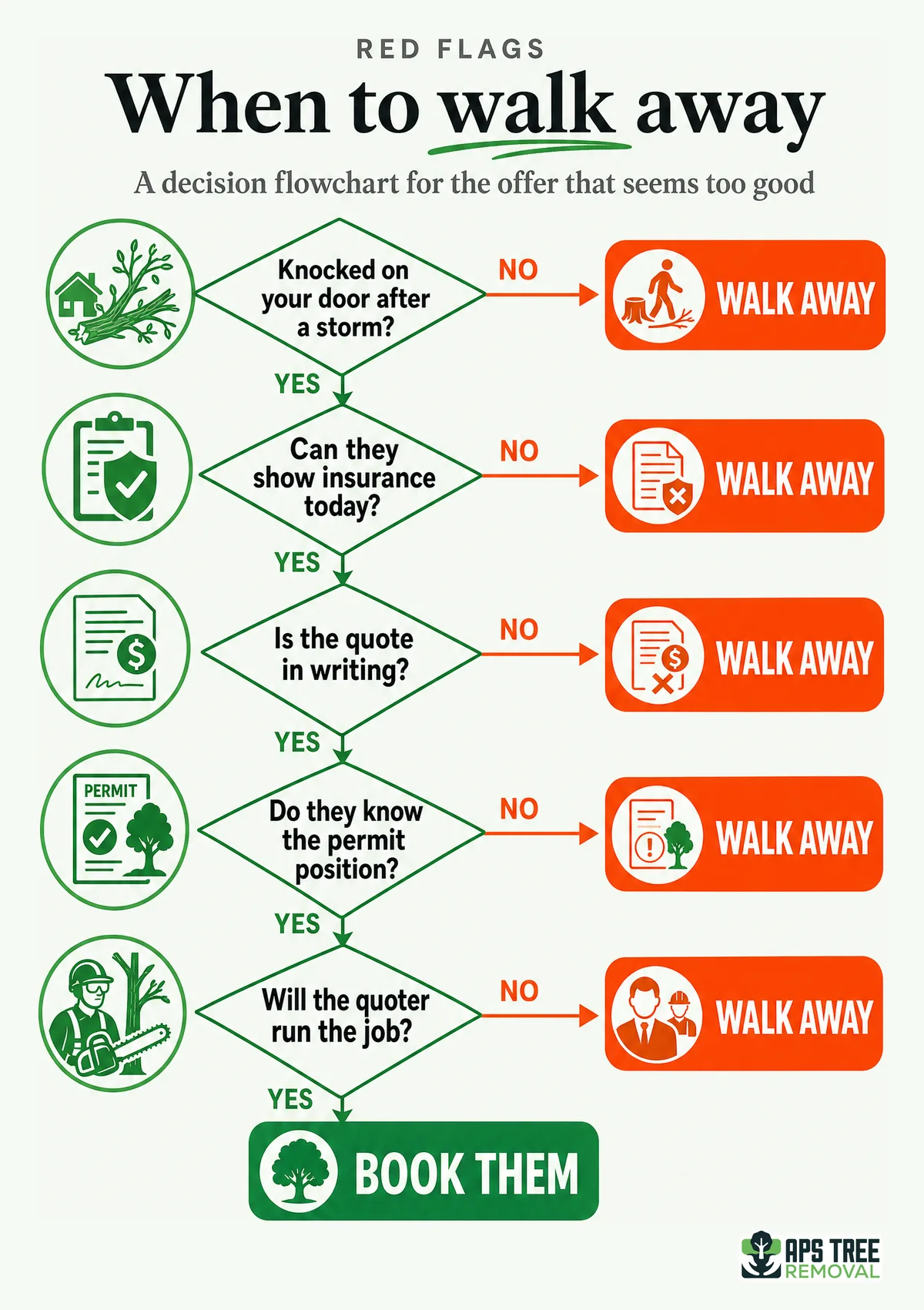
Consumer Affairs Victoria warns against people who knock on your door or telephone unexpectedly offering cheap deals on jobs around the home [7], and in Melbourne the knock comes after a storm. VICSES responds to around 20,000 requests for help from storms each year, close to 80 per cent of everything it attends, and much of the damage comes from tree branches and falling overhanging limbs [4]. The morning after, there are utes doing laps of the streets with a chainsaw on the tray, and a tree over your carport makes the cheap price sound reasonable.
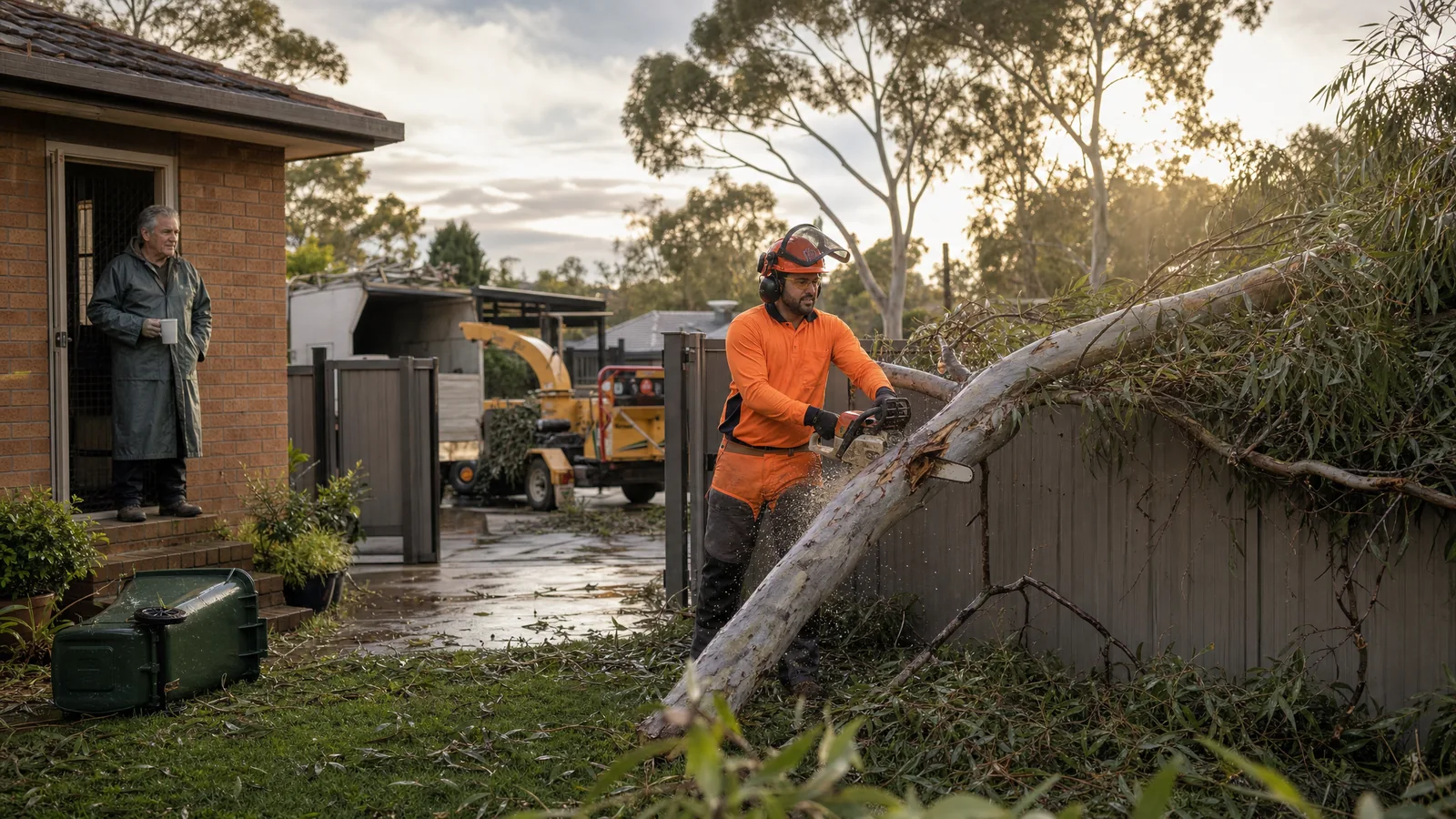
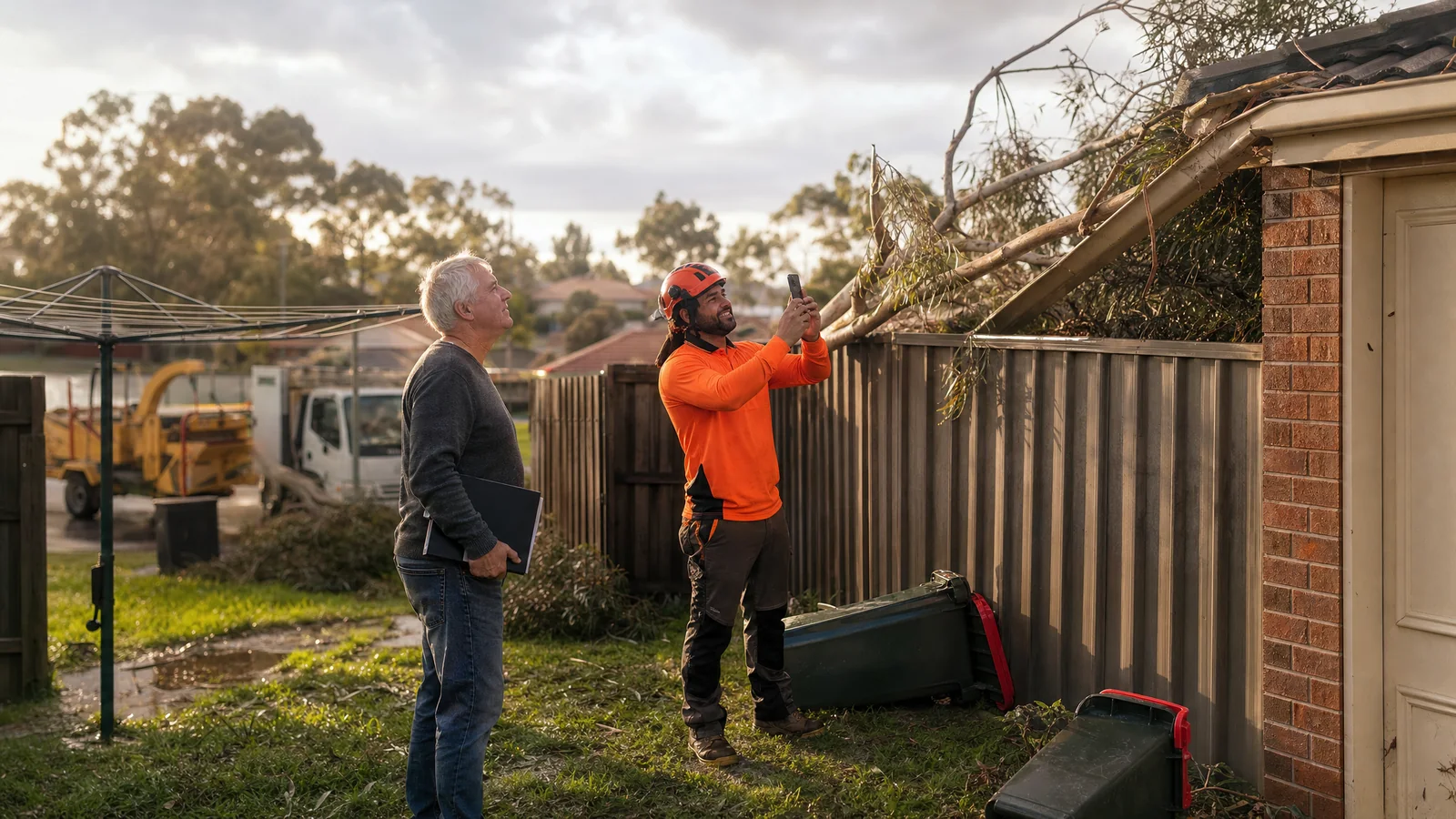
It is not, for two reasons. The first is that a storm-damaged tree is the most dangerous kind: VICSES says heat, fire or recent storms can make trees unstable and more likely to fall [4]. Safe Work Australia's assessment step exists because split or hung-up timber cannot be climbed or cut the way a healthy tree can [9]. The second is that the person at the door has no reason to come back if it goes wrong. If a tree has already come down, the steps to take after a tree falls are simple: keep everyone at least eight to ten metres from any fallen powerline, because you do not have to touch a line to get a shock, photograph the damage, and call your insurer before authorising work [13].
Sorting tree removal contractors
Worth a second phone call
- Names the qualification and offers to show it
- Sends the certificate of currency without being chased
- Visits the site and quotes in writing, with the stump and the waste spelled out
- Explains the method and mentions the powerline before you do
- Knows the permit position or says they will check the title
- The person quoting is the person running the crew
Walk away
- Knocked on the door after the storm with a price that is only good today
- Wants cash, a large deposit, or full payment before starting
- Cannot produce insurance today but has it back at the office
- Prices from the street or from a photo without walking the block
- Proposes a ladder, or has no plan for the line to your house
- Says no tree ever needs a permit
One more that catches careful people: the very cheap third quote. If two quotes are close and one is half the price, it is not a bargain until you can see what it left out. Usually that is the stump, the waste, the insurance or the safe method, and each one is a cost that comes back to you. It helps to understand how tree removal is priced before you compare, because a quote that ignores what moves a price stands out.
Running the checks in order: a simple sequence
Put together, the Consumer Affairs checklist and the arborist-specific checks make a short sequence for vetting tree removal contractors that fits inside a week. For finding tree removal near you in the first place, start with the Google and hipages reviews of operators who work your suburb, then run every name through the steps below.
From first call to job done
- Before you callPhotograph the tree, note what is under it and near it, measure the side gate, and check your title for overlays so every contractor gets the same description.
- On the phoneAsk who is qualified, who is insured, and who will be on site. Ask for the certificate of currency to be sent before the visit.
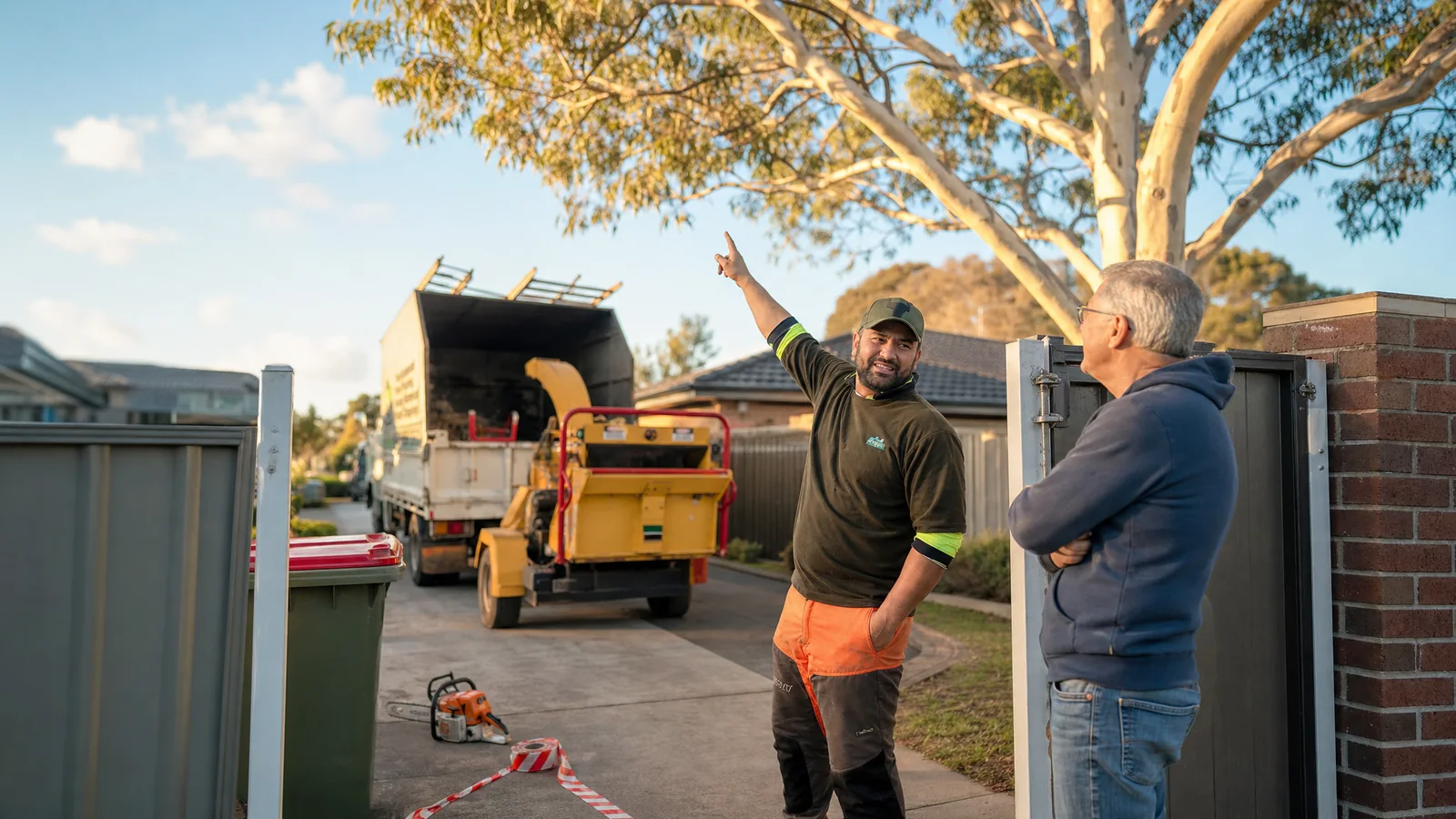
- On the quote visitWalk the block with them and listen for the assessment: the lean, the dead wood, the powerline, the drop zone. Ask what method they will use and why.
- Before you signCompare three written quotes on the same description. Check the business name matches the insurance. Confirm the stump, the waste and the permit are addressed.
- On the dayExpect an exclusion zone, cars moved, and the person who quoted running the job. If it looks different from what was described, stop and ask.
- After the jobCheck the clean-up against the quote. Pay on completion. Leave a review that says what they actually did.
Consumer Affairs Victoria suggests checking references too: did the tradesperson start and finish on time, communicate clearly, and did the price increase, and if so was that reasonable and agreed [7]. For tree work, reviews do this job if you read them for specifics. A review that says great job tells you little. One that says they turned up when they said, showed the insurance, ground the stump and left the lawn clean tells you everything.
What you get when you hire Api
We are not the cheapest crew in the west and we do not try to be. What you get from our tree and palm removal service is the five checks answered before you ask. Api is a qualified arborist. The business is fully insured and the certificate is available on request. Every quote is a site visit followed by a fixed written price that lists the stump separately and includes the chipping, the clean-up and the green waste. The method is explained on the day it is quoted, and the council position on your title is checked before the job is booked. The crew that quotes is the crew that turns up, 7 days from 6am, with the truck, the chipper, the climbing gear and an elevating work platform where a tree cannot be climbed.
The cheapest tree removal contractors are the ones whose mistakes you pay for. The right one costs what the job costs, and nothing after.
That is what the checks are for: to make sure the person who touches your tree is the person you thought you were hiring, and that if something goes wrong, it is their problem and not yours.
How you get a tree removal contractor you can trust with your property
Getting a tree removal contractor you can trust with your property does not have to be complicated. At Aps Tree Removal we look at the job with you, tell you what actually needs doing and what does not, and put a fixed price on it before anything is cut.
No pushy sales. Api comes out, walks the property with you, explains the options and what each one means for the result, the risk and the price. You decide at your own pace. People choose us because they understand the job before they book it, and the crew that quotes is the crew that turns up.
We will tell you if a council permit applies and what the process is, we will point out anything near powerlines or the neighbour's boundary that changes the method, and we will say plainly when a cheaper option is the better one. Every job is done by a qualified arborist, fully insured, and the site is left cleaner than we found it.
Get in touch today. Api quotes for free, 7 days, 6am to 5pm, across Melbourne's west, the inner city and Geelong.
How we work with you
We talk and answer your questions
Call 0422 856 090 or send the form. Api asks what is worrying you about the tree, hedge or stump, what access is like, and whether anything sits near powerlines or a fence line.
We look and give you a fixed price
Api visits, inspects the tree or hedge, checks the permit position for your council, and quotes in writing. The price covers the job, the clean-up and the green waste unless we say otherwise.
You decide what works best
Remove, reduce, prune or wait: we explain the difference and what each costs. No pressure, no expiring offers. The choice is yours.
We do the job and stay in touch
The crew arrives when we said, works to the plan, and leaves the site clean. If the tree throws a surprise on the day, we tell you before we change anything.
Frequently asked questions
Do tree removal contractors need a licence in Australia?
No. There is no specific licence for arborists in Australia, which is why the checking falls to you. Look for a Certificate III in Arboriculture, a certificate of currency for public liability insurance and membership of a body such as Arboriculture Australia, and ask to see the documents rather than taking the website's word for it.
What insurance should a tree removal contractor have?
Public liability insurance, which covers damage to your property or a neighbour's, plus personal insurance for the people on the crew. Ask for the certificate of currency, check the business name on it matches the name on the quote, and check the expiry date is after your job date. Api shows his on request.
What is a certificate of currency?
A one-page document from the insurer confirming the policy is live, who it covers, what it covers and when it expires. It is the only proof that a contractor is insured today. A line on a business card saying fully insured is a claim, not a certificate.
How many quotes should I get for tree removal?
Consumer Affairs Victoria recommends at least three, all on the same detailed description of the job, and all in writing. Compare what each one includes rather than the bottom line, because the cheapest quote is often the one that left out the stump, the green waste or the clean-up.
Is it my job or the contractor's to get the council permit?
It is the homeowner's responsibility to make sure planning permits are obtained, according to Consumer Affairs Victoria, and since 15 September 2025 every Victorian planning scheme has carried a canopy-tree rule that applies near boundaries in residential zones. A good contractor checks anyway. Api checks the council position on your title as part of every quote.
Should I hire someone who knocks on my door after a storm?
No. Consumer Affairs Victoria warns against unexpected door-knockers offering cheap deals, and a storm-damaged tree is the most dangerous kind to cut, so it is the last job to hand to an unknown operator. Photograph the damage, call your insurer before authorising work, then call an arborist you have checked. Api takes calls 7 days from 6am and prioritises hazards.
What does a safe tree removal look like?
An assessment of the tree before anyone climbs it, an exclusion zone under it so nothing lands on people or property, no ladders, and a plan for any powerline before the first cut. If the contractor cannot describe the method in plain words on the quote visit, they have not planned it.
Will Api show me his qualifications and insurance?
Yes, before the quote if you like. Api is a qualified arborist, the business is fully insured, and the person who quotes the job is the person who runs it. He would rather you ask him than not ask the next operator.
Sources
- hipages: How much does an arborist cost? [2026] (updated 6 January 2026)
- WorkSafe Victoria: Controlling the risks of working with trees (news, 28 January 2020)
- Arboriculture Australia: Arboriculture Australia (national industry body)
- Victoria State Emergency Service (VICSES): Storms: plan and stay safe
- training.gov.au (Australian Government): AHC30820 Certificate III in Arboriculture
- hipages: How much does tree removal cost? [2026] (updated 22 January 2026)
- Consumer Affairs Victoria: Home improvements costing $10,000 or less: checklist
- Consumer Affairs Victoria: Giving quotes: tradespeople and small works (updated 8 July 2025)
- Safe Work Australia: Guide to managing the risks of tree work (March 2023)
- Energy Safe Victoria: Managing trees near powerlines
- Planning Victoria (Department of Transport and Planning): Protecting and enhancing our tree canopy for a greener Victoria
- Wyndham City Council: Planning frequently asked questions
- Energy Safe Victoria: Trees and vegetation FAQ (reviewed 16 March 2026)
Information about tree work, council permits and insurance changes often, and every property is different: figures here are general guidance and linked pages may change or become outdated. For a price on your own tree, hedge or stump, call Api on 0422 856 090 for a free quote.