By Aps Tree Removal · · Updated
Api Mariner, Qualified Arborist · 14 min read

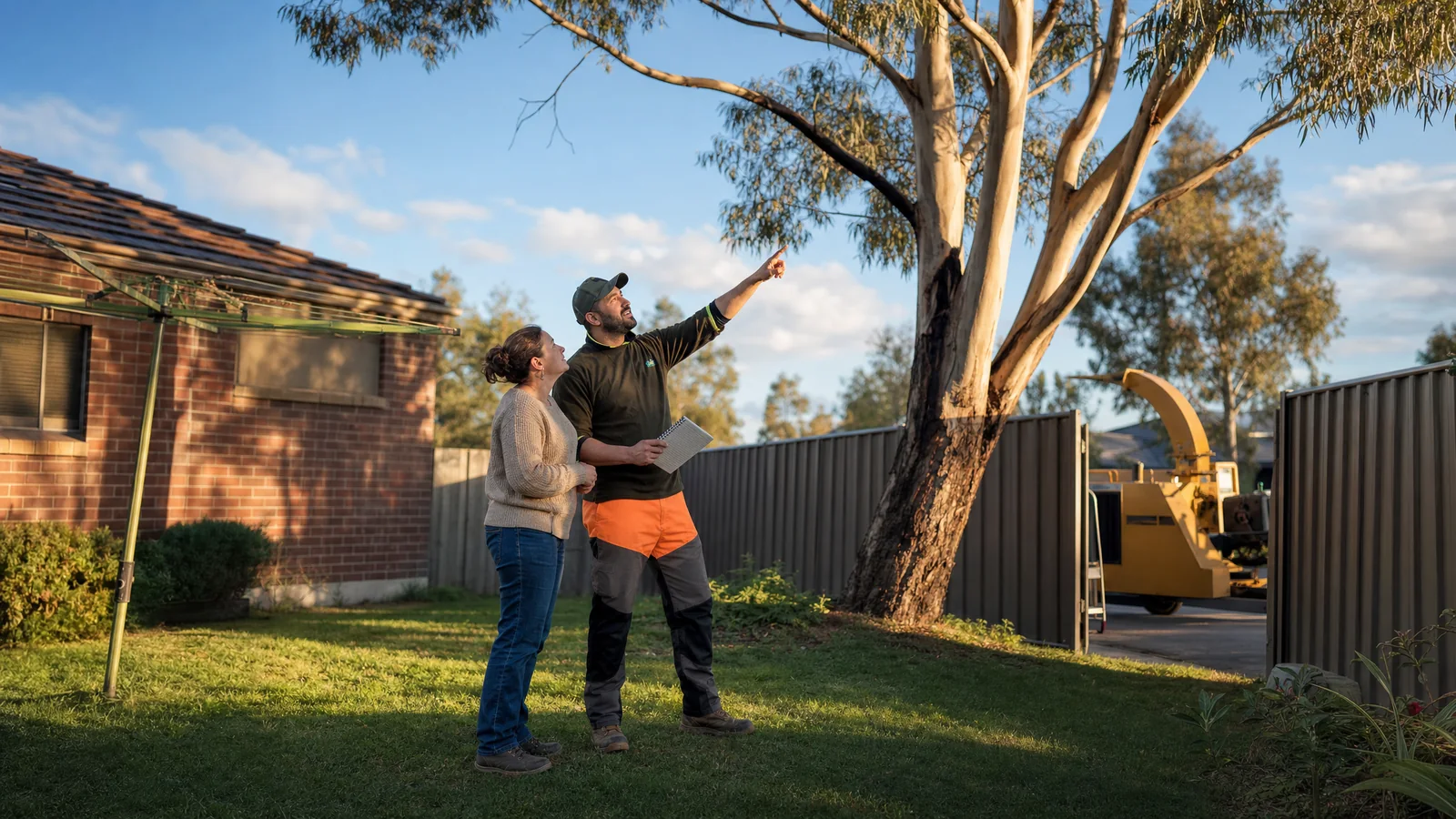
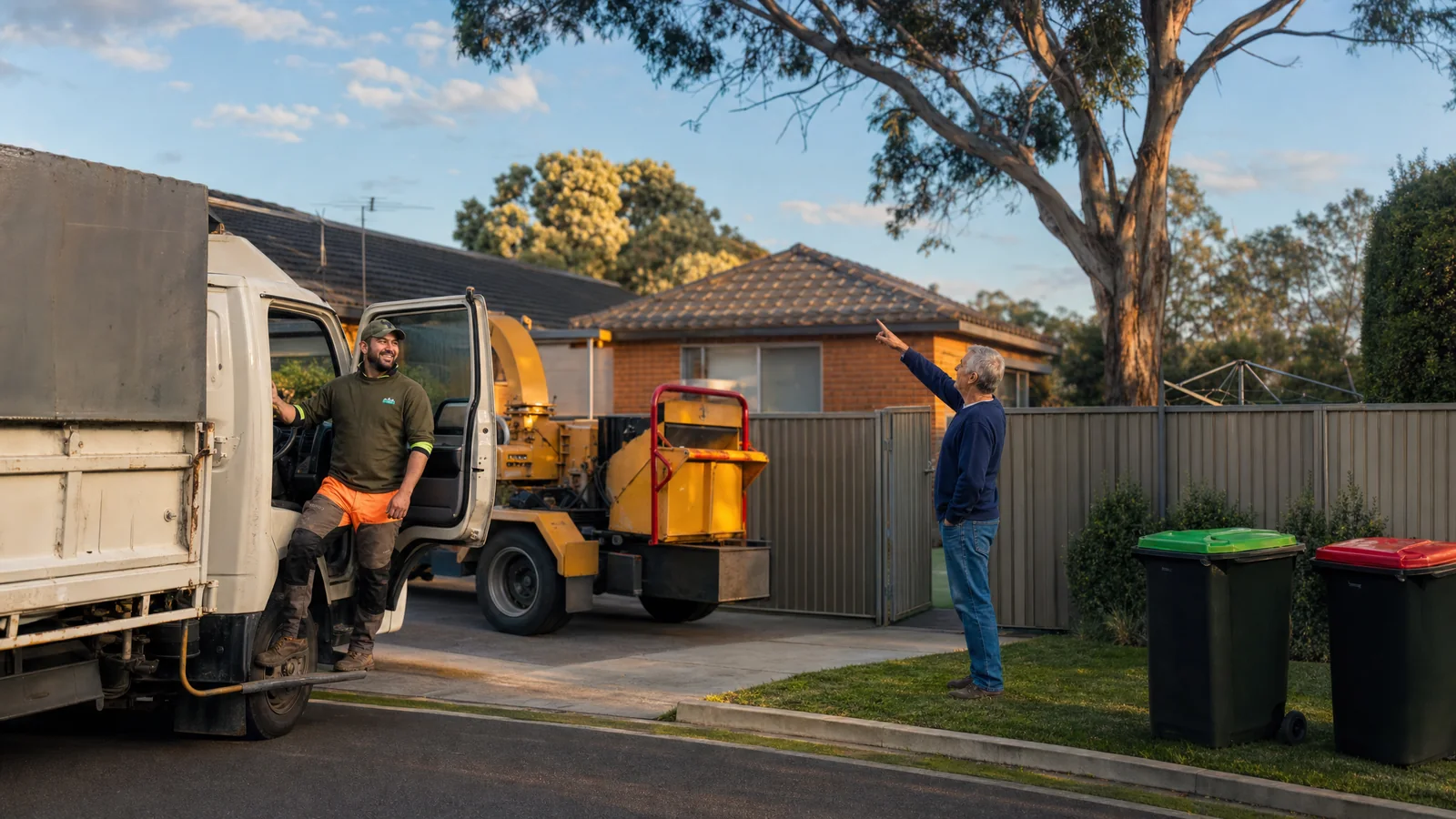
Every week Api gets the same first question on the phone: what is the tree removal cost going to be? The honest answer is that nobody can price a tree from a description, because the tree is only half the job. The other half is what is around it: the fence, the roof, the neighbour's carport, the powerline, the side gate the chipper has to fit through. This guide explains how tree removal is priced in Melbourne, what the indicative ranges look like right now, the extras that catch people out, and how to read three quotes so the cheapest one does not turn into the most expensive.
Api Mariner is a qualified arborist who has quoted and removed trees across Melbourne's west, the inner suburbs and Geelong for more than 16 years. What follows is how he works out a price, written down.
What tree removal costs in Melbourne right now
The most useful public figures come from hipages, which publishes national averages from the jobs booked through its platform. Its January 2026 guide puts typical tree removal in Australia between $360 and $3,000, with extra-large trees of 20 to 50 metres reaching $10,000 or more, and gives Melbourne an average of about $2,350 per job, a little under Sydney and well above Brisbane, Perth and Adelaide [1].
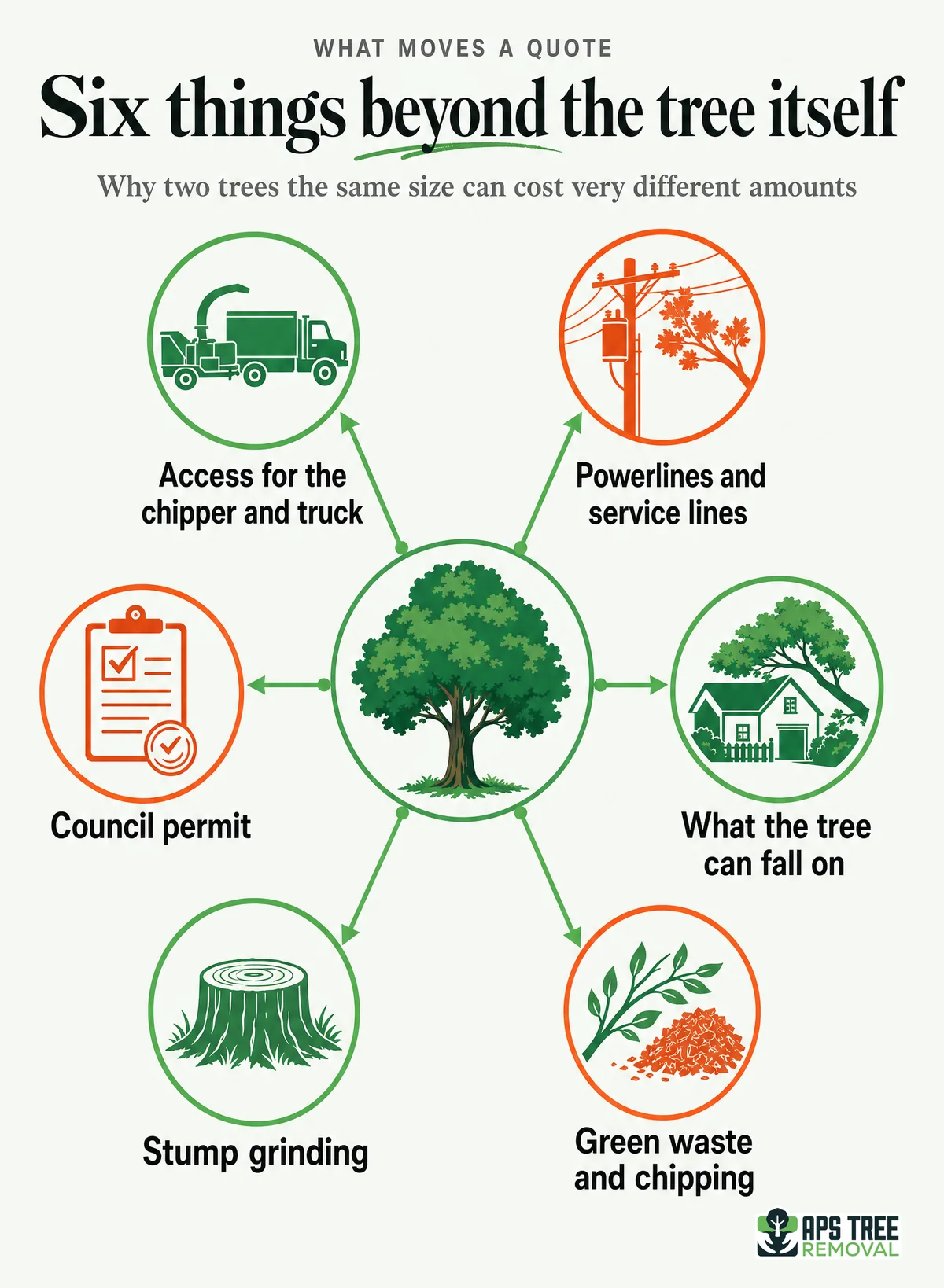
Those are averages across every kind of job, so they say less than the size bands underneath them. hipages breaks the ranges down by height [1]:
Indicative tree removal cost by size (Australia, January 2026)
Two things to take from that table. First, the bands overlap a lot, which is the tree telling you that height alone does not set the price. Second, the same guide notes that where you live can move the figure by 25 to 50 per cent, and that the quoted prices usually include a basic clean-up but not the stump, a crane, a skip or extra safety gear [1]. Treat every number here as a starting point, not a quote.
How tree removal is priced: the six things beyond the tree
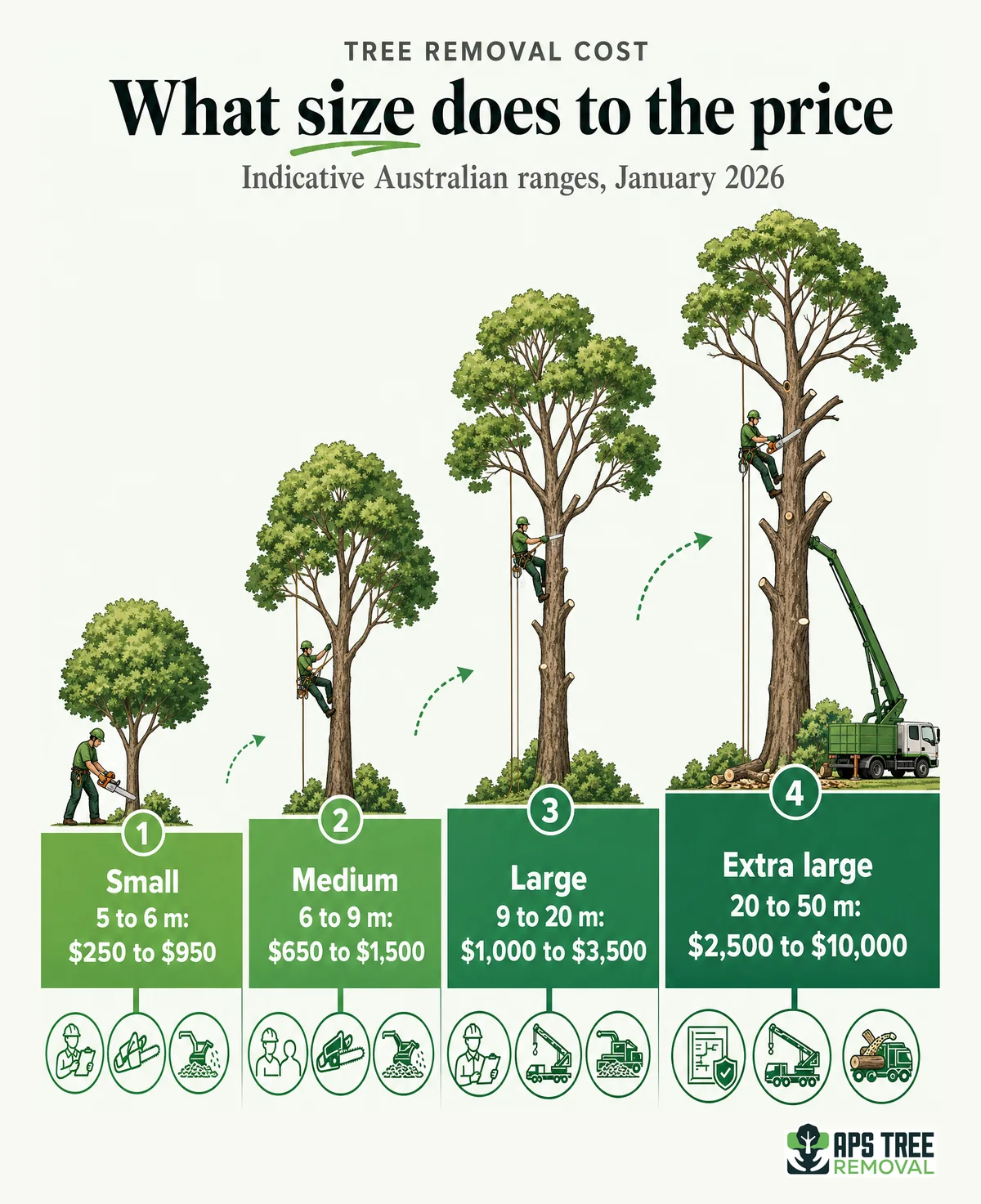
When Api walks a property he is pricing time, people and machinery, and six things decide how much of each the tree needs.
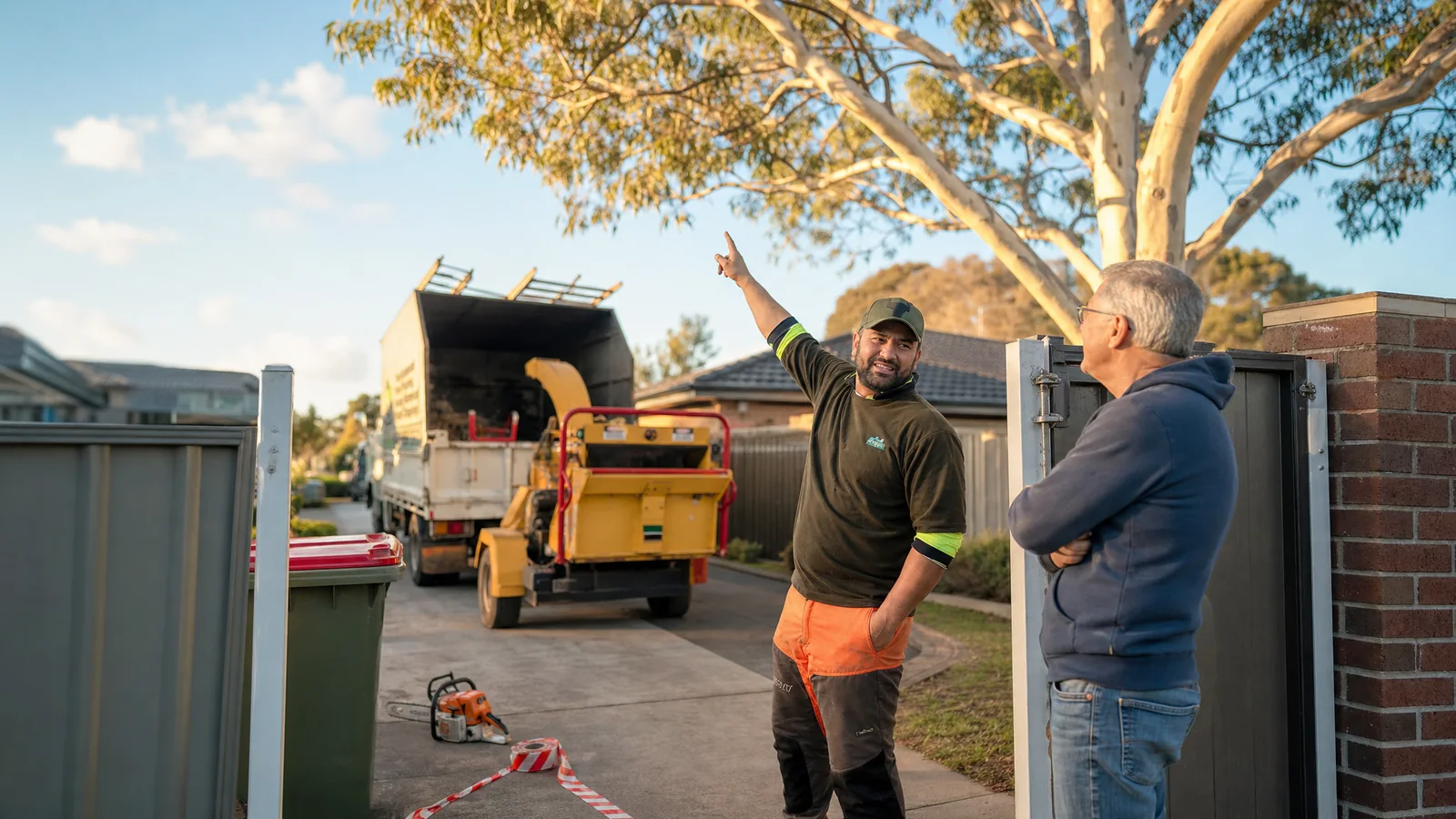
What Api looks at on a quote visit
- 1Size and speciesHeight, trunk diameter and how the canopy spreads. A dense gum with heavy limbs is more cutting and more rigging than an open-crowned tree the same height.
- 2AccessCan the chipper and truck get near the tree, or does every branch get carried through a side gate? Narrow access means more hand-carrying and more hours.
- 3What is under itA lawn is a drop zone. A roof, a pool, a glasshouse or a neighbour's fence means every limb is lowered on ropes instead of dropped.
- 4PowerlinesAnything near a service line or a street line changes the method, and some pruning near lines can only be done by an authorised contractor.
- 5ConditionDead, split or storm-damaged timber cannot be climbed the same way. A hazardous tree often needs an elevating work platform or a crane.
- 6The extrasStump grinding, a permit application, mulch delivery and green-waste disposal are each their own line, and they are where quotes differ most.
Access
This is the item that surprises people most. The tree in the back corner of a Werribee block with a 900 mm side gate costs more to remove than the same tree on a corner lot with a driveway to the trunk, because every piece has to be cut smaller and walked out. It is also why Api asks about gates, retaining walls and steps before he visits.
What can the tree fall on
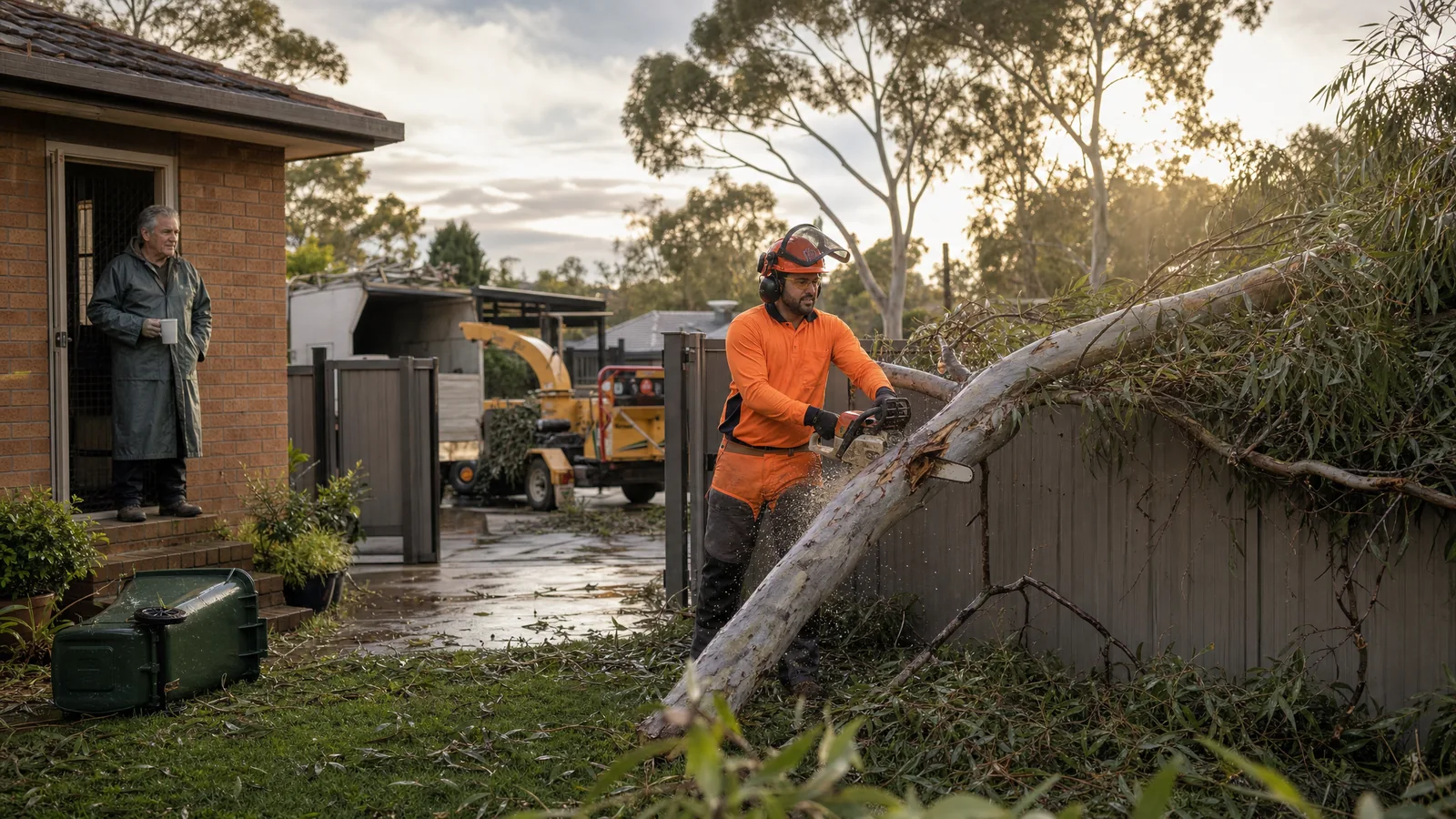
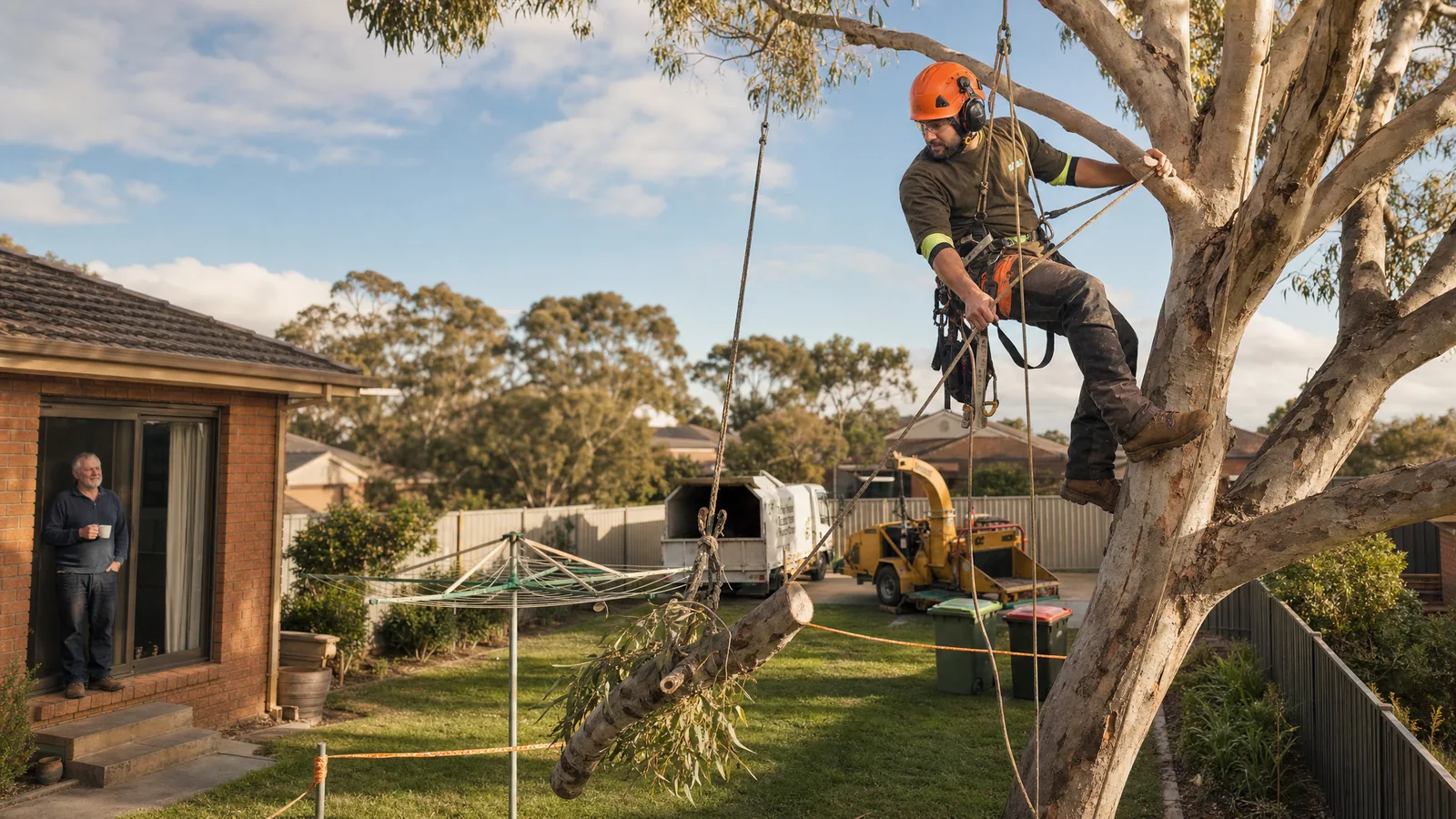
A tree over open lawn can be felled or dropped in sections. A tree over the house is dismantled piece by piece with each limb roped and lowered, and that is slower, needs more crew and more gear. Safe Work Australia's guide to tree work describes exactly this: an assessment by a competent person before anyone goes up, and an exclusion zone under the tree so nothing lands on a person or a property [8]. The method the site demands is the price.
Powerlines and service lines
Energy Safe Victoria is clear that the owner is responsible for keeping a tree on their property clear of the service line that runs to their own house, and that clearing should happen before growth comes within one metre of that line in any direction [7]. Trees touching or close to street powerlines are a different matter and only authorised powerline contractors should prune them. When a tree has grown into a service line, the arborist may need the line dropped or insulated before work, and that is a cost item worth asking about early.
Api is a pleasure to work with. Prompt site visit and the best quote of 3. Great communication, lopped and removed trees beautifully. Removed every speck of waste and then some. Nothing was too much trouble. look no further! Very, very happy.
The two extras almost everyone forgets
The stump
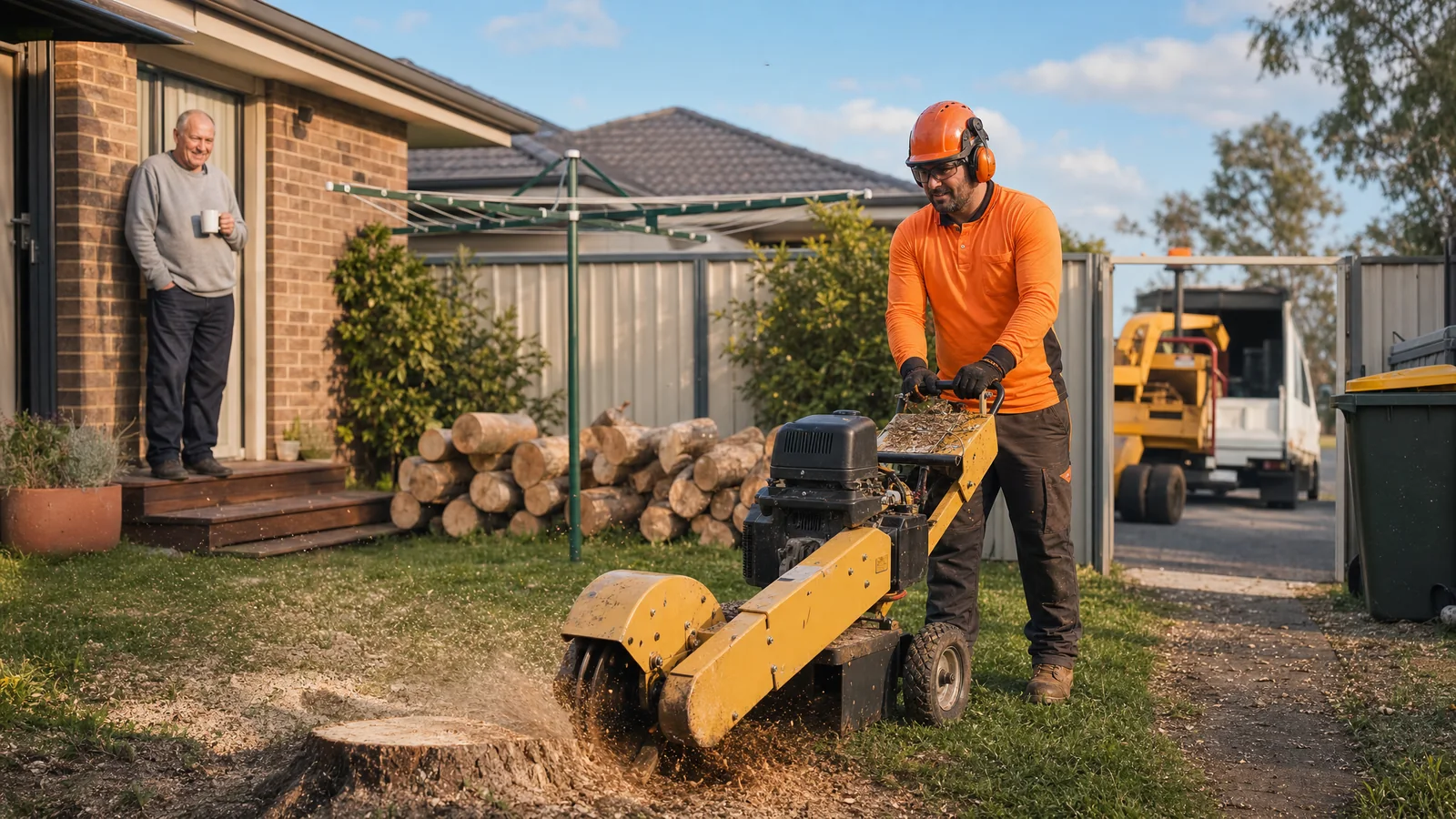
Across the industry, stump grinding is a separate machine and a separate charge, and it is not usually included in a tree removal price [2]. hipages gives an indicative $100 to $150 for a 10 cm stump and notes that most stumps take 30 minutes to two hours to grind, with narrow access, nearby pipes, steps, slopes and buried rubble all pushing the price up [3]. Leaving a stump behind to save that line rarely works out: it resprouts, it is a trip hazard, and a rotting stump is a magnet for ants and termites [3].
Api grinds stumps 300 to 400 mm below ground so the lawn or garden bed can go straight back over the top, and because the grinder is already on the truck, it is cheaper on the same day as the removal than as a second visit. Ask for the stump in the same quote and have the two priced together.
The permit
Council permits are the other surprise. Since 15 September 2025, every Victorian planning scheme has a canopy-tree clause: a planning permit is needed to remove, destroy or lop a canopy tree (more than 5 metres tall, a trunk over 0.5 metres around at 1.4 metres above ground, and a canopy at least 4 metres across) anywhere on a vacant residential lot, or within 6 metres of the street frontage or 4.5 metres of the rear boundary of a lot that already has a house [4]. Fast-tracked applications should be decided in 10 business days, and many permits come with a condition to plant a replacement canopy tree [4].
Some councils add their own local law on top. Hobsons Bay, for example, requires a $137 local-law permit and about 15 business days for any tree with a trunk 110 cm or more around at 1.5 metres, even one overhanging from next door [10]. hipages puts a typical council application at $75 to $100 for one to five trees, plus an arborist's report where the council asks for one [1]. Api checks the zone and the overlays on your title as part of quoting, so you know before the job is booked whether a permit is in the price.
Why this matters for the price
A permit is not just a fee. It is time: a fast-tracked application is decided in about ten business days, a standard one takes longer, and the arborist's report the council may ask for is a separate cost. Book the quote early if a tree is near a boundary, so the paperwork and the job line up.
A realistic tree removal budget: a worked example
Say you have a 12 metre gum in a Point Cook backyard, healthy, leaning slightly over the fence, with a standard side gate and no powerlines. Here is how the pieces stack up using the indicative public ranges above.
| Item | What decides it | Indicative range |
|---|---|---|
| Removal of a 9 to 20 m tree | Size, rigging over the fence, crew hours | $1,000 to $3,500 [1] |
| Stump grinding | Diameter, access, what is buried around it | From $100 to $150 for a small stump; larger stumps more [3] |
| Council permit (if the tree qualifies) | Distance to boundary, council local law | $75 to $100 application; some councils charge more [1] |
| Green waste and chipping | Volume; whether you keep the mulch | Often built into the removal price; ask |
| Extra machinery | A hoist or crane where the tree cannot be climbed | Indicatively around $170 an hour for a truck hoist [2] |
The point of the table is not the total. It is that four of the five lines are decided by things you can describe on the phone: the gate width, what is under the tree, how far it sits from the boundary, and whether you want the stump gone. Give the arborist those four facts and the site visit confirms the fifth.
Got a tree you want priced properly? Api quotes on site for free, 7 days a week, and the price is fixed before a single cut.
How to read three quotes
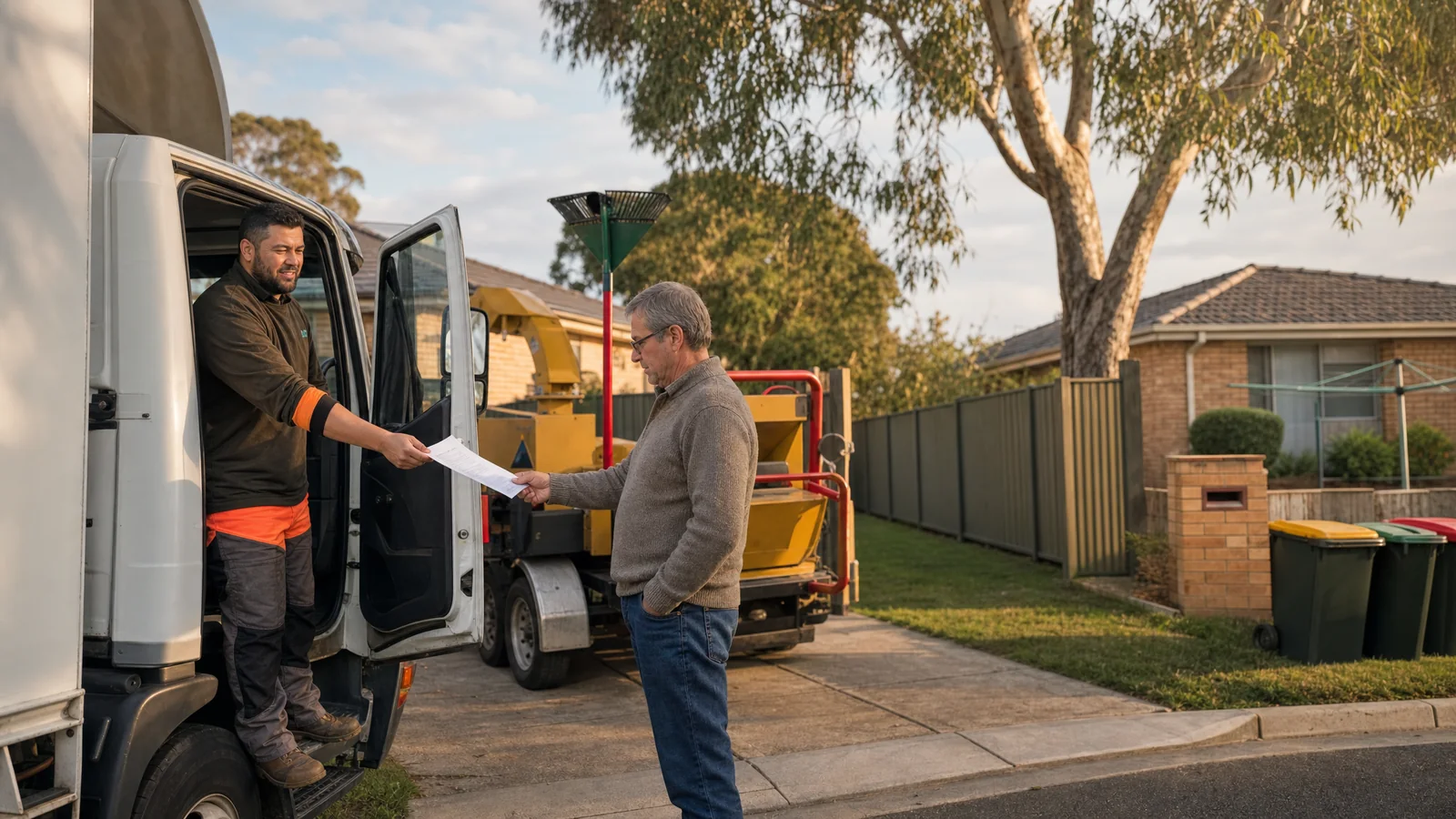
Consumer Affairs Victoria's advice for any home job is to get at least three quotes on the same detailed description, to have a written contract even for small work, and to ask for the tradesperson's full name, physical address and registered business name [5]. For tree work, add these to the list.
Comparing tree removal quotes
A quote worth trusting
- Written, with the tree, the method and the clean-up described
- Says whether the stump, the mulch and the green waste are in or out
- The arborist visited the site rather than pricing from a photo
- A certificate of currency for public liability insurance is offered without fuss
- The person quoting is the person running the job
A quote to question
- A verbal price with no description of what is included
- No mention of the stump or what happens to the waste
- Door-knocked after a storm with a cheap price if you book today
- Cannot say whether the tree needs a council permit
- Cheapest by a wide margin with nothing to explain why
Consumer Affairs Victoria also tells tradespeople what a clear quote should spell out: whether transport is included, what the labour covers, and any call-out, weekend or public holiday rates [6]. If a quote does not answer those questions, ask. The cheapest of three quotes is often the one that left the stump, the waste or the insurance out, and you find out on the day.
Api was a pleasure to deal with from the first call. He came the same day to have a look at the trees which needed to be cut and provided a very competitive quote. Api and team arrived at the agreed time and completed the work without issue. I recommend Aps tree removal for any work you need done. Thanks Api for your professional and friendly service!
Why the cheap job costs more
Tree removal is dangerous work, and the price of a proper crew reflects it. WorkSafe Victoria reported a coroner's finding that 31 people died in Victoria from tree felling or related activity between January 2012 and September 2018, and 13 of those deaths were at work [9]. Safe Work Australia's guide says plainly that tree trimming and removal should not be done from ladders, and that contact with any powerline, whether it carries 230 volts or 400,000, can kill without being touched [8].
That is the gap between a lopper with a ute and a qualified crew. The crew's price pays for the climbing gear, the rigging, the chipper, the insurance and the training that means the tree comes down in the planned order and nothing lands on the house. When something does go wrong on a cheap job, the homeowner is often the one carrying it, because a contractor without public liability cover has nothing to claim against. That is also the moment to know what your policy covers and what it does not, because a healthy tree you chose to remove is not a storm claim.
Ways to keep the price down without cutting corners
There are honest ways to bring a tree removal cost down, and none of them involve skipping the insurance.
Before the crew arrives
- Clear the side access so the chipper can get as close as possible
- Move cars, trampolines, pots and outdoor furniture out of the drop zone
- Decide on the stump before the quote so it is priced on the same visit
- Ask whether you want the mulch left: free mulch saves a tip fee
- Combine jobs: a hedge, a couple of prunes or a second tree on the same day cost less than three visits
- Check your title and zone for overlays so the permit question is answered early
- Book outside storm season if the tree is not urgent, when calendars are quieter
Combining work is the one Api recommends most. The travel, the set-up and the chipper are already on site, so the second job is priced on the extra hours alone. It is the same reason the stump is cheaper on the day of the removal than a month later.
When the tree cannot wait
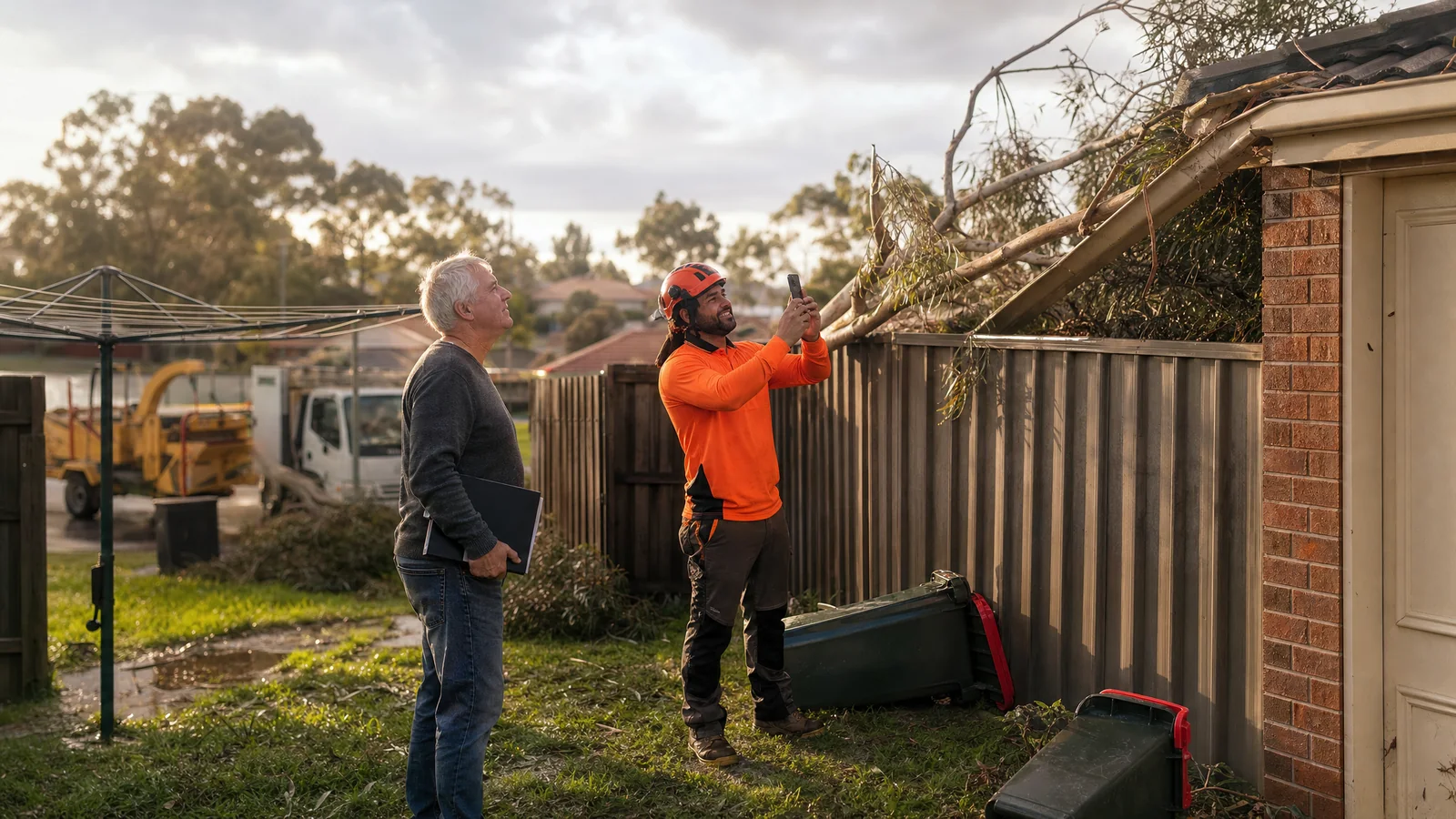
Not every removal is a planned one. When a tree comes down in a storm or a limb splits over the roof, the price question changes to a safety question, and the steps to take after a tree falls are different: keep everyone at least eight to ten metres away from any fallen powerline, photograph the damage before anything is moved, and call the insurer before authorising work [7]. Api takes storm calls 7 days from 6am, and an urgent make-safe is priced on the same six factors as any other job; it is the crane or the after-hours crew that adds cost, not the emergency itself.
What Api's quote includes
Every quote from our tree and palm removal service is a site visit, a fixed written price and a plain explanation of the method. It covers the removal, the chipping, the clean-up and the green waste unless it says otherwise, and the stump is listed separately so you can see exactly what it adds. Api checks the council position on your title, points out anything near a service line, and tells you straight if a reduction or a prune would do the job for less than a removal. The crew that quotes is the crew that turns up, fully insured, and the site is left cleaner than it was found.
That is how you get a tree removal cost you can actually plan around: not a national average, but a price for your tree, on your block, with nothing left out.
How you get a fixed tree removal price you can trust
Getting a fixed tree removal price you can trust does not have to be complicated. At Aps Tree Removal we look at the job with you, tell you what actually needs doing and what does not, and put a fixed price on it before anything is cut.
No pushy sales. Api comes out, walks the property with you, explains the options and what each one means for the result, the risk and the price. You decide at your own pace. People choose us because they understand the job before they book it, and the crew that quotes is the crew that turns up.
We will tell you if a council permit applies and what the process is, we will point out anything near powerlines or the neighbour's boundary that changes the method, and we will say plainly when a cheaper option is the better one. Every job is done by a qualified arborist, fully insured, and the site is left cleaner than we found it.
Get in touch today. Api quotes for free, 7 days, 6am to 5pm, across Melbourne's west, the inner city and Geelong.
How we work with you
We talk and answer your questions
Call 0422 856 090 or send the form. Api asks what is worrying you about the tree, hedge or stump, what access is like, and whether anything sits near powerlines or a fence line.
We look and give you a fixed price
Api visits, inspects the tree or hedge, checks the permit position for your council, and quotes in writing. The price covers the job, the clean-up and the green waste unless we say otherwise.
You decide what works best
Remove, reduce, prune or wait: we explain the difference and what each costs. No pressure, no expiring offers. The choice is yours.
We do the job and stay in touch
The crew arrives when we said, works to the plan, and leaves the site clean. If the tree throws a surprise on the day, we tell you before we change anything.
Frequently asked questions
How much does tree removal cost in Melbourne?
Indicative Australian figures put most jobs between $360 and $3,000, with Melbourne's average around $2,350 and very large trees running to $10,000 or more. Api quotes every tree on site for free, and the price is fixed before anything is cut.
Does the quote include the stump?
Usually not, anywhere in the industry: stump grinding is a separate machine and a separate line. Ask for it in the same quote. Api grinds stumps 300 to 400 mm below ground and it is cheaper done on the same day as the removal.
Do I need a council permit to remove a tree in Melbourne?
Sometimes. Since 15 September 2025 every Victorian residential zone has the state canopy-tree rule, and some councils add a local law on top. Api checks what applies to your title as part of quoting and tells you before the job is booked.
Why is one quote half the price of another?
Look at what it leaves out: the stump, the green waste, the chipping, insurance, or a safe method for what is under the tree. Consumer Affairs Victoria's advice is to get three quotes on the same written description and compare what each one covers.
Is it cheaper to remove a tree in winter?
Sometimes the calendar is quieter outside storm season, but the price is driven by the tree, the access and the hazards, not the month. What you can control is booking early, clearing access and combining jobs on one visit.
Will my home insurance pay for tree removal?
Only when the tree has damaged something insured, such as the roof, a fence or a car, and even then the policy usually covers the damage and the debris on it rather than a tree you simply want gone. Check the PDS and talk to the insurer before authorising work.
Sources
- hipages: How much does tree removal cost? [2026] (updated 22 January 2026)
- hipages: How much does an arborist cost? [2026] (updated 6 January 2026)
- hipages: How much does stump grinding cost? [2026] (updated 6 January 2026)
- Planning Victoria (Department of Transport and Planning): Protecting and enhancing our tree canopy for a greener Victoria
- Consumer Affairs Victoria: Home improvements costing $10,000 or less: checklist
- Consumer Affairs Victoria: Giving quotes: tradespeople and small works (updated 8 July 2025)
- Energy Safe Victoria: Trees and vegetation FAQ (reviewed 16 March 2026)
- Safe Work Australia: Guide to managing the risks of tree work (March 2023)
- WorkSafe Victoria: Controlling the risks of working with trees (news, 28 January 2020)
- Hobsons Bay City Council: Tree protection laws and permits
Information about tree work, council permits and insurance changes often, and every property is different: figures here are general guidance and linked pages may change or become outdated. For a price on your own tree, hedge or stump, call Api on 0422 856 090 for a free quote.